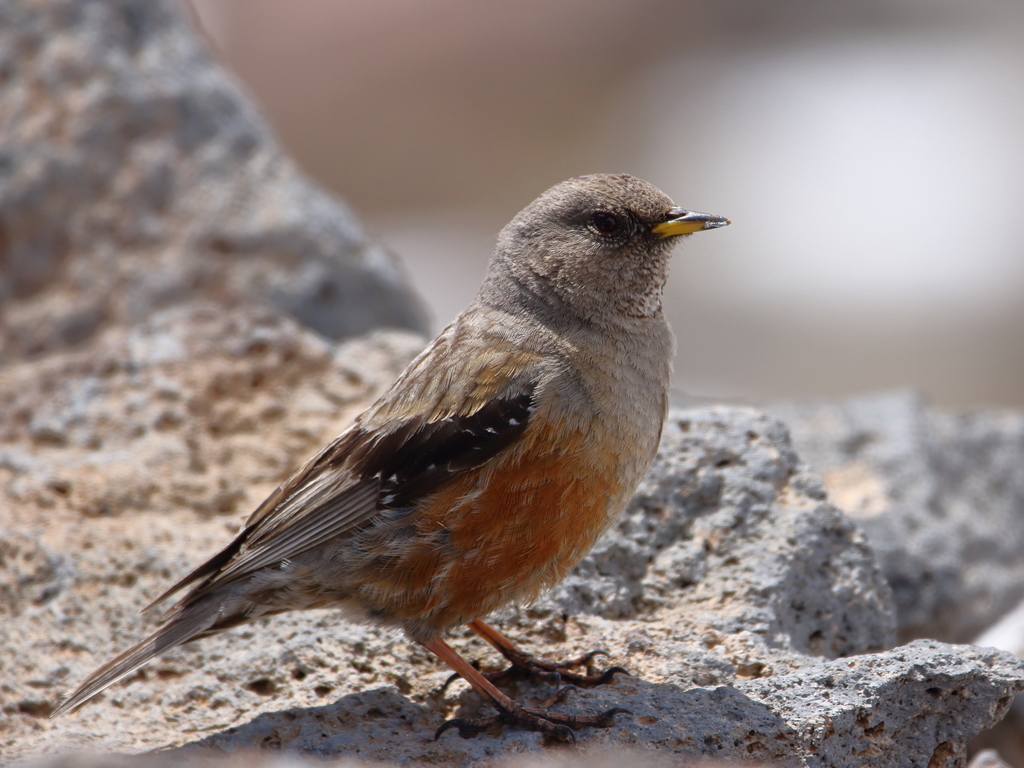
Alpine Accentor
Photo © Ani Sarkisyan
Photo © Ani Sarkisyan — CC BY 4.0 — Source: iNaturalist photo #8368214Identification
The Alpine Accentor is a robin-sized passerine measuring 15–17.5 cm in length, slightly larger than its relative the dunnock. Adults are distinctive: they feature a streaked brown back resembling a house sparrow, but are distinguished by an all-grey head and red-brown spotting on the underparts. The bird possesses a fine pointed bill typical of insectivores. Sexes are similar in plumage, though males may appear more contrasted. Young birds have browner heads and underparts than adults, making them separable in the field.
Range & Habitat
This species is native to Eurasia and North Africa, with nine recognized subspecies distributed across mountain ranges from southwestern Europe through the Carpathians and Balkans, across Turkey, the Caucasus, and Iran, extending eastward through the Himalayas to central Asia, Siberia, Japan, Korea, China, and Taiwan. The Alpine Accentor is found throughout the mountains of southern temperate Europe, Lebanon, and Asia at elevations above 2,000 m. It is mainly resident within its range, though it winters at lower latitudes and occasionally wanders as a rare vagrant to Great Britain. The species inhabits bare mountain areas with low vegetation.
Behaviour & Diet
As an insectivore, the Alpine Accentor feeds on small invertebrates suited to its fine pointed bill. Its breeding behaviour is remarkable and complex. Birds occupy home ranges in socially polygynandrous groups of three to four males with three to four females—unrelated individuals engaging in a sophisticated mating system. Males establish a dominance hierarchy, with alpha males typically older than subordinates. Females solicit matings with all males in their group, though alpha males may attempt to monopolize access. Males reciprocally seek matings with all females. DNA studies reveal that broods often contain mixed paternity, yet females always remain the true mothers. Males provision chicks at multiple nests within the group, but only when they are likely the biological fathers, demonstrating facultative parental investment.
Best Time & Places to See It
Alpine Accentors are year-round residents across their mountain range, making them potentially observable throughout the year in suitable habitat. The species is best found in high-altitude bare mountain areas with sparse low vegetation across the Alps, Carpathians, Balkans, Caucasus, Iranian highlands, Himalayas, and Asian mountain ranges above 2,000 m elevation. Spring and summer are optimal for observing breeding groups in their territories.
Photography Tips
Photograph this species in its natural high-altitude habitat to capture the stark mountain backdrop that defines its ecology. The distinctive grey head and red-brown underpart spotting are key field marks to emphasize. Early morning light will best reveal the subtle streaking on the brown back and the contrast between head and body plumage. Patient observation of breeding groups during spring and summer offers opportunities to document their complex social behaviour and interactions among multiple individuals.
Abruzzo, Lazio and Molise National Park
Alpilles Regional Nature Park
Appennino Tosco-Emiliano National Park
Aspromonte National Park
Baima Snow Mountain National Nature Reserve
Baronnies Provençales Regional Nature Park
Bavarian Forest National Park
Belluno Dolomites National Park
Bieszczady National Park
Nothing matches these filters.
No community photos yet. Log in to add the first one.
No community observations of this species yet.