Identification
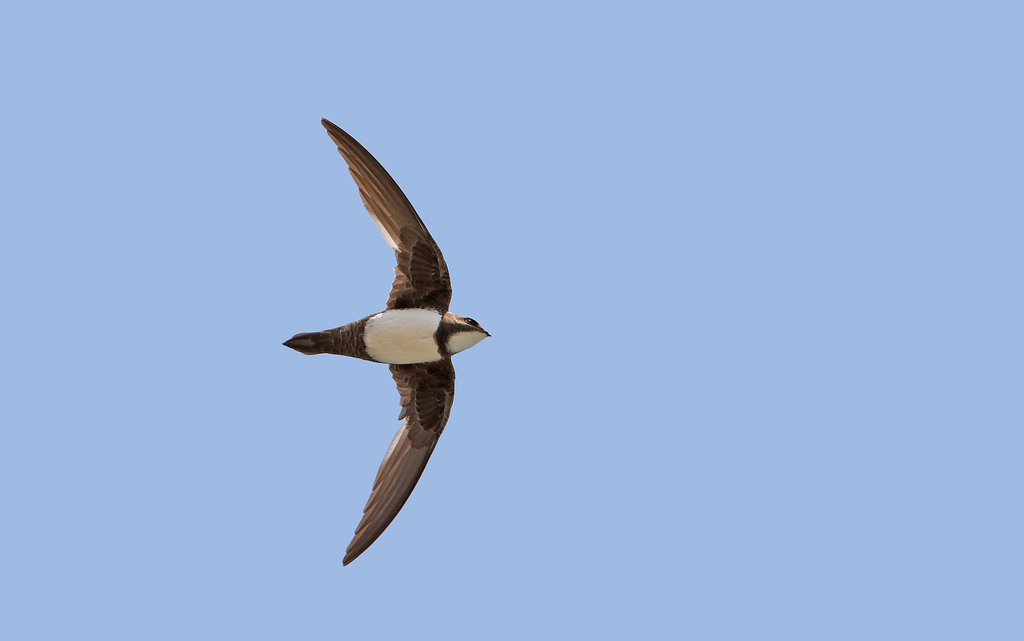
The Alpine Swift is a large swift measuring 20–22 cm in length with a distinctive wingspan of 54–60 cm. Its most striking features are the broad, crescent-shaped wings, shallow-forked tail, and highly visible white belly patch encircled by an olive-brown breastband. The upper parts are olive-brown with noticeably blacker wing-tips, while the underparts show a white throat (often subtle) and white belly. At roughly twice the size of common swifts in their range, Alpine Swifts are readily distinguished from smaller swift species by their larger proportions and bold white markings, particularly the belly patch and dark neck band.
Subspecies vary in plumage intensity: some races are paler with grey-brown plumage, while others are considerably darker with blackish coloring. Juveniles resemble adults but have pale-edged feathers. Their long, swept-back wings can be held stretched straight out or curved like a boomerang, giving them a distinctive silhouette in flight.
Range & Habitat
Alpine Swifts breed in mountains from southern Europe through Turkey and the Caucasus to the Himalayas, with populations found across a range spanning from northwest Iran to Central Asia. The species is strongly migratory, with the southern European population wintering much further south in southern Africa. They are found year-round in eastern and southern Africa, Madagascar, western peninsular India, and Sri Lanka. During migration, they wander widely and are regularly seen across southern Europe, the Middle East, and Asia.
These swifts have adapted well to urban conditions and frequently nest in old buildings around the Mediterranean, where large, low-flying flocks are a familiar summer sight. They traditionally breed in mountain colonies in cliff holes and caves, often returning to the same nesting sites year after year.
Behaviour & Diet
Like all swifts, Alpine Swifts are almost entirely aerial, spending most of their lives in the air and living on insects they catch in their beaks. They have very short legs adapted only for clinging to vertical surfaces and never voluntarily settle on the ground. Their flight is slower and more powerful than smaller swift species, accompanied by a distinctive drawn-out twittering call. They breed in colonies, laying two or three eggs per nest, and pairs bond for life.
Young swifts exhibit a remarkable adaptation to harsh weather: they can drop their body temperature and enter torpor if bad weather prevents their parents from catching insects nearby. This allows them to survive periods when food is unavailable, a crucial survival mechanism in mountain environments.
Best Time & Places to See It
Alpine Swifts are most readily observed during summer months in southern Europe, particularly around the Mediterranean region where they are a familiar feature of towns and villages. Mountain regions from southern Europe through the Caucasus to the Himalayas offer excellent viewing opportunities during the breeding season. Large, low-flying flocks are characteristic around Mediterranean towns, making urban areas surprisingly good locations for observation.
For those seeking wintering birds, southern African locations attract the European breeding populations. The species' regular occurrence across the Middle East and Asia during migration makes spring and autumn promising times for sightings across this broader range.
Photography Tips
Photographing Alpine Swifts presents the challenge of capturing fast-moving aerial subjects. Their distinctive white belly patch and large size make them identifiable even at distance, but patience and fast shutter speeds are essential. Early morning or late afternoon hours often provide better lighting conditions for photography than midday, and watching for their characteristic low-flying flocks around Mediterranean towns can yield multiple photo opportunities.
The bird's silhouette in flight—with its distinctive crescent-shaped wings and forked tail—is a key identifying feature worth capturing. Their powerful, steady flight pattern differs from smaller swifts, providing photographers with slightly more predictable movement to anticipate and frame shots effectively.