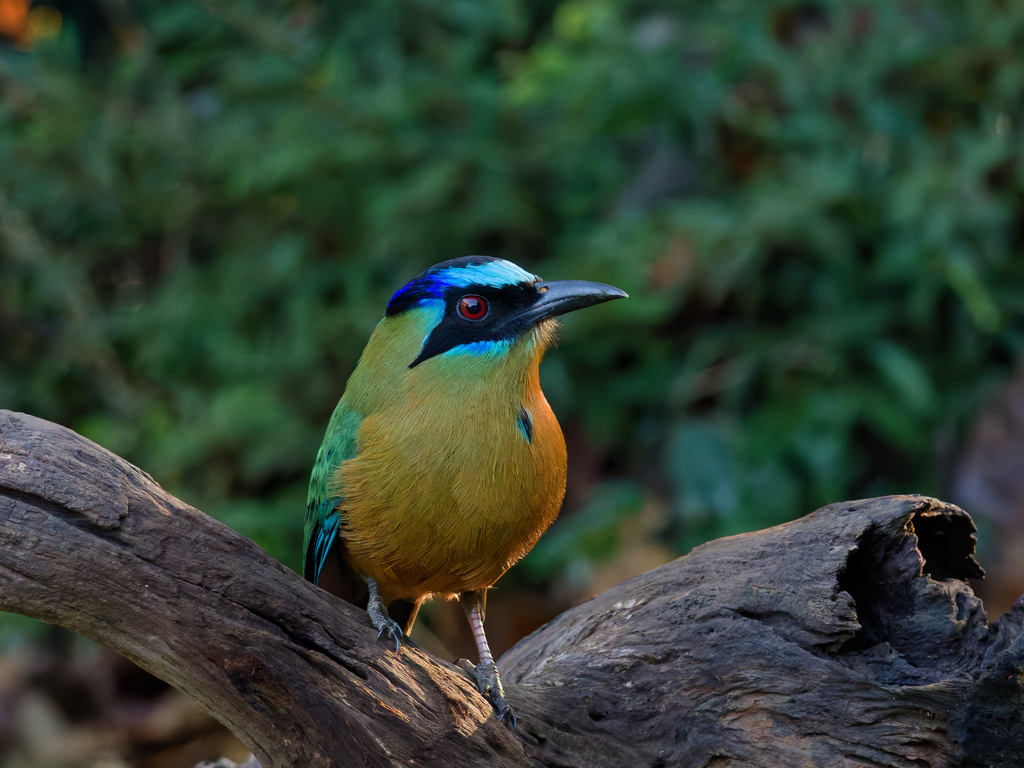
Amazonian Motmot
Photo © Donald Davesne
Photo © Donald Davesne — CC BY 4.0 — Source: iNaturalist photo #586648442Identification
The Amazonian motmot is a strikingly colorful bird with predominantly green plumage across its body. Its most distinctive features are a long tail with extended feathers that have characteristic racquet-shaped tips in green or black, and a striking black eyemask that varies in size and shape between subspecies. The crown is black and encircled or partially bordered by a vibrant blue band, creating an eye-catching pattern on the head.
Plumage varies among the nine recognized subspecies. Most birds display a black eyemask, while the nominate subspecies features a chestnut nape. Two subspecies, M. m. ignobilis and M. m. cametensis, show more extensive chestnut coloring on the neck and face, adding to the regional variation you may encounter across the bird's wide range.
Range & Habitat
The Amazonian motmot is widely distributed across South America east of the Andes, with nine subspecies occupying different regions from eastern Venezuela to northeastern Argentina. Its range spans from the Guianas and northern Brazil through the Amazon basin, extending into southeastern Colombia, Ecuador, Peru, Bolivia, and eastern Brazil, demonstrating the species' adaptability across vast territories.
Throughout its range, the Amazonian motmot favors the interior and edges of humid lowland forest. Elevation varies by region: it can be found up to 1,200 meters in Venezuela, 1,000 meters in Ecuador, and 750 meters in Peru, making it accessible to travelers exploring lowland and lower montane forest habitats.
Behaviour & Diet
The Amazonian motmot is an omnivorous forager with a diverse diet. It feeds on insects and other arthropods, small mammals and reptiles, and fruit, allowing it to exploit various food sources throughout the year and across different forest microhabitats.
Like other members of the Coraciiformes order, the Amazonian motmot nests in long tunnels excavated in earth banks, a fascinating breeding behavior shared with kingfishers and bee-eaters. The bird is vocal and distinctive, with its song described as "a fast, hollow hoo-do" or "a bubbling whOOP-oo," along with gruff "kak" calls sometimes delivered in series that help identify its presence in dense forest.
Best Time & Places to See It
The Amazonian motmot can be encountered throughout the humid lowland forests of its extensive range, from the Guianas and Venezuela through the Amazon basin to eastern Brazil and Argentina. Its wide distribution means that travelers visiting major Amazonian destinations across multiple countries have opportunities to find this species in appropriate forest habitat.
The bird's preference for forest interiors and edges makes it most readily located by listening for its distinctive vocalizations, particularly the characteristic "hoo-do" call. Early morning hours are typically productive for bird watching, when the motmot is most vocal and active.
Photography Tips
The Amazonian motmot's vibrant green, blue, and black plumage provides striking photographic opportunities, especially when sunlight illuminates the blue crown band and the intricate racquet-tipped tail feathers. Position yourself with backlight to capture the luminous quality of the green plumage and the detail of the specialized tail feathers.
Since these birds frequent forest edges and interior clearings, patience and attention to their vocalizations will improve your chances of locating and photographing them. The distinctive eyemask and crown pattern are key identifying features that should be captured clearly, along with the characteristic tail morphology that distinguishes motmots from other Amazonian birds.
Where to stay to see the Amazonian Motmot
Emas National Park
Brazil
+333 birds+23 mammals
Across the high plateaux of central Brazil, where the cerrado grasslands roll toward distant horizons under an immense sky, Emas National Park anchors one of South…
VIEW NATIONAL PARKYasuní National Park
Aguarico, Ecuador
+601 birds+43 mammals
Where the western Amazon basin converges with Ecuador's Orellana Province, lowland rainforest reaches toward the horizon in an unbroken canopy of staggering botanical density. Yasuní National…
VIEW NATIONAL PARKNatural Sierra de Chiribiquete National Park
Solano, Colombia
+359 birds+27 mammals
Massive table-top mountains rise abruptly from the lowland rainforest of southeastern Colombia, their sheer sandstone cliffs and isolated summits creating some of the most dramatic topography…
VIEW NATIONAL PARKNatural la Paya National Park
Puerto Leguízamo, Colombia
+262 birds+4 mammals
Where the Amazon's western reaches fold into the Andes foothills, La Paya National Park sprawls across more than 8,500 square kilometers of pristine Amazonian rainforest in…
VIEW NATIONAL PARKNatural Sierra de la Macarena National Park
Vista Hermosa, Colombia
+566 birds+15 mammals
Across nearly 20,000 square kilometres of Colombia's Meta Department, the terrain rises from lowland savanna into Andean foothills through a mosaic of gallery forests, palm-fringed wetlands,…
VIEW NATIONAL PARKAmacayacu National Park
Leticia, Colombia
+567 birds+25 mammals
Where the Rio Amazonas curves through the tri-border region where Colombia, Peru, and Brazil converge, Amacayacu National Park sprawls across more than 5,250 square kilometres of…
VIEW NATIONAL PARKViruá National Park
Brazil
+389 birds+6 mammals
Across the northern frontier of Roraima, where the forest canopy rises from ancient Amazonian lowlands, Viruá National Park protects nearly 3,700 square kilometres of terra firme…
VIEW NATIONAL PARKSerra do Pardo National Park
Brazil
+153 birds
Vast upland forests and weathered plateaus define this 7,129-square-kilometre protected expanse in the heart of Pará's remote interior, where ancient bedrock and swollen rivers have carved…
VIEW NATIONAL PARKChapada dos Guimarães National Park
Brazil
+450 birds+1 mammals
Where weathered sandstone plateaus rise above the cerrado grasslands of central Brazil, Chapada dos Guimarães National Park protects 624 square kilometres of ecological transition zone that…
VIEW NATIONAL PARKChapada dos Veadeiros National Park
Brazil
+324 birds+6 mammals
Where granite plateaus rise above the cerrado savanna in central Brazil, Chapada dos Veadeiros National Park unfolds across 6,665 square kilometres of some of the world's…
VIEW NATIONAL PARKAmazônia National Park
Brazil
+439 birds+6 mammals
Where the Rio Amazonas and its tributaries weave through the heart of Pará state, a vast tapestry of rainforest stretches across 23,611 square kilometers of unbroken…
VIEW NATIONAL PARKMapinguari National Park
Brazil
+354 birds
Vast tracts of western Amazonian rainforest blanket the remote terrain of this 56,827 square kilometre national park in Amazonas state, where seasonal rivers wind through dense…
VIEW NATIONAL PARKJaú National Park
Brazil
+354 birds+3 mammals
Vast floodplain forests and blackwater rivers define this remote corner of western Amazonas, where the Rio Negro and its tributaries have carved an intricate mosaic of…
VIEW NATIONAL PARKPacaás Novos National Park
Brazil
+279 birds+1 mammals
Across the border between Rondônia and Amazonas, vast tracts of humid tropical forest rise and fall in gentle undulations, carved by clear-flowing rivers that feed into…
VIEW NATIONAL PARKAnavilhanas National Park
Brazil
+468 birds+8 mammals
Across the Rio Negro in central Amazonas, an archipelago of over a thousand islands rises from the world's largest rainforest river system, creating a labyrinth of…
VIEW NATIONAL PARKCampos Amazónicos National Park
Amazonas, Brazil
+434 birds+7 mammals
Sprawling across the southwestern Amazon basin in Amazonas state, this 27,263-square-kilometre national park encompasses some of the region's most pristine lowland rainforest, where terra firme forest…
VIEW NATIONAL PARKSerra do Divisor National Park
Brazil
+448 birds+10 mammals
Where the western Amazon meets the Andes foothills, Serra do Divisor National Park sprawls across one of South America's most biodiverse and least accessible frontiers. Spanning…
VIEW NATIONAL PARKYanachaga–chemillén National Park
Palcazu, Peru
+639 birds+6 mammals
Where the eastern slopes of Peru's central cordillera plunge into cloud forest, Yanachaga–Chemillén National Park protects nearly three thousand square kilometres of montane wilderness that few…
VIEW NATIONAL PARKManu National Park
Manu, Peru
+892 birds+26 mammals
Across the eastern slopes of the Peruvian Andes, tropical rainforest descends into the Amazon basin with a complexity that few terrestrial ecosystems match. Manu National Park…
VIEW NATIONAL PARKSierra del Divisor National Park
Alto Tapiche, Peru
+298 birds+2 mammals
Where the western Amazon meets the Andes foothills, nearly 41,000 square kilometres of pristine rainforest rise across Peru's Alto Tapiche region in a landscape of extraordinary…
VIEW NATIONAL PARKBahuaja Sonene National Park
San Pedro de Putina Punco, Peru
+602 birds+8 mammals
Where the Madre de Dios and Heath rivers converge in southeastern Peru rises one of South America's most biodiverse wilderness regions: a vast protected realm of…
VIEW NATIONAL PARKTingo Maria National Park
Mariano Dámaso Beraún, Peru
+423 birds
Where the eastern slopes of the Peruvian Andes descend toward the Amazon basin, the landscape fractures into a maze of limestone ridges, humid gorges, and cloud-wrapped…
VIEW NATIONAL PARKEl Rey National Park
Municipio de Las Lajitas, Argentina
+317 birds+4 mammals
Where the eastern slopes of the Andes descend into northwestern Argentina's subtropical transition zone, El Rey National Park unfolds across 841 square kilometers of dramatically varied…
VIEW NATIONAL PARKCalilegua National Park
Municipio de Calilegua, Argentina
+288 birds+8 mammals
Where the eastern Andean slopes plunge into northwestern Argentina's humid subtropics, nearly 2,645 square kilometers of steep terrain and luxuriant forest compose one of South America's…
VIEW NATIONAL PARKNo community photos yet. Log in to add the first one.
No community observations of this species yet.