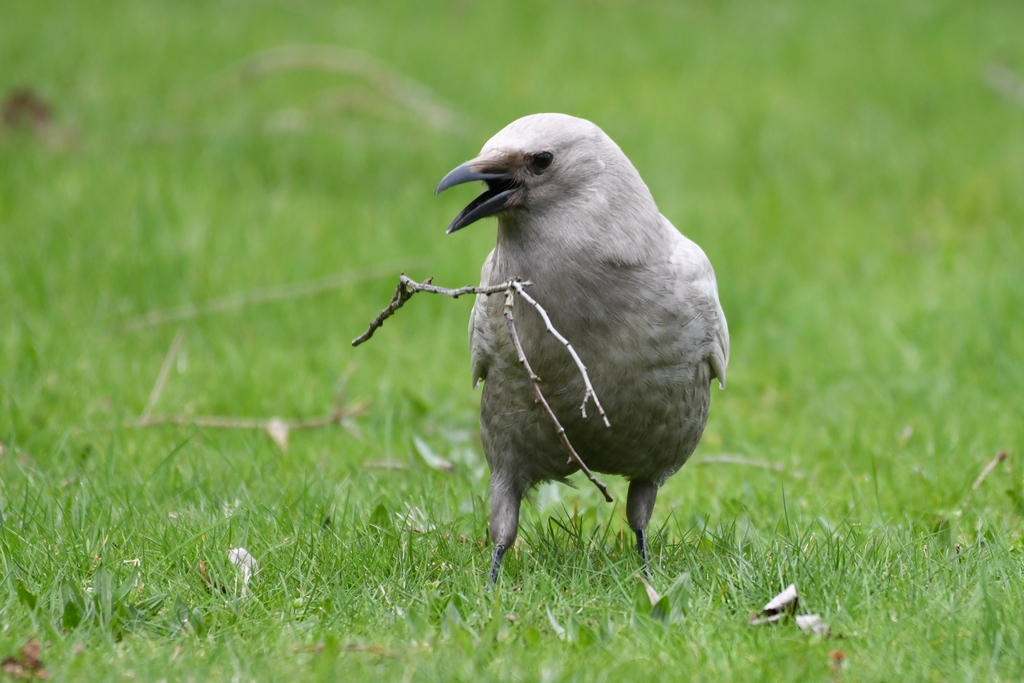
American Crow
Photo © Justin Flint
Photo © Justin Flint — CC BY 4.0 — Source: iNaturalist photo #483180028Identification
The American crow is a large passerine bird measuring 40–53 cm in length, with a wingspan ranging from 85 to 100 cm. It is instantly recognizable by its all-black plumage, including iridescent feathers on the body with black legs, feet, and bill. Males tend to be larger than females, and birds vary in size across North America, with the smallest found in the far west and southern coast, and the largest in the northeastern United States and eastern Canada.
The most characteristic vocalization is a loud, short, and rapid caaw-caaw-caaw call, usually accompanied by upward and downward head thrusts. American crows can produce a wide variety of sounds and sometimes mimic noises made by other animals, including other birds. Distinguishing the American crow from similar species requires attention to detail: the common raven is noticeably larger with a lozenge-shaped tail and rarely flaps while flying, whereas crows flap constantly. The fish crow is extremely difficult to distinguish visually but tends to have more slender bills and feet and characteristically hunches and fluffs its throat feathers when calling.
Range & Habitat
The American crow is a common and widespread bird found throughout much of North America, occurring in all biomes except the tundra. It occupies similar ecological niches to the carrion crow and hooded crow of Eurasia. Subspecies vary across the continent: the largest eastern crow inhabits the northeastern United States and eastern Canada; the western crow is found across western North America except the Arctic north and extreme south; the northwestern crow inhabits Pacific temperate rain forests; the Florida crow is endemic to Florida; and the southern crow is found throughout the southern United States.
Behaviour & Diet
The American crow is highly intelligent and adaptable to human environments. It has the same brain-weight-to-body-ratio as humans and has been shown to be self-aware. Crows can remember and identify people based on their appearance, and young crows learn from tolerant parents over an extended period. The species is an omnivore, feeding on insects, seeds, and nuts while also preying on small animals. It rarely feeds on carrion, which has led to cultural associations with death and bad luck in some societies, though Native American and some Gaelic cultures regard crows as symbols of good luck due to their intelligence.
Best Time & Places to See It
As a common and widespread species found year-round throughout most of North America, American crows can be observed in virtually any season and habitat except tundra. They are particularly easy to locate in and around human settlements, parks, and open woodlands where their distinctive calls readily betray their presence. The species' ubiquity and vocal nature make it one of the most accessible corvids for observation across the continent.
Photography Tips
Photograph American crows in good light to capture the iridescent quality of their black plumage, which often displays subtle purple and blue sheens. Their characteristic head-thrusting behavior during calling provides dynamic photographic opportunities. When attempting to distinguish crows from similar species in photographs, pay close attention to bill and leg proportions, throat posture during calling, and flight behavior—crows' constant wing-flapping differs markedly from the soaring flight of ravens.
Tombstone Territorial Park
Acadia National Park
Alaska Maritime National Wildlife Refuge
Algonquin Provincial Park
Alligator River National Wildlife Refuge
Arches National Park
Badlands National Park
Banff National Park
Bear River Migratory Bird Refuge
Nothing matches these filters.
No community photos yet. Log in to add the first one.
No community observations of this species yet.