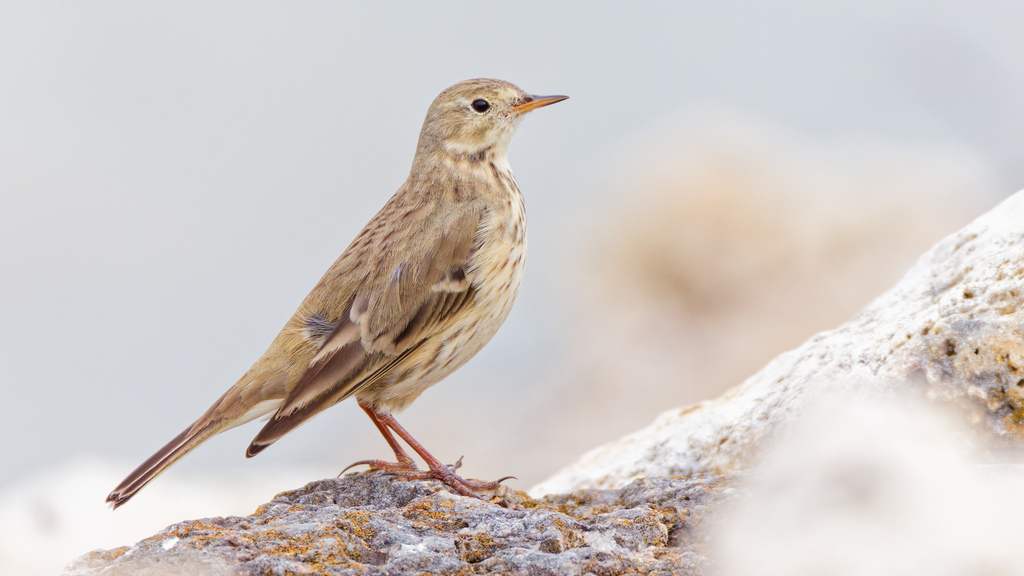
American Pipit
Photo © Brent Cox
Photo © Brent Cox — CC BY 4.0 — Source: iNaturalist photo #451140143Identification
The American pipit is a small, slender songbird measuring 16 cm in length with a wingspan of 24 cm and weighing just 22 g. Like other pipits, it is an understated species best identified by its lightly streaked grey-brown upperparts and diffusely streaked buff breast and flanks, with a whitish belly. The bill and legs are dark. In flight or at rest, it is often seen running on the ground rather than perching prominently. The related Siberian pipit, now recognized as a distinct species, can be distinguished by its darker upperparts, bolder black streaking on whiter underparts, and reddish-tinged legs. The American pipit's call is a distinctive squeaky 'sip' sound.
Range & Habitat
Three subspecies are recognized across North America. The nominate subspecies breeds in northern Canada east to Greenland and the northeastern United States, wintering in Central America. The Pacific subspecies breeds from Alaska to Oregon, wintering in western Mexico, while the Rocky Mountain subspecies ranges from southern British Columbia to California, wintering in Mexico. All populations are fully migratory. Notably, the wintering range has expanded northward during the 20th century, with birds now spending less time in traditional winter quarters. The species winters on both Pacific and Atlantic coasts of North America, occasionally reaching as far north as the Great Lakes region. It is a rare vagrant to Western Europe.
Behaviour & Diet
American pipits are exclusively insectivorous, feeding on arthropods that become abundant during snowmelt on the breeding grounds. During breeding season, males are highly territorial and engage in fierce one-on-one combat to secure mates and optimal nesting sites. The breeding habitat is tundra, while outside the breeding season they favor open, lightly vegetated areas. Nests are always placed on the ground in meadows—wet or dry—never in shrubs or trees, and are constructed from sedge, grass, and sometimes horsehair. Clutch size typically ranges from 4 to 5 eggs, incubated for 13–14 days. Both parents feed the young, which fledge after approximately 7 days in the nest but remain dependent on parental care for a further 14 days. After fledging, immature birds form small flocks and wander together.
Best Time & Places to See It
American pipits are widespread and common throughout their range. During migration, they can be found between March and May and from late September to November in many regions, with increasing numbers wintering farther north than historically recorded. Spring migration coincides with snowmelt on the breeding grounds, when arthropod abundance peaks. Look for them in open tundra habitats during breeding season (April–July) and in lightly vegetated open areas during migration and winter. In regions like northern Ohio, they are now considered widespread migrants, whereas they were formerly recorded as uncommon during these seasons.
Photography Tips
American pipits are ground-dwelling birds, so position yourself low and scan open, sparse vegetation to locate them. They are often easier to spot during migration when they congregate in suitable habitat. Their habit of running rather than flying makes them accessible to patient photographers willing to wait quietly in open areas. Dawn and dusk offer the best light for capturing their subtle plumage details. A telephoto lens (at least 300 mm) is essential, as these small birds will not tolerate close approach. Their squeaky 'sip' call can help you locate individuals; learning to recognize this call will significantly improve your chances of finding them in the field.
Tombstone Territorial Park
Acadia National Park
Alaska Maritime National Wildlife Refuge
Algonquin Provincial Park
Alligator River National Wildlife Refuge
Arches National Park
Arctic National Wildlife Refuge
Auyuittuq National Park
Badlands National Park
Nothing matches these filters.
No community photos yet. Log in to add the first one.
No community observations of this species yet.