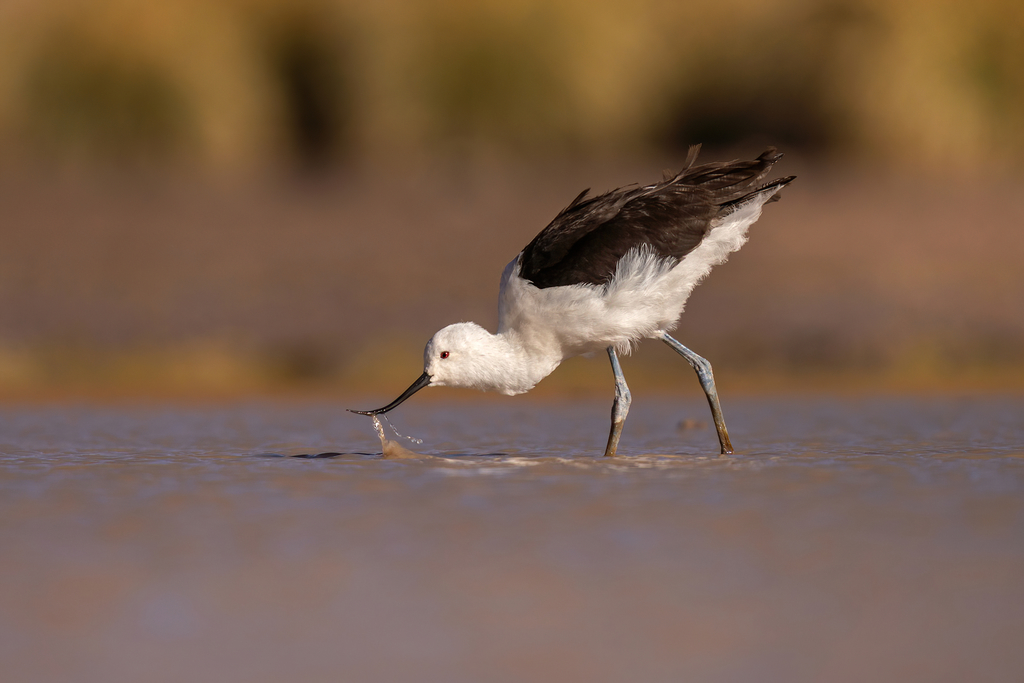
Andean Avocet
Photo © Luciano Massa
Photo © Luciano Massa — CC BY 4.0 — Source: iNaturalist photo #171997107Identification
The Andean avocet is a striking large wader measuring 43–48 cm in length, making it likely the heaviest member of the avocet and stilt family. It displays a bold colour pattern: a white head, neck, underparts and rump contrast sharply with a dark brown back, wings and tail. The bird's most distinctive feature is its long, thin black bill that curves upward at the tip—a characteristic adaptation shared with other avocets. Its thin grey legs are notably shorter than those of related avocet species, and the sexes are similar in appearance.
The Andean avocet resembles the local black-winged stilt subspecies in its overall colour pattern, but the two species are easily distinguished: the stilt possesses very long red legs, a white tail, and crucially, a straight bill rather than the avocet's upturned one.
Range & Habitat
This species is endemic to the Andes mountains, where it is a year-round resident. It breeds above 3500 m elevation across a range spanning northwestern Argentina, western Bolivia, northern Chile and southern Peru. The Andean avocet favours shallow, preferably alkaline lakes in the high-altitude Andean environment.
While non-migratory, the species may move to slightly lower altitudes during the non-breeding season, though it remains within its core Andean range throughout the year.
Behaviour & Diet
Andean avocets are social birds that often nest in small groups near their preferred alkaline lakes. Eggs are laid from at least January onwards, anchoring their breeding cycle to the austral summer. The species is non-migratory but shows some flexibility in altitude, shifting to lower elevations when not breeding before returning to higher breeding grounds.
When foraging, the Andean avocet frequents shallow water and mud flats, employing its distinctive upturned bill in its characteristic feeding style: sweeping the bill from side to side through the water to detect and capture prey. Crustaceans and aquatic insects form the bulk of its diet, making it a specialist feeder adapted to the sparse resources of high-altitude Andean lakes.
Best Time & Places to See It
The breeding season from January onwards offers the best opportunity to observe Andean avocets, particularly at shallow alkaline lakes in the high Andes above 3500 m. The species' year-round residency in the region means it can be encountered throughout the year, though birds may be found at slightly lower elevations during the non-breeding season.
Target the northwestern Argentine highlands, western Bolivian altiplano, northern Chilean uplands, and southern Peruvian mountains where suitable alkaline lake habitat exists. Look for small groups gathered at shallow water margins during the breeding season.
Photography Tips
The Andean avocet's striking white and dark brown plumage and distinctive upturned bill make it visually rewarding to photograph. The high-altitude Andean environment offers dramatic backdrop scenery, but present significant logistical challenges: bring appropriate gear for extreme altitude, thin air and potentially harsh weather conditions.
Early morning light is ideal for capturing the contrast between the white head and neck against the darker back and wings. Photograph birds in shallow water as they sweep their bills side to side during foraging—this behaviour showcases the species' most distinctive feature and creates dynamic compositional opportunities.
Salar del Huasco National Park
Pica, Chile
+75 birds+2 mammals
High above the Atacama's shimmering flats, where the Andes grip the sky, lies a landscape of stark geological drama and surprising biological richness. Salar del Huasco…
VIEW NATIONAL PARKLauca National Park
Putre, Chile
+139 birds+17 mammals
Where the Andes rise toward the altiplano in Chile's far north, Lauca National Park sprawls across more than 3,000 square kilometres of some of South America's…
VIEW NATIONAL PARKReserva Nacional las Vicuñas
Putre, Chile
+87 birds+6 mammals
High desert plateaus interlace with volcanic ridges across this 4,204-square-kilometre expanse at the border between Chile and Bolivia, where altitudes exceed 3,500 metres and the climate…
VIEW NATIONAL PARKSalar de Surire Natural Monument
Putre, Chile
+61 birds
High across the Altiplano of northern Chile, where the Andes push toward 4,300 metres and the air thins to a crystalline clarity, lies a vast shallow…
VIEW NATURAL MONUMENTNo community photos yet. Log in to add the first one.
No community observations of this species yet.