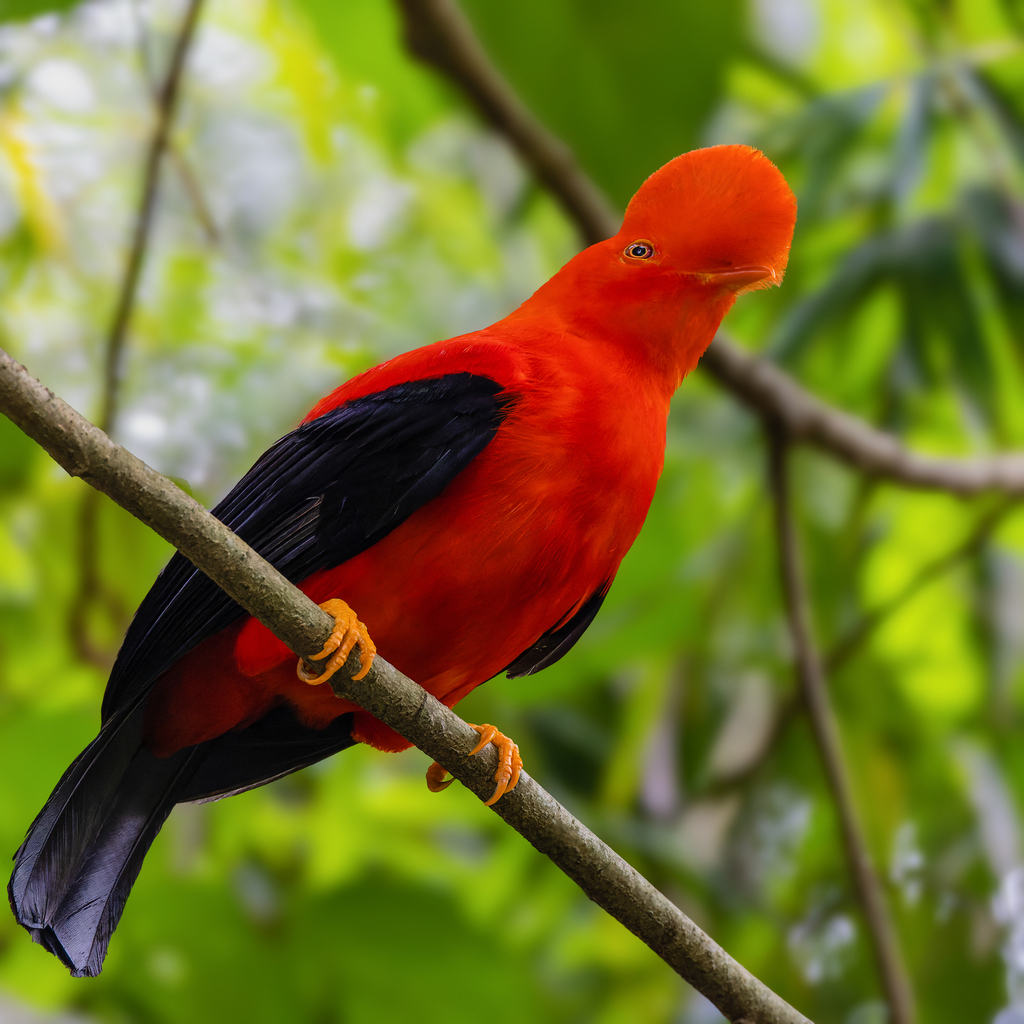
Andean Cock-of-the-rock
Rupicola peruvianus
Photo © Gary T. Leavens
Photo © Gary T. Leavens — CC BY-SA 4.0 — Source: iNaturalist #208909326ABOUT
Subspecies of Andean Cock-of-the-rock
Rupicola peruvianus sanguinolentusRupicola peruvianus aequatorialisRupicola peruvianus peruvianusRupicola peruvianus saturatus
Identification
The Andean Cock-of-the-rock is a large passerine approximately 32 cm long, weighing around 265 grams, with males noticeably larger than females. The species exhibits striking sexual dimorphism. Males display a large disk-like crest and brilliant scarlet or orange plumage with black tail and wings, pale greyish scapulars, and a yellowish bill. Females are significantly drabber and browner with a less prominent crest, a dark bill with a small yellow tip, and more subdued coloration overall. Eye color varies by sex and subspecies, ranging from red to bluish-white in males and whitish to brown in females.
Range & Habitat
This species is distributed across the cloud forests of the Andes, inhabiting a vast range of approximately 260,000 km² spanning Venezuela, Colombia, Ecuador, Peru, and Bolivia. It typically occupies ravines and forested streams in montane areas between 500 and 2,400 meters elevation, preferring the lower and middle forest levels while occasionally ranging higher into fruiting trees. Generally shy and inconspicuous, the bird is often glimpsed only briefly after being flushed or while flying swiftly down a valley. Four subspecies are recognized, with R. p. aequatorialis being the most widespread across the northern Andes.
Behaviour & Diet
The Andean Cock-of-the-rock feeds primarily on fruit, particularly from Lauraceae, Annonaceae, and Rubiaceae families, supplemented by insects, lizards, frogs, and occasionally small rodents. Males are polygamous and gather at communal leks to perform elaborate display rituals showcasing their magnificent plumage. These competitive displays involve bowing, jumping, wing-flapping, bill-snapping, and varied vocalizations that intensify when females approach. Display activity is influenced by light intensity. After mating, females alone construct mud-plastered nests beneath rocky overhangs or cave entrances, incubating eggs and raising young independently.
Best Time & Places to See It
The Andean Cock-of-the-rock is best observed at traditional lek sites within cloud forest ravines across the Andes of Peru, Colombia, Ecuador, Bolivia, and Venezuela. Breeding occurs at different times depending on location: February to July in Colombia and July to February in Ecuador. Early morning often provides the best viewing opportunities, as display activity correlates with specific light intensity levels. Look for males at lek sites during breeding season, though the species is easily disturbed and requires patient, careful observation.
Photography Tips
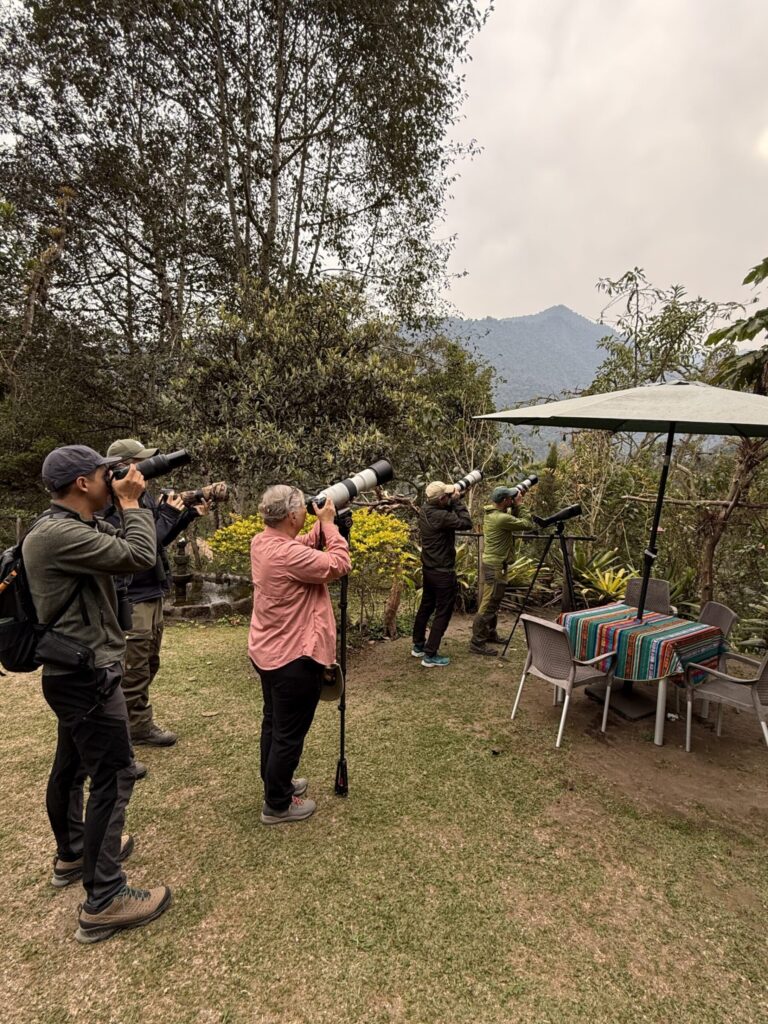
Capture the male's striking scarlet or orange plumage and distinctive disk-like crest against the forest backdrop. Early morning light enhances the bird's brilliant coloration. Position yourself carefully at lek sites to photograph confrontation displays and courtship behaviors without disturbing the birds. The dramatic color contrast between males and females offers varied compositional opportunities. Wide apertures help isolate subjects within dense cloud forest vegetation, while faster shutter speeds freeze the rapid movements during display sequences. Respect the species' sensitivity to disturbance by maintaining distance and using longer lenses.
STAYS
HOTSPOTS
National Park
Sangay National Park
Cebadas, Ecuador
+320 birds+10 mammals
High in Ecuador's Andean spine, where the Western Cordillera rises to touch perpetual snow, a landscape of volcanic drama and ecological intensity unfolds across Sangay National…
VIEW NATIONAL PARKNational Park
Río Negro-Sopladora National Park
Chontal, Ecuador
+84 birds
Where the eastern cordillera of Ecuador descends toward the Amazon basin, the Río Negro-Sopladora National Park sprawls across 615 square kilometers of montane forest and riverine…
VIEW NATIONAL PARKNational Park
Podocarpus National Park
Zamora, Ecuador
+496 birds+6 mammals
Where the Andes descend toward the Amazon basin, Podocarpus National Park sprawls across nearly 2,800 square kilometres of the most biodiverse terrain in Ecuador's southern highlands.…
VIEW NATIONAL PARKNational Park
Sumaco Napo-Galeras National Park
Loreto, Ecuador
+563 birds+4 mammals
Where Ecuador's Amazon transitions into cloud forest, a massive shield volcano rises from the emerald lowlands of Orellana Province, anchoring one of the continent's most biodiverse…
VIEW NATIONAL PARKNational Park
Antisana National Park
Quijos, Ecuador
+432 birds+21 mammals
Where the eastern Andean slopes descend into the Amazon basin, Antisana National Park sprawls across roughly 2,500 square kilometers of some of South America's most dramatic…
VIEW NATIONAL PARKNational Park
Llanganates National Park
Tena, Ecuador
+239 birds+8 mammals
Where the eastern slopes of the Andes plunge toward the Amazon basin, Llanganates National Park sprawls across nearly 3,500 square kilometers of montane wilderness, its terrain…
VIEW NATIONAL PARKNational Park
Natural Serranía de los Churumbelos National Park
Santa Rosa, Colombia
+70 birds+2 mammals
Where the western cordillera of Colombia rises toward the Pacific watershed, the Serranía de los Churumbelos unfolds across more than 3,200 square kilometers of some of…
VIEW NATIONAL PARKNational Park
Natural Serranía de los Yariguíes National Park
El Carmen de Chucurí, Colombia
+320 birds+3 mammals
Where the northern cordilleras of Colombia rise toward cloud forest, the Serranía de los Yariguíes unfolds across nearly 1,820 square kilometers of some of the most…
VIEW NATIONAL PARKNational Park
Natural Farallones de Cali National Park
Buenaventura, Colombia
+733 birds+27 mammals
Where the Pacific coastal plain meets the western slopes of the Andes, Farallones de Cali National Park sprawls across nearly 3,500 square kilometers of dramatic topography…
VIEW NATIONAL PARKNational Park
Natural Chingaza National Park
Junín, Colombia
+285 birds+6 mammals
Where the Andes rise above three thousand metres in the Cundinamarca region, high-altitude grasslands and cloud forests converge in a landscape shaped by both geology and…
VIEW NATIONAL PARKNational Park
Natural el Cocuy National Park
Güicán, Colombia
+313 birds+3 mammals
Where the Andes rise to their highest peaks in Colombia's eastern cordillera, El Cocuy National Park sprawls across more than 6,600 square kilometers of some of…
VIEW NATIONAL PARKNational Park
Puracé National Natural Park
Puracé, Colombia
+327 birds+2 mammals
Where the Andes thrust upward across southwestern Colombia, Puracé National Natural Park spans nearly 2,631 square kilometers of some of South America's most dramatic montane terrain.…
VIEW NATIONAL PARKNational Park
Guácharos Cave National Natural Park
Acevedo, Colombia
+359 birds
High in the Andean foothills of southern Huila, where mist-laden slopes rise above 1,600 metres, lies a landscape carved by underground rivers and crowned by karst…
VIEW NATIONAL PARKNational Park
Natural Sumapaz National Park
Cubarral, Colombia
+368 birds+1 mammals
Where the Andes descend toward the Amazon basin, the high páramo grasslands of Sumapaz National Park sprawl across more than five thousand square kilometers of Meta…
VIEW NATIONAL PARKNational Park
El Tamá National Park
Toledo, Colombia
+435 birds
Where the Andes descend toward the Caribbean coastal lowlands of northern Colombia, El Tamá National Park sprawls across nearly 3,800 square kilometres of montane forest, cloud…
VIEW NATIONAL PARKNational Park
Natural Sierra de la Macarena National Park
Vista Hermosa, Colombia
+566 birds+15 mammals
Across nearly 20,000 square kilometres of Colombia's Meta Department, the terrain rises from lowland savanna into Andean foothills through a mosaic of gallery forests, palm-fringed wetlands,…
VIEW NATIONAL PARKNational Park
Natural Nevado del Huila National Park
Planadas, Colombia
+117 birds
Where the Colombian Andes rise above 5,000 metres, tropical cloud forest yields to páramo and glaciated peaks, and the Planadas region of Tolima contains one of…
VIEW NATIONAL PARKNational Park
Yanachaga–chemillén National Park
Palcazu, Peru
+639 birds+6 mammals
Where the eastern slopes of Peru's central cordillera plunge into cloud forest, Yanachaga–Chemillén National Park protects nearly three thousand square kilometres of montane wilderness that few…
VIEW NATIONAL PARKNational Park
Manu National Park
Manu, Peru
+892 birds+26 mammals
Across the eastern slopes of the Peruvian Andes, tropical rainforest descends into the Amazon basin with a complexity that few terrestrial ecosystems match. Manu National Park…
VIEW NATIONAL PARKNational Park
Bahuaja Sonene National Park
San Pedro de Putina Punco, Peru
+602 birds+8 mammals
Where the Madre de Dios and Heath rivers converge in southeastern Peru rises one of South America's most biodiverse wilderness regions: a vast protected realm of…
VIEW NATIONAL PARKNational Park
Tingo Maria National Park
Mariano Dámaso Beraún, Peru
+423 birds
Where the eastern slopes of the Peruvian Andes descend toward the Amazon basin, the landscape fractures into a maze of limestone ridges, humid gorges, and cloud-wrapped…
VIEW NATIONAL PARKNational Park
Cordillera Azul National Park
Pampa Hermosa, Peru
+322 birds+1 mammals
Where the eastern Andes descend into the western Amazon basin, Cordillera Azul National Park sprawls across nearly 38,000 square kilometres of some of Peru's most pristine…
VIEW NATIONAL PARKCOMMUNITY
Share your photo of this species
No community photos yet. Log in to add the first one.
0
Observed by
0
Hotspots reported
0
Countries
No community observations of this species yet.