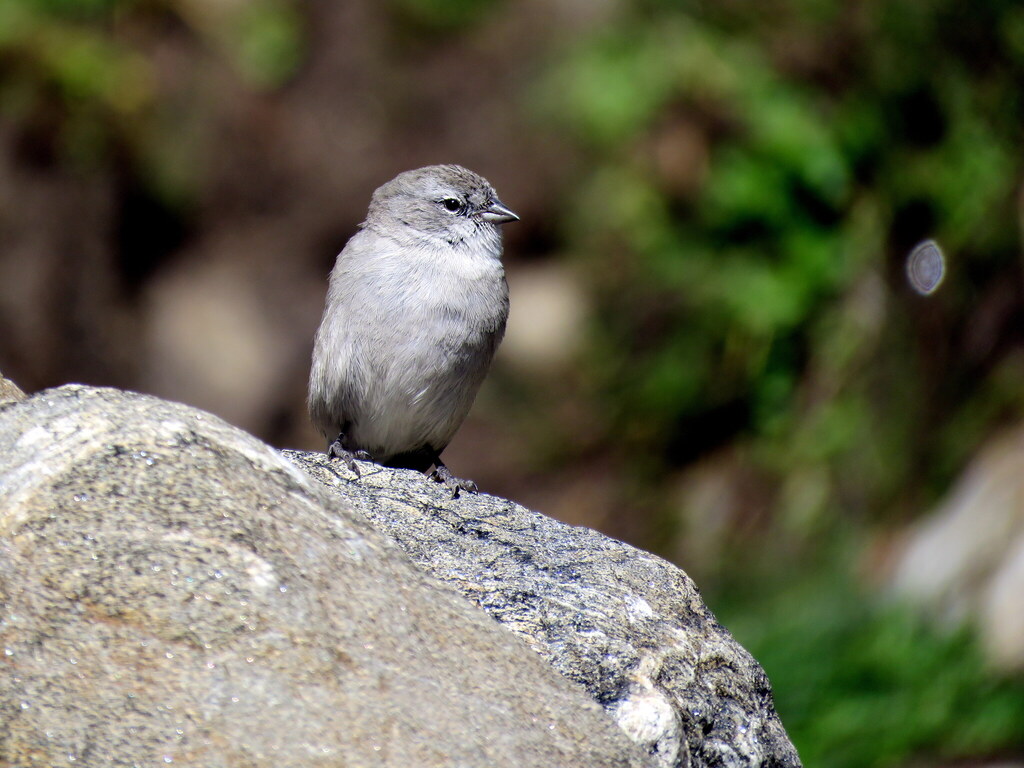
Ash-breasted Sierra Finch
Photo © Diego Carús
Photo © Diego Carús — CC0 1.0 — Source: iNaturalist photo #602755706Identification
The ash-breasted sierra finch is a small finch measuring just 11–11.5 cm in length and weighing 13–17.4 g, making it one of the tiniest members of its family. True to its name, this species is characterized by its distinctive ash-gray breast, which sets it apart from related sierra finches. The species exhibits subtle plumage variations across its range, with three recognized subspecies differing in size and coloration. The nominate subspecies displays heavier streaking on the upperparts, while the smaller ocularis subspecies has a more grayish tone with less prominent streaking. The naroskyi subspecies, found in Argentina, is notably darker with considerably darker flanks and blackish tail and wings. All subspecies share the characteristic short tail typical of sierra finches.
Range & Habitat
This species has an extensive distribution across the high Andes, ranging from Ecuador south through Peru, Chile, and Bolivia to Argentina. The ash-breasted sierra finch is primarily a highland specialist, typically found at elevations between 2,500–5,000 m, though a lowland population in the Tumbes area of southern Ecuador and far northwestern Peru descends almost to sea level. The species occupies diverse high-altitude habitats including flat dry puna grasslands, open woodlands, forest edges, rocky slopes, and cactus-dominated terrain. It also frequents the boundaries of bofedal wetlands and, in northern Chile, is found in Polylepis forests at elevations exceeding 4,000 m.
A notably adaptable species, the ash-breasted sierra finch prefers open habitats with sparse vegetation and shows remarkable tolerance for arid environments and human-modified landscapes such as villages and overgrazed pastures. This flexibility has helped it maintain a stable presence throughout its large range, making it patchily common rather than rare.
Behaviour & Diet
The ash-breasted sierra finch is primarily granivorous, feeding mainly on seeds while supplementing its diet with arthropods. It typically forages in small mixed flocks, sometimes joining feeding associations with the greenish yellow-finch, a behavioral pattern that may offer advantages in locating food and detecting predators across open terrain.
The breeding season varies geographically in accordance with local dry seasons, lasting from October to July depending on location—from October to November in northern Chile, October in Bolivia, June to July in southern Peru, and March to April in Cuzco. Females construct bulky nests from grass, hair, wool, and feathers, placing them in crevices, under house eaves, beneath rocks, or occasionally on low bushes or grass clumps 20–30 cm above the ground. Each clutch typically consists of two pale blue-green eggs decorated with dark brown spotting, densest toward the larger end.
Best Time & Places to See It
The ash-breasted sierra finch can be encountered year-round throughout its range, though timing should align with breeding seasons for increased activity and visibility. The breeding season varies considerably—plan visits for October–November in northern Chile, October in Bolivia, June–July in southern Peru, and March–April in the Cuzco region. The species occurs in several protected areas, including Lauca National Park and Las Vicuñas National Reserve in Chile, making these reliable destinations. Look for small flocks foraging in open puna grasslands, along forest edges, and in rocky, sparsely vegetated terrain at high elevations. Villages and overgrazed pastures in mountain regions also provide good viewing opportunities.
Photography Tips
Photographing this small finch requires patience and attention to its preferred open habitats. Position yourself near areas of sparse vegetation where flocks forage openly, offering unobstructed views. The species' small size and preference for open terrain mean you'll benefit from a telephoto lens (at least 400–600 mm) to capture detail from a distance without disturbing the birds. Early morning light is ideal for capturing the ash-gray breast coloration that characterizes this species. Since birds often feed in small mixed flocks, scan feeding areas carefully—the presence of greenish yellow-finches may indicate active foraging flocks. The variable plumage across subspecies offers excellent opportunities to document regional variation if visiting multiple locations across the Andes.
Podocarpus National Park
Zamora, Ecuador
+496 birds+6 mammals
Where the Andes descend toward the Amazon basin, Podocarpus National Park sprawls across nearly 2,800 square kilometres of the most biodiverse terrain in Ecuador's southern highlands.…
VIEW NATIONAL PARKAntisana National Park
Quijos, Ecuador
+432 birds+21 mammals
Where the eastern Andean slopes descend into the Amazon basin, Antisana National Park sprawls across roughly 2,500 square kilometers of some of South America's most dramatic…
VIEW NATIONAL PARKCotopaxi National Park
Mulaló, Ecuador
+211 birds+6 mammals
High in Ecuador's volcanic corridor, where the páramo transitions into cloud forest along the slopes of Cotopaxi volcano, the national park unfolds across nearly 500 square…
VIEW NATIONAL PARKLlanganates National Park
Tena, Ecuador
+239 birds+8 mammals
Where the eastern slopes of the Andes plunge toward the Amazon basin, Llanganates National Park sprawls across nearly 3,500 square kilometers of montane wilderness, its terrain…
VIEW NATIONAL PARKCajas National Park
Cuenca, Ecuador
+190 birds+7 mammals
High in the Andes above Cuenca, where elevation ranges from 3,100 to 4,200 metres, the páramo landscape dominates—a windswept realm of cushion plants, alpine grasses, and…
VIEW NATIONAL PARKManu National Park
Manu, Peru
+892 birds+26 mammals
Across the eastern slopes of the Peruvian Andes, tropical rainforest descends into the Amazon basin with a complexity that few terrestrial ecosystems match. Manu National Park…
VIEW NATIONAL PARKHuascarán National Park
Independencia, Peru
+201 birds+5 mammals
Where granite peaks pierce the Andean sky above 6,000 metres, Huascarán National Park sprawls across more than 11,500 square kilometres of Peru's Cordillera Blanca, a landscape…
VIEW NATIONAL PARKSalar del Huasco National Park
Pica, Chile
+75 birds+2 mammals
High above the Atacama's shimmering flats, where the Andes grip the sky, lies a landscape of stark geological drama and surprising biological richness. Salar del Huasco…
VIEW NATIONAL PARKLauca National Park
Putre, Chile
+139 birds+17 mammals
Where the Andes rise toward the altiplano in Chile's far north, Lauca National Park sprawls across more than 3,000 square kilometres of some of South America's…
VIEW NATIONAL PARKReserva Nacional las Vicuñas
Putre, Chile
+87 birds+6 mammals
High desert plateaus interlace with volcanic ridges across this 4,204-square-kilometre expanse at the border between Chile and Bolivia, where altitudes exceed 3,500 metres and the climate…
VIEW NATIONAL PARKSalar de Surire Natural Monument
Putre, Chile
+61 birds
High across the Altiplano of northern Chile, where the Andes push toward 4,300 metres and the air thins to a crystalline clarity, lies a vast shallow…
VIEW NATURAL MONUMENTLos Cardones National Park
Argentina
+193 birds+6 mammals
Where the Andes descend into northwestern Argentina, Los Cardones National Park sprawls across nearly 1,200 square kilometres of one of South America's most distinctive high-altitude desert…
VIEW NATIONAL PARKCalilegua National Park
Municipio de Calilegua, Argentina
+288 birds+8 mammals
Where the eastern Andean slopes plunge into northwestern Argentina's humid subtropics, nearly 2,645 square kilometers of steep terrain and luxuriant forest compose one of South America's…
VIEW NATIONAL PARKNo community photos yet. Log in to add the first one.
No community observations of this species yet.