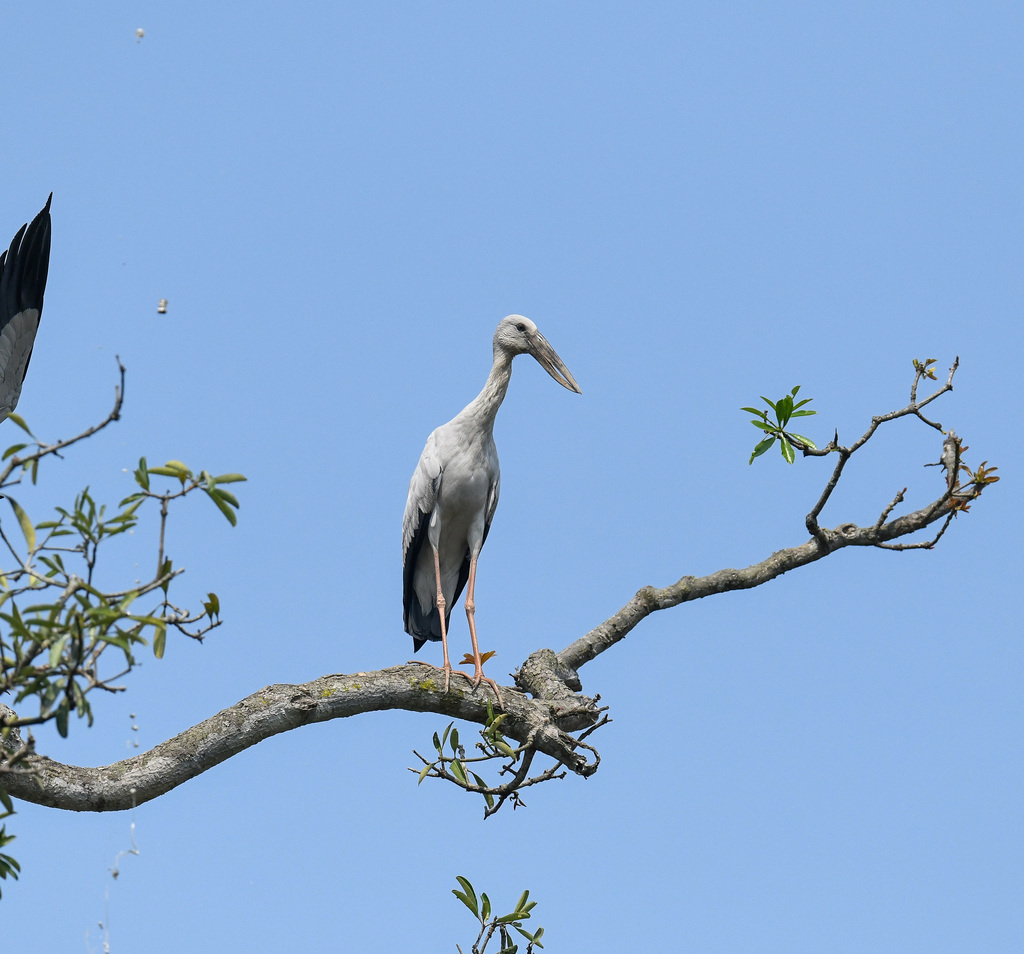
Asian Openbill
Photo © Rejoice Gassah
Photo © Rejoice Gassah — CC BY 4.0 — Source: iNaturalist #301158315Identification
The Asian openbill is a distinctive large wading bird standing 68 cm tall, characterized by its striking plumage that varies with season. Breeding birds are predominantly white, while non-breeding plumage is smoky grey. Both sexes display glossy black wings and tail with a green or purple sheen. The most recognizable feature is the unusual gap between the recurved lower and arched upper mandible—a trait that gives the species its name and is thought to aid in handling snails. Young birds lack this gap and display brownish-grey plumage with a brownish mantle. The short legs are pinkish to grey, becoming reddish before breeding season. The bill itself is horn-grey with fine brush-like cutting edges. At a distance, Asian openbills may resemble white storks or Oriental storks, though they are relatively small for their family. Like all storks, they fly with their necks outstretched and are broad-winged soaring birds that rely on thermals for sustained flight.
Range & habitat
The Asian openbill is found mainly throughout the Indian subcontinent and Southeast Asia. It is widespread and common across India, Sri Lanka, Nepal, Bangladesh, Myanmar, Thailand, and Cambodia, with very recent range expansion into southwestern China. The species is very rare in the Sind and Punjab regions of Pakistan. These birds favour inland wetlands as their usual foraging habitat and are only rarely seen along river banks and tidal flats. On agricultural landscapes, they forage in crop fields, irrigation canals, and seasonal marshes. Though resident within their range, Asian openbills are highly mobile, making long-distance movements in response to weather and food availability. Ringed birds have been recovered hundreds of kilometres from their origin points, with one individual tracked 1500 km between Thailand and Bangladesh.
Behaviour & diet
Asian openbills are usually found in flocks, though single birds are not uncommon. During warmer parts of the day, they soar on thermals and often descend rapidly into feeding areas. Groups forage together in close proximity in shallow water or marshy ground, walking with a slow and steady gait. Their diet consists mainly of large molluscs, especially Pila species of snails, which they extract from their shells using a specialized foraging technique. The birds hold their bill tips slightly apart and make rapid vertical jabs in shallow water, often with their head and neck partially submerged. The snail's body is extracted with the bill still underwater, sometimes with the lower mandible tip twisted to the right. While the function of the bill gap remains debated, the rough edges of the mandible are thought to provide better grip on hard, slippery shells. Remarkably, young birds without the characteristic gap are still able to forage successfully on snails. Asian openbills also feed on water snakes, frogs, and large insects, and when available, preferentially use natural marshes over other agricultural habitats.
Best time & places to see it
For reliable sightings, visit wetland regions across India, Bangladesh, Thailand, and Cambodia where the species is widespread and common. In Kerala's Thirunavaya Lotus Lake Wetland, Asian openbills are most regularly seen between September and February. Inland wetlands and freshwater marshes are the most productive habitats to search. Birds are active throughout the day, making visible thermal-soaring displays during warm hours. Look for them in flocks in shallow water or marshy ground, often descending rapidly into feeding areas. Long-distance movements mean that sightings may vary seasonally based on weather and food availability, so local knowledge of current conditions will improve your chances of observation.
Photography tips
Photograph Asian openbills in their open wetland habitats where they have space to soar and forage. The contrast between their white or grey bodies and glossy black wings and tail provides striking compositional opportunities, especially in breeding plumage. During the warm part of the day, capture them soaring on thermals with their necks outstretched—a classic stork behaviour. For feeding shots, position yourself at the water's edge of shallow marshes where flocks forage together; the rapid vertical jabbing motions they use to extract snails can create dynamic images. Close-up shots of the distinctive mandible gap are rewarding when birds are near enough, as this feature is the species' most recognizable identifier. Early morning or late afternoon light will enhance the glossy sheen of their black wing feathers. Remember that these are social birds often seen in groups, so compositions including multiple individuals can effectively convey their typical behaviour.
Lunugamvehera National Park
Sri Lanka
+204 birds+14 mammals
Dry scrubland and shallow wetlands converge in Sri Lanka's southeastern lowlands, where Lunugamvehera National Park anchors one of the island's most ecologically vital landscapes. The park's…
VIEW NATIONAL PARKMinneriya National Park
Sri Lanka
+158 birds+9 mammals
Across the dry zone of Sri Lanka's North Central Province spreads a landscape of shallow tanks, grassland margins, and scattered dry forest—a mosaic of water and…
VIEW NATIONAL PARKWasgamuwa National Park
Sri Lanka
+156 birds+8 mammals
Dry deciduous forest and open grassland sweep across the North Central lowlands where Wasgamuwa National Park protects one of Sri Lanka's largest remaining tracts of this…
VIEW NATIONAL PARKAngamedilla National Park
Polonnaruwa, Sri Lanka
+40 birds+2 mammals
Ancient tanks and sal forests define this water-rich sanctuary in Sri Lanka's North Central heartland, where seasonal wetlands and dry deciduous woodland create a mosaic of…
VIEW NATIONAL PARKMaduru Oya National Park
Sri Lanka
+74 birds+1 mammals
Granite ridges rise abruptly from the humid lowlands of Sri Lanka's Uva Province, their weathered slopes clothed in dry monsoon forest and scattered woodland where deciduous…
VIEW NATIONAL PARKOrang National Park
Rangagarapathar, India
+298 birds+1 mammals
Where the Brahmaputra's floodplains meet the foothills of Assam, Orang National Park unfolds across a mosaic of riverine grasslands, forests and wetlands that pulse with the…
VIEW NATIONAL PARKIndravati National Park
Bijapur, India
+41 birds
Where the Indravati River cuts through the elevated plateaus of central India, a landscape of deciduous forest and open woodland unfolds across Bijapur district in Chhattisgarh.…
VIEW NATIONAL PARKRanthambhore National Park
Sawai Madhopur, India
+294 birds+20 mammals
Granite ridges and ravines carved through the Aravalli Range frame this protected landscape in eastern Rajasthan, where deciduous forest mingles with open scrubland and seasonal water…
VIEW NATIONAL PARKMu Ko Ang Thong National Park
Thailand
+47 birds+1 mammals
Forty-two limestone islands rise from the Gulf of Thailand, their weathered karst peaks piercing emerald waters in a landscape of stunning geological drama. Mu Ko Ang…
VIEW NATIONAL PARKHat Noppharat Thara-Mu Ko Phi Phi National Park
Ao Nang, Thailand
+253 birds+9 mammals
Where limestone karsts rise dramatically from turquoise waters, Hat Noppharat Thara-Mu Ko Phi Phi National Park unfolds across a mosaic of beach, mangrove forest, and island…
VIEW NATIONAL PARKKhao Yai National Park
Prachantakham District, Thailand
+377 birds+46 mammals
Evergreen dipterocarp forest blankets the rolling terrain of this national park in eastern Thailand, where limestone hills rise abruptly from the forest floor and seasonal streams…
VIEW NATIONAL PARKMu Ko Similan National Park
Lam Kaen, Thailand
+82 birds+1 mammals
Granite islands rise from the Andaman Sea in a scattered archipelago where limestone cliffs meet turquoise shallows, their steep faces weathered into caves and overhangs that…
VIEW NATIONAL PARKKhao Laem Ya-Mu Ko Samet National Park
Mueang Rayong District, Thailand
+159 birds+3 mammals
Where limestone hills meet the Gulf of Thailand, Khao Laem Ya–Mu Ko Samet National Park stitches together a mosaic of terrestrial and marine worlds that few…
VIEW NATIONAL PARKKhao Laem National Park
Sangkhla Buri District, Thailand
+197 birds
Where the Vajiralongkorn Reservoir sprawls across the forested valleys of Kanchanaburi's northern borderlands, Khao Laem National Park protects a landscape where limestone ridges rise dramatically from…
VIEW NATIONAL PARKKanha Tiger Reserve
Kanha Kisli F.V., India
+321 birds+23 mammals
Where sal forests give way to emerald meadows and crystalline streams carve through ancient valleys, one of India's finest wilderness reserves unfolds across the Maikal Range.…
VIEW NATIONAL PARKTadoba National Park
Palasgaon Singru, India
+270 birds+20 mammals
Where sal forests meet open grasslands and rocky outcrops rise from red laterite soil, central India's landscape unfolds in raw, untamed beauty. Ancient teak woodlands and…
VIEW NATIONAL PARKBandhavgarh National Park
Garhpuri, India
+285 birds+17 mammals
Where granite ridges rise dramatically above sal and bamboo forests, one of India's most pristine tiger reserves unfolds across the Vindhyan plateau. Ancient rock formations tower…
VIEW NATIONAL PARKPanna National Park
Badgadi Kalan, India
+271 birds+17 mammals
Where granite gorges slice through central India's Vindhyan plateau, a landscape of stark beauty unfolds across nearly six hundred square kilometers. The Ken River carves through…
VIEW NATIONAL PARKKaziranga National Park
Kohora, India
+422 birds+26 mammals
Dawn breaks over the floodplains of the Brahmaputra, where tall grasslands stretch endlessly beneath monsoon-heavy skies. This sprawling wilderness of northeastern Assam is a mosaic of…
VIEW NATIONAL PARKKeoladeo National Park
Shreenagar Rural, India
+326 birds+14 mammals
Where shallow wetlands shimmer beneath vast Rajasthani skies, one of Asia's finest bird sanctuaries pulses with extraordinary life. This former maharaja's hunting reserve, now spanning 29…
VIEW NATIONAL PARKPeriyar National Park
Mlappara, India
+232 birds+4 mammals
Dawn breaks over mist-shrouded ridges where the Western Ghats tumble toward Kerala's spice-scented lowlands. Here, ancient tropical forests envelope a glittering artificial lake, creating a mosaic…
VIEW NATIONAL PARKPampadum Shola National Park
Vattavada, India
+258 birds+14 mammals
Where misty shola forests cling to the high plateaus of the Nilgiri Mountains, ancient evergreen remnants create a world apart. This 2,316-hectare reserve protects one of…
VIEW NATIONAL PARKBandipur National Park
Hirehalli, India
+302 birds+19 mammals
Where the Western Ghats descend into the Deccan plateau, ancient deciduous forests blanket a landscape carved by the Nugu River. Bandipur unfolds across 880 square kilometres…
VIEW NATIONAL PARKNagarahole Tiger Reserve
Nalkeri Forest, India
+323 birds+23 mammals
Where granite escarpments rise above dense deciduous forests and the Kabini River carves through pristine wilderness, one of India's most biodiverse landscapes unfolds across the Western…
VIEW NATIONAL PARKTaman Negara National Park
Kampong Samas, Malaysia
+393 birds+48 mammals
Where ancient rainforest meets limestone peaks, one of Southeast Asia's oldest protected wilderness preserves sprawls across 4,343 square kilometers of primordial landscape. Dipterocarp giants tower overhead,…
VIEW NATIONAL PARKGir National Park
Asundrali, India
+258 birds+13 mammals
Dry deciduous forests cloak the rolling hills of western Gujarat where the Gir landscape rises as a final sanctuary for one of the world's rarest felids:…
VIEW NATIONAL PARKPoyang Lake National Nature Reserve
Shangrao, China
+270 birds+7 mammals
Where the Yangtze River's massive floodplain spreads across central China, Poyang Lake National Nature Reserve encompasses one of the continent's most dynamic and water-rich wetland systems.…
VIEW NATURE RESERVECaohai National Nature Reserve
Bijie, China
+93 birds
At roughly 1,900 metres elevation on Guizhou's high plateau, Caohai sprawls across a temperate landscape shaped by pronounced seasonal extremes. Winters here are dry and cool,…
VIEW NATURE RESERVEXishuangbanna National Nature Reserve
Xishuangbanna Dai Autonomous Prefecture, China
+173 birds+2 mammals
Where subtropical monsoon forests meet the margins of the Yunnan plateau, Xishuangbanna National Nature Reserve sprawls across a landscape of dramatic relief—deep river valleys carved by…
VIEW NATURE RESERVENo community photos yet. Log in to add the first one.
No community observations of this species yet.