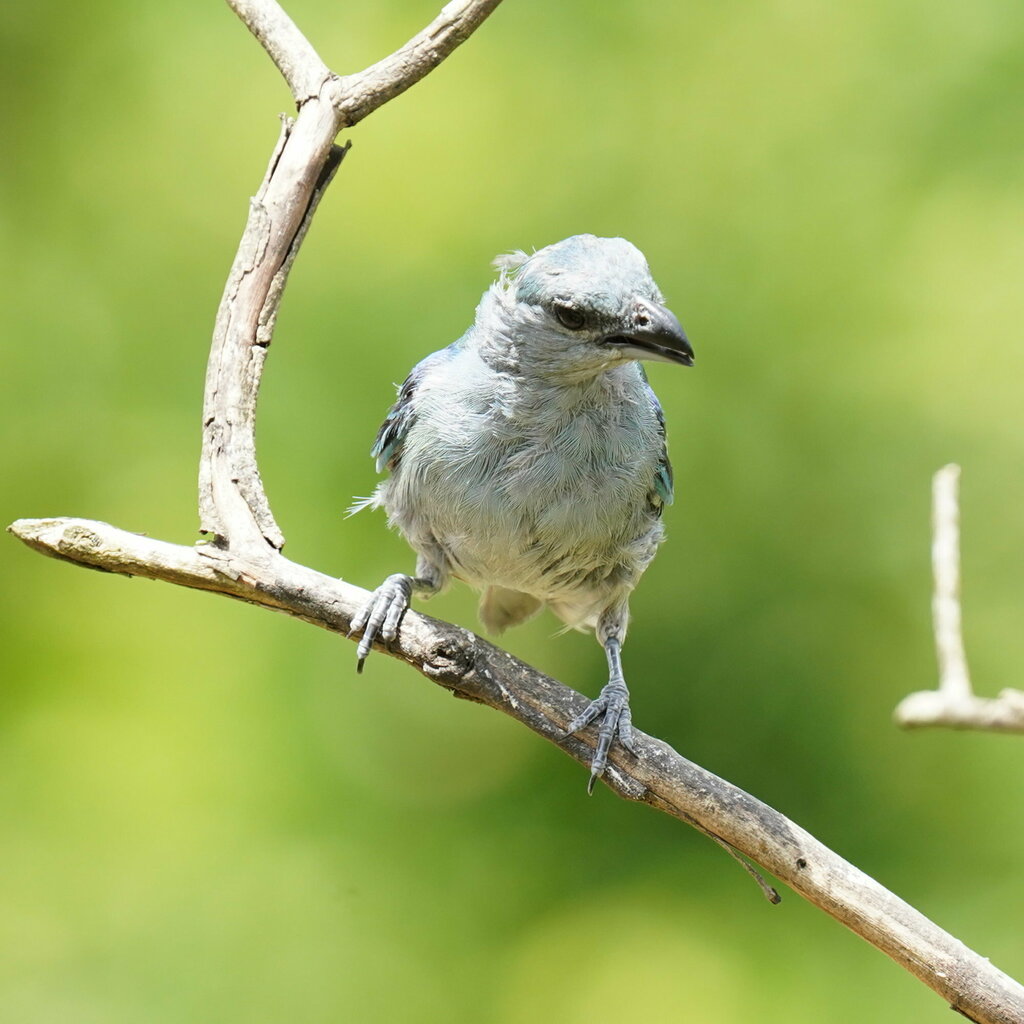
Azure-shouldered Tanager
Photo © Daniel S. Katz
Photo © Daniel S. Katz — CC BY 4.0 — Source: iNaturalist #264951228Identification
The azure-shouldered tanager is a large, thick-billed tanager measuring 18 cm in length with a mass of 41–46 g. Both sexes are alike, displaying predominantly bluish plumage with gray-blue upperparts and heads, darker lores, and more bluish crowns. The throat and underparts are paler than the upper body, while the rump, uppertail coverts, and tail are bright blue. The flanks show a greenish wash. The upperwing-coverts are a rich, glossy violet-blue, with the greater coverts dark and edged in turquoise-blue. The flight feathers have dusky plumage with broad turquoise fringes. The upper mandible is blackish while the lower mandible is blue-gray; the iris is dark brown and legs are dark horn-gray. Juveniles are noticeably duller than adults.
The species' song is distinctive among Thraupis tanagers, comprising an initial assortment of soft notes followed by clear, musical phrases transcribed as jittle-jittle-jittle or look heeere, right heeere, drink-drink-jrrr. These notes are typically repeated twice or three times, with the song beginning complex and gradually becoming slower and more melodic. Calls include thin sweee notes and several squeaky vocalizations.
Range & Habitat
The azure-shouldered tanager is endemic to the Atlantic Forest of southeastern Brazil, occurring from southeastern Bahia, eastern Minas Gerais, and Espírito Santo south to northern Rio Grande do Sul. It is mainly found on the Atlantic slopes of Serra do Mar. Reports from Paraguay likely represent misidentified sayaca tanagers. The species prefers forested habitats more than other Thraupis tanagers, inhabiting humid montane forests, open woodlands, secondary growth, forest edges, and orchards on Santa Catarina Island.
Azure-shouldered tanagers typically remain below 1,200 m elevation, though they can be found at elevations up to 1,600 m. The species is likely non-migratory throughout most of its range, though southern populations may migrate seasonally.
Behaviour & Diet
Azure-shouldered tanagers are primarily frugivorous, feeding on fruit, flowers, and leaves—an unusual dietary component among tanagers. They consume fruit from melastomes, Livistona palms, and Eugenia umbelliflora, along with flowers and leaves from Acnistus arborescens and Solanum species. Despite their small gapes, they crush larger fruit externally to access a variety of fruit sizes. Leaves of Sechium and Psychotria species are also consumed. A network study in the Atlantic Forest found azure-shouldered tanagers contributed the third-largest influence on forest ecology, likely due to their highly frugivorous diet and role in seed dispersal.
Foraging occurs in mixed-species or single-species flocks of 15–20 birds, primarily in tall trees and, in Espírito Santo, among moss on large branches. The species shows aggressive behavior toward sayaca tanagers. Breeding begins after the dry season ends, with nests constructed deep within tangles of epiphytic bromeliads. Clutches contain two eggs, which are either pale blue with dark purple spots or white with small brown splotches.
Best Time & Places to See It
The azure-shouldered tanager is best observed in humid montane forests and forest edges throughout its range in southeastern Brazil. The Atlantic slopes of Serra do Mar, particularly in areas of Espírito Santo, Minas Gerais, and Rio de Janeiro, offer reliable viewing opportunities. Secondary growth and woodland edges also harbor this species. Elevations between 600 and 1,200 m are most productive, though birds may be found higher during the breeding season.
Observing flocking behavior offers the best chance of seeing multiple individuals. Early morning hours are typically most productive for locating foraging flocks in tall fruiting trees.
Photography Tips
The azure-shouldered tanager's vibrant violet-blue upperwing-coverts and turquoise-fringed flight feathers are best captured with side or three-quarter angles that showcase the shoulder coloration. The contrast between the glossy violet-blue wings and gray-blue head provides excellent compositional opportunities. Photographing birds in fruiting trees captures both the species and its ecological role.
Early morning light accentuates the rich blue tones of the plumage, particularly the bright rump and tail. Patience when observing flocks of 15–20 birds increases the chance of capturing multiple individuals in frame. The species' habit of foraging in tall trees and on moss-covered branches may require flexible angles and positioning to achieve clear, unobstructed shots.
Carlos Botelho State Park
Ilha do Cardoso State Park
Intervales State Park
Itatiaia National Park
Saint-Hilaire/Lange National Park
São Joaquim National Park
Serra da Bocaina National Park
Serra do Itajaí National Park
Serra do Mar State Park
Nothing matches these filters.
No community photos yet. Log in to add the first one.
No community observations of this species yet.