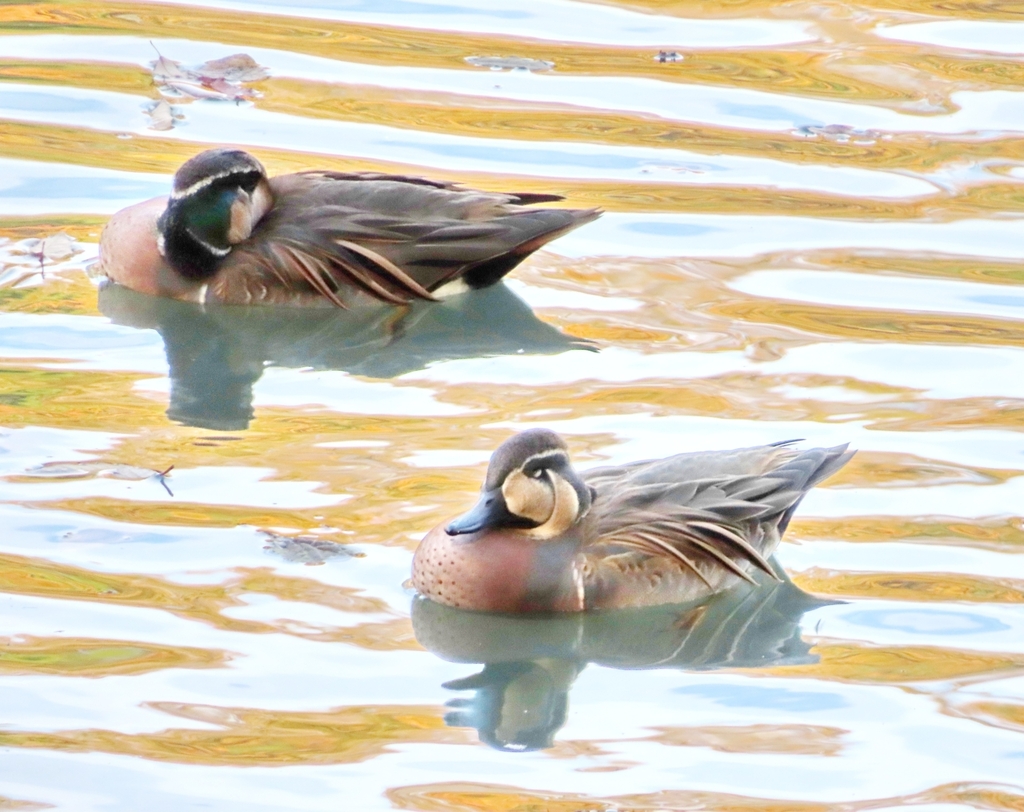
Baikal Teal
Photo © mami_t_t
Photo © mami_t_t — CC BY 4.0 — Source: iNaturalist #254082208Identification
The Baikal teal is a small dabbling duck, measuring 39–43 cm in length and weighing around 500 g, making it slightly larger and longer-tailed than the common teal. The breeding male is unmistakable and strikingly beautiful, with a vivid green nape, yellow and black auriculars, neck, and throat, combined with a dark crown and light brown breast spotted with dark markings. Its grey sides are framed by white bars at front and rear, creating a distinctive pattern unique among dabbling ducks.
Females are more subtle in appearance, resembling female green-winged teals but with a notably longer tail and diagnostic features including a white spot at the base of the bill, white throat angling to the back of the eye, and a distinct light eyebrow bordered by a darker crown. Juveniles closely resemble females but can be distinguished from common teal by a pale loral spot. In eclipse (non-breeding) plumage, males lose their striking markings and become a much richer reddish-brown colour, resembling females but with noticeably deeper coloration.
Range & Habitat
The Baikal teal breeds within the forest zone of eastern Siberia, ranging from the Yenisey basin eastward to Kamchatka, northern Koryak, eastern Magadan Oblast, northern Khabarovsk Krai, and parts of Sakha, Irkutsk Oblast, and Krasnoyarsk Krai. This is a highly migratory species, wintering across much of East Asia including South Korea, Japan, Taiwan, and China from Beijing southward along the coast to the Vietnam border, with populations also reaching inland to Yunnan, Chongqing, and Henan.
During breeding season, Baikal teals favour pools on the tundra edge and within swampy forests of their Siberian range. In winter, they congregate on lowland freshwater bodies throughout their Asian wintering grounds, making them accessible to birdwatchers across a wide geographic region during the colder months.
Behaviour & Diet
Like other dabbling ducks, the Baikal teal is an adaptable forager, feeding on freshwater habitats and utilising shallow waters where it can tip-up to reach food. The species is known for its vocal nature—one of its common names, the squawk duck, reflects its communicative behaviour. Males display elaborate plumage patterns during breeding season, and the species exhibits the typical duck courtship and pair-bonding behaviours associated with temperate dabbling ducks.
The Baikal teal's recovery from near-extinction demonstrates its resilience as a species. Once classified as vulnerable due to hunting pressure and wetland destruction, improved protection of wintering habitats and reduced hunting have allowed populations to rebound dramatically from tens of thousands in the 1980s to an estimated 1.07 million individuals by 2010, earning it a current status of Least Concern on the IUCN Red List.
Best Time & Places to See It
Winter is the optimal season for observing Baikal teals, as they congregate in large numbers across their East Asian wintering grounds. South Korea and Japan are particularly reliable destinations, where substantial wintering populations gather on freshwater lakes, marshes, and wetland areas. Northern and eastern China, including coastal regions and inland freshwater bodies, also host significant numbers during winter months.
For those unable to travel to Asia, noting the species' breeding range in eastern Siberia is important, though access to these remote forest and tundra habitats presents considerable logistical challenges. Winter birdwatching trips to wetland reserves and protected areas in South Korea and Japan offer the most realistic opportunities for North American and European travellers to encounter this elegant duck in its natural habitat.
Photography Tips
Photographing male Baikal teals during breeding season offers exceptional opportunities, as their striking plumage—the emerald nape, yellow and black facial markings, and contrasting body patterns—provides excellent subject material. The high contrast between dark and light areas of the male's head and body creates naturally appealing compositions. Winter congregations on open water bodies provide relatively approachable subjects, particularly in protected wetland reserves where birds are habituated to human presence.
Female and juvenile Baikal teals require closer attention to detail, as their subtle plumage features—the white spot at the bill base, white throat, and pale eyebrow stripe—are key identification marks that also make compelling photographic details when captured with sufficient magnification. Patience and early morning light will highlight the delicate colour gradations in female plumage. When photographing, note the species' slightly longer tail compared to common teals, as this proportion can aid field identification in photographs taken for later review.
Bannau Brycheiniog National Park
Powys, United Kingdom
+178 birds+36 mammals
Where sandstone ridges rise above the rolling moorlands of mid-Wales, Bannau Brycheiniog National Park protects one of Britain's most compelling upland landscapes. The park's dramatic peaks,…
VIEW NATIONAL PARKSt. Paul Island
Saint Paul, United States
+255 birds+8 mammals
Windswept tundra rolls across this remote Pribilof island, where volcanic basalt cliffs plunge into the Bering Sea and fog rolls in thick enough to erase the…
VIEW PROTECTED LANDSCAPETransbaikal National Park
Barguzinsky Rayon, Russia
+83 birds+7 mammals
Where the eastern shore of Lake Baikal meets the Barguzinsky Range, a vast wilderness of boreal forest, alpine tundra, and rocky shoreline unfolds across more than…
VIEW NATIONAL PARKKeoladeo National Park
Shreenagar Rural, India
+326 birds+14 mammals
Where shallow wetlands shimmer beneath vast Rajasthani skies, one of Asia's finest bird sanctuaries pulses with extraordinary life. This former maharaja's hunting reserve, now spanning 29…
VIEW NATIONAL PARKYancheng National Nature Reserve
Yancheng, China
+208 birds+4 mammals
Where the East China Sea's tidal rhythms sculpt the Jiangsu coast, Yancheng National Nature Reserve sprawls across one of Asia's most dynamic wetland complexes. This vast…
VIEW NATURE RESERVEPoyang Lake National Nature Reserve
Shangrao, China
+270 birds+7 mammals
Where the Yangtze River's massive floodplain spreads across central China, Poyang Lake National Nature Reserve encompasses one of the continent's most dynamic and water-rich wetland systems.…
VIEW NATURE RESERVERibble Estuary National Nature Reserve
Southport, United Kingdom
+197 birds+17 mammals
Where the Ribble flows into the Irish Sea, a landscape of mudflats, salt marshes and shallow pools creates one of northwest England's most dynamic estuarine ecosystems.…
VIEW NATURE RESERVENo community photos yet. Log in to add the first one.
No community observations of this species yet.