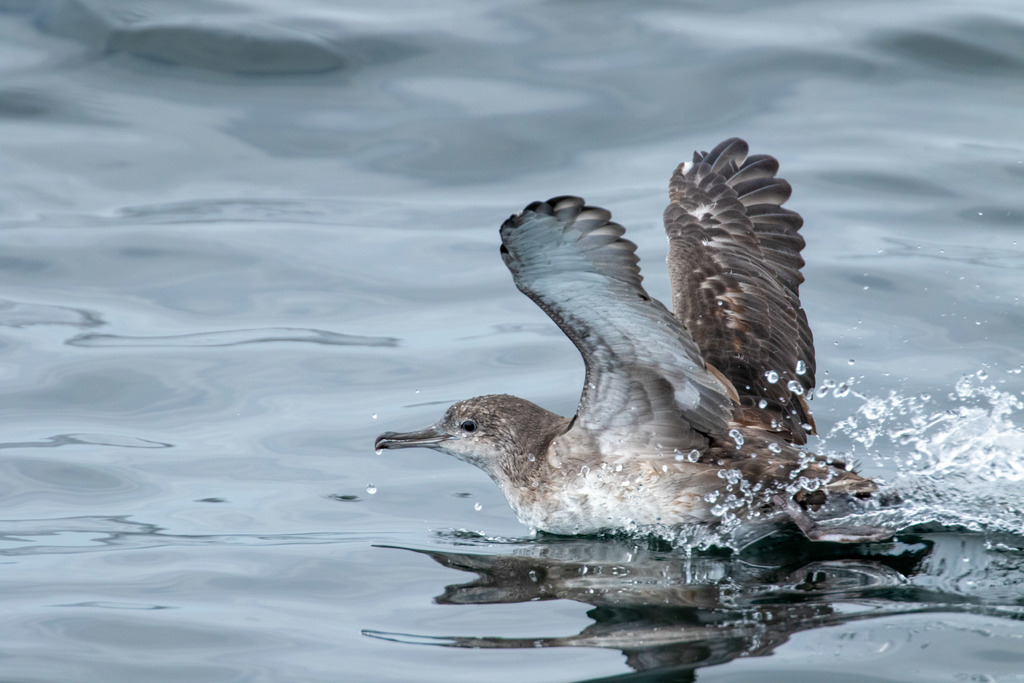
Balearic Shearwater
Photo © Thibaud Aronson
Photo © Thibaud Aronson — CC BY-SA 4.0 — Source: iNaturalist photo #152270171Identification
The Balearic shearwater is a medium-sized seabird measuring 34–39 cm in length with a wingspan of 78–90 cm. It is best identified by its characteristic "shearing" flight pattern: the bird dips from side to side on stiff wings with minimal wingbeats, its wingtips nearly touching the water as it travels low over the sea. In flight, it resembles a flying cross, with wings held at right angles to the body. The plumage shifts dramatically in appearance as the bird moves—dark brown upperparts and paler undersides are alternately exposed, creating a striking contrast between dark and dirty white as it skims the waves.
Apart from its less contrasting plumage, the Balearic shearwater closely resembles the Manx and yelkouan shearwaters found elsewhere in the Mediterranean. Indeed, genetic studies suggest very little difference between the Balearic and yelkouan shearwaters. For reliable field identification, a combination of morphological characteristics and careful observation is recommended, particularly given the overlap in their ranges and the existence of mixed breeding colonies.
Range & Habitat
This species breeds exclusively on islands and coastal cliffs in the Balearic Islands. While most populations winter in the same waters, some birds venture into the Atlantic in late summer, occasionally reaching as far north as Great Britain and Ireland. The Balearic shearwater has a distinctly Mediterranean focus, though its winter range overlaps with the yelkouan shearwater across the Central Mediterranean.
Behaviour & Diet
The Balearic shearwater is a highly gregarious species, often encountered in large numbers when observed from boats or coastal headlands, particularly during autumn. At sea, these birds remain silent, but their breeding colonies transform dramatically after dark—the night air comes alive with raucous cackling calls that are higher-pitched than those of the Manx shearwater. The species nests in burrows and caves, visiting these sites only under the cover of darkness to avoid predation by large gulls.
Balearic shearwaters feed primarily on fish and molluscs. Unlike some seabird species, they do not follow boats, making them less habituated to human vessels than certain other shearwater species.
Best Time & Places to See It
Autumn is the prime season for observing Balearic shearwaters in large numbers. The Balearic Islands themselves are the core location for this species, where they can be observed from boats and headlands throughout their range. Late summer, when some individuals venture into Atlantic waters, offers opportunities to see them further north, including off the coasts of Great Britain and Ireland for those willing to travel.
Photography Tips
Photographing Balearic shearwaters from a boat or coastal vantage point during autumn will yield the best opportunities to capture their distinctive flight. Their low, rapid movement over the water and rapid wing dips present a dynamic challenge. Position yourself to capture the characteristic cross-like silhouette and the alternating exposure of dark and pale plumage as they bank and turn. Dawn observations at breeding colonies may reveal birds returning from feeding, though these must be conducted respectfully to avoid disturbance. The species' critically endangered status demands that all observation be carried out with conservation ethics paramount.
Serra D’Irta Natural Park
Alcossebre, Spain
+122 birds+13 mammals
Where Mediterranean limestone cliffs meet the Balearic Sea, Serra d'Irta unfolds as a tapestry of dramatic coastal terrain and diverse terrestrial habitats. This Category 5 protected…
VIEW NATURAL PARKS’Albufera Natural Park
Platja de Muro, Spain
+253 birds+6 mammals
Where Mediterranean lagoons meet the Balearic coast, S'Albufera stretches across nearly 1,600 hectares of wetland and dune systems that rank among Europe's most ecologically vital shallow-water…
VIEW NATURAL PARKCap de Ferrutx Nature Reserve
Artà, Spain
+41 birds
Steep limestone cliffs plunge toward the sapphire Mediterranean at Cap de Ferrutx, where the northeastern tip of Mallorca meets the sea in a landscape carved by…
VIEW NATURE RESERVEL’Albufera Natural Park
València, Spain
+321 birds+18 mammals
Where shallow lagoons meet Mediterranean coastal marshland, L'Albufera Nature Park unfolds as one of Spain's most vital wetland complexes. This protected landscape, designated under IUCN Category…
VIEW NATURAL PARKDoñana National Park
Hinojos, Spain
+300 birds+13 mammals
Where the Guadalquivir River delta spreads into the Atlantic, vast marshes, cork woodlands, and coastal dunes converge to create one of southwestern Europe's most biodiverse wetland…
VIEW NATIONAL PARKPembrokeshire Coast National Park
Pembrokeshire, United Kingdom
+250 birds+41 mammals
Where the Cambrian coastline meets the Celtic Sea, cliff-top moorland and hidden coves define a landscape carved by 300 million years of geological drama. Pembrokeshire Coast…
VIEW NATIONAL PARKNorth York Moors National Park
North Yorkshire, United Kingdom
+234 birds+32 mammals
Across the high moorlands of North Yorkshire, where heather and bilberry sprawl beneath vast skies, the landscape rises and falls in gentle undulation—a patchwork of open…
VIEW NATIONAL PARKSouth Downs National Park
Chichester, United Kingdom
+298 birds+45 mammals
Chalk downland ridges rise and fall across the South Downs, their open grasslands and beech hangers creating a mosaic of habitats that has shaped human settlement…
VIEW NATIONAL PARKCabo de Gata-Níjar Natural Park
San José, Spain
+274 birds+11 mammals
Where volcanic ridges plunge toward the Mediterranean, Cabo de Gata-Níjar Nature Park unfolds across one of Europe's most arid coastlines, a landscape sculpted by tectonic violence…
VIEW NATURAL PARKPenínsula de Llevant Natural Park
Betlem, Spain
+79 birds+1 mammals
Where low limestone hills descend toward crystalline Mediterranean waters, the Península de Llevant Nature Park unfolds as a tapestry of drylands, scrubland, and rocky coves that…
VIEW NATURAL PARKParcial C Marina de les Medes Nature Reserve
Torroella de Montgrí, Spain
+93 birds
Where the Costa Brava's limestone cliffs plunge into crystalline Mediterranean waters, the Parcial C section of Marina de les Medes Nature Reserve protects one of Catalonia's…
VIEW NATURE RESERVEDelta de l’Ebre Natural Park
Eucaliptus, Spain
+341 birds+18 mammals
Where the Ebro River spreads into a vast labyrinth of shallow lagoons, reed beds, and brackish marshes before surrendering to the Mediterranean, one of southern Europe's…
VIEW NATURAL PARKCap de Creus Natural Park
Roses, Spain
+245 birds+23 mammals
Where the Pyrenees tumble into the Mediterranean, Cap de Creus Nature Park unfolds across 300 square kilometres of one of northeastern Spain's most dramatic coastal wilderness…
VIEW NATURAL PARKParc del Garraf
Rat-Penat, Spain
+190 birds+15 mammals
Where limestone ridges rise abruptly from the Mediterranean coastal plain, Parc Natural del Garraf unfolds across 319 square kilometers of one of Catalonia's most dramatic protected…
VIEW NATURAL PARKEspacio Natural Remolar-Filipinas
El Prat del Llobregat, Spain
+297 birds+7 mammals
Where the Llobregat River delta meets the Mediterranean, a patchwork of salt marshes, reed beds, and shallow lagoons creates one of Catalonia's most dynamic wetland ecosystems.…
VIEW NATURE RESERVECamargue Regional Nature Park
Saintes-Maries-de-la-Mer, France
+378 birds+48 mammals
Where the Rhône Delta sprawls into the Mediterranean, a landscape of stark and haunting beauty emerges—vast salt marshes punctuated by shallow lagoons, reed beds, and scrubland…
VIEW NATURAL PARKEstrecho Natural Park
Pedro Valiente, Spain
+281 birds+20 mammals
Where Mediterranean pine forests meet wind-sculpted coastal cliffs, one of Europe's most dynamic ecological crossroads unfolds across the Strait of Gibraltar. Spanning 686 square kilometers of…
VIEW NATURAL PARKSkomer Island
Haverfordwest, United Kingdom
+177 birds+5 mammals
Where the Irish Sea crashes against the Welsh coast, wind-scoured cliffs rise dramatically from churning waters, creating one of Britain's most pristine island sanctuaries. Skomer Island's…
VIEW ISLAND & ARCHIPELAGOCabo Peñas
Susacasa, Spain
+303 birds+21 mammals
Where sea cliffs rise sheer from the Bay of Biscay, Susacasa's observation point commands one of Asturias's most dramatic coastal vistas. The landscape here is defined…
VIEW OBSERVATION POINTCalanques National Park
Bouches-du-Rhône, France
+233 birds+42 mammals
Where limestone cliffs plunge dramatically into crystalline Mediterranean waters, Calanques National Park preserves one of Europe's most striking coastal landscapes. These steep-sided inlets, carved by erosion…
VIEW NATIONAL PARKNo community photos yet. Log in to add the first one.
No community observations of this species yet.