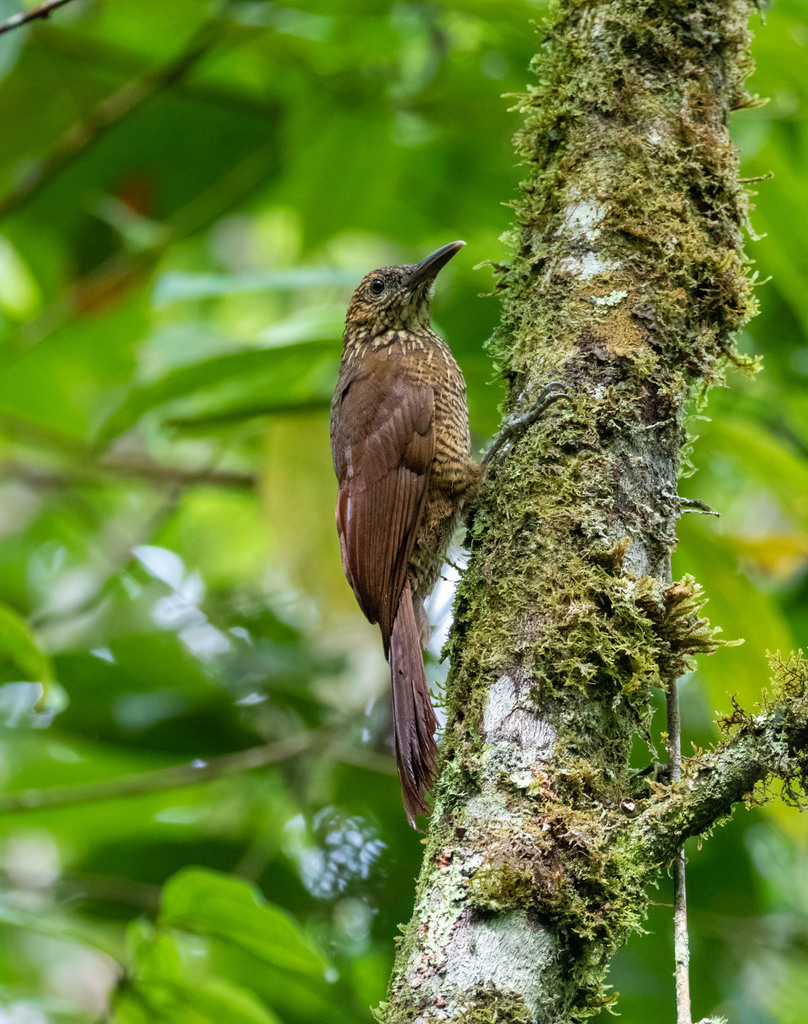
Black-banded Woodcreeper
Photo © Thibaud Aronson
Photo © Thibaud Aronson — CC BY-SA 4.0 — Source: iNaturalist photo #109942085Identification
The black-banded woodcreeper is one of the larger members of its subfamily, measuring 24 to 30.5 cm in length. It is a slim bird with a long tail and medium-length straight bill. The nominate subspecies displays a dusky face and neck with buffy to tawny streaks, a dark brown crown and nape with buff streaks, and an olive-brown back with fine pale streaks and faint dark bars. The rump, wings, and tail are rufous-chestnut. The underparts feature a whitish to buff throat, an olive-brown breast with bold buff streaks, and buffy-brown belly and flanks with strong black barring. The bill is black with lighter edges, the iris dark brown, and legs greenish-gray to brown. Sexes are identical in plumage. Ten subspecies are recognized, showing considerable variation across their range, from the "spot-throated" groups in Central America to the "pale-billed" populations in southern South America.
Range & Habitat
This species is found discontinuously from Chiapas, Mexico, through Central America to Panama, and across every mainland South American country except Chile and Uruguay. Different subspecies occupy distinct regions: northern populations range through Guatemala, Honduras, Nicaragua, and into the Colombian highlands, while Amazonian forms inhabit the western, northern, and lower Amazon Basin. Southern populations reach into Bolivia, Paraguay, and northwestern Argentina. The black-banded woodcreeper inhabits a remarkably wide variety of forested landscapes, demonstrating considerable ecological flexibility across its vast range.
Behaviour & Diet
As a member of the woodcreeper family, this species is an active forager that systematically searches tree trunks and branches for food. Like other dendrocolaptines, it employs its stiffened tail feathers as a prop while climbing vertically or spiraling around tree trunks in typical woodcreeper fashion. Its long, straight bill is well-adapted for gleaning arthropods from bark crevices and probing into wood. The species typically forages on larger trees and appears to show flexibility in its foraging behavior and habitat use across different regions of its range.
Best Time & Places to See It
The black-banded woodcreeper's wide distribution across multiple habitat types and elevations means that opportunities to observe it vary considerably by location. The nominate subspecies occurs in the northern Amazon Basin, while other populations can be found in montane forests from Mexico to Argentina. Birders should focus on forested areas appropriate to their target subspecies, searching tree trunks and major branches where the bird characteristically forages. Early morning hours typically offer the best viewing conditions for active woodcreepers.
Photography Tips
Photographing this species requires patience and careful positioning. Position yourself to observe tree trunks and larger branches where the bird forages, as it moves predictably while climbing. The bird's dark plumage with intricate streaking and barring demands careful exposure metering to retain detail in both light and dark areas. Use a fast shutter speed to freeze movement as the bird climbs and spirals around trunks. The long tail and climbing posture can provide dynamic compositional opportunities; include part of the tree trunk to emphasize the species' characteristic foraging behavior. Early morning light is ideal for revealing the subtle pattern variations among subspecies.
Amacayacu National Park
Bahuaja Sonene National Park
Baru Volcano National Park
Braulio Carrillo National Park
Calilegua National Park
El Rey National Park
El Tamá National Park
French Guiana Amazonian Park
Guácharos Cave National Natural Park
Nothing matches these filters.
No community photos yet. Log in to add the first one.
No community observations of this species yet.