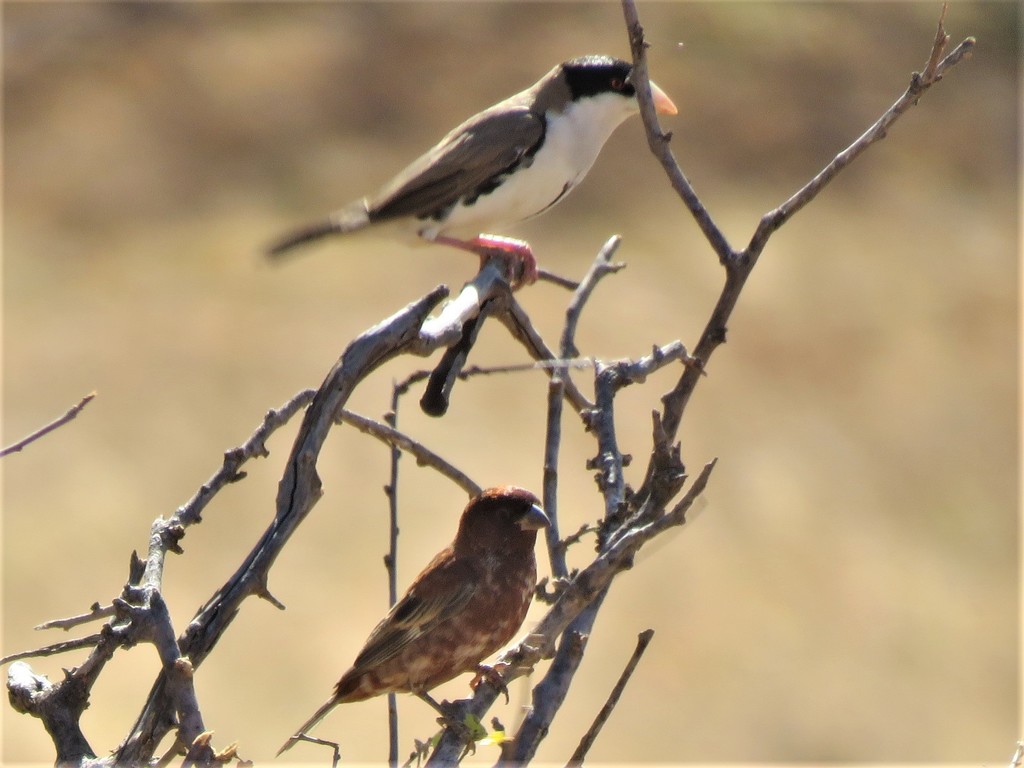
Black-capped Social Weaver
Photo © Annika Lindqvist
Photo © Annika Lindqvist — CC BY 4.0 — Source: iNaturalist #31831163The black-capped social weaver (Pseudonigrita cabanisi) is a sparrow-like species of bird that has been assigned to the weaverbird family. It was originally described by Fisher and Reichenow, and later re-classified by the latter to the genus Pseudonigrita. Adults have a large black cap, ivory-colored bill, red eyes, brown back and wings, blackish-brown tail, white throat and underparts with a black midline, and dark horn-colored legs. It breeds in colonies and roofed nests with an entrance at the bottom in thorny trees such as acacias are constructed by the male from grass stems. It is found in parts of Ethiopia, Kenya, Somalia, and Tanzania. It is sometimes kept and bred in captivity. == Taxonomy and systematics == In 1884, the black-capped social weaver was first described by German East-Africa explorer Gustav Fischer and German ornithologist Anton Reichenow as Nigrita cabanisi, based on a specimen collected in 1883 by Fischer in the Pare Mountains. In 1903, Reichenow assigned the species to his newly erected genus Pseudonigrita, because he considered P. arnaudi and P. cabanisi related to weaverbirds (Ploceidae), while the other species Nigrita bicolor, N. canicapillus, N. fusconota and N. luteifrons are negrofinches assigned to the estrildid finches. In 1942, Hans…
Arusha National Park
Tanzania
+555 birds+16 mammals
Where the slopes of Mount Mawenzi rise above the Arusha region, a compact yet ecologically rich national park unfolds across montane forest, moorland, and alpine zones.…
VIEW NATIONAL PARKTsavo East National Park
Athi ward, Kenya
+468 birds+50 mammals
Across the semi-arid lowlands of southeastern Kenya, where acacia woodland fragments into scrubland and the landscape rolls toward the Indian Ocean horizon, lies one of Africa's…
VIEW NATIONAL PARKTsavo West National Park
Mwatate, Kenya
+513 birds+49 mammals
Where volcanic ridges and weathered lava flows meet the semi-arid lowlands of south-central Kenya, Tsavo West National Park unfolds across a landscape sculpted by fire and…
VIEW NATIONAL PARKAmboseli National Park
Etonet/Lenkism ward, Kenya
+501 birds+43 mammals
Where the Amboseli basin opens toward the Tanzanian frontier, a shallow alkaline lake mirrors vast skies across one of East Africa's most iconic savanna landscapes. The…
VIEW NATIONAL PARKTarangire National Park
Tanzania
+527 birds+50 mammals
Acacia woodland and grassland sweep across the Manyara Region where the Tarangire River carves through low hills and volcanic soils, creating one of East Africa's most…
VIEW NATIONAL PARKNgorongoro Conservation Area
Tanzania
+626 birds+55 mammals
Volcanic calderas and open grassland dominate this high plateau in northern Tanzania, where the landscape rises above 2,000 metres and ancient geological forces have shaped both…
VIEW WILDLIFE MANAGEMENT AREAYabelo Wildlife Sanctuary
Bedewera, Ethiopia
+359 birds+5 mammals
Where acacia woodlands meet volcanic plateaus in southern Ethiopia, a landscape of austere beauty unfolds across nearly 2,500 square kilometers. Yabelo Wildlife Sanctuary sprawls across semi-arid…
VIEW WILDLIFE SANCTUARYMeru National Park
Igembe Central, Kenya
+408 birds+38 mammals
Granite outcrops and acacia woodland rise across the northern reaches of Meru, where semi-arid savanna transitions into drier scrubland under the fierce equatorial sun. The park's…
VIEW NATIONAL PARKSamburu National Reserve
Samburu, Kenya
+430 birds+42 mammals
Across the arid plains of northern Kenya, where scattered acacia woodland gives way to rocky outcrops and dry riverbeds, Samburu National Park unfolds as one of…
VIEW NATURE RESERVENo community photos yet. Log in to add the first one.
No community observations of this species yet.