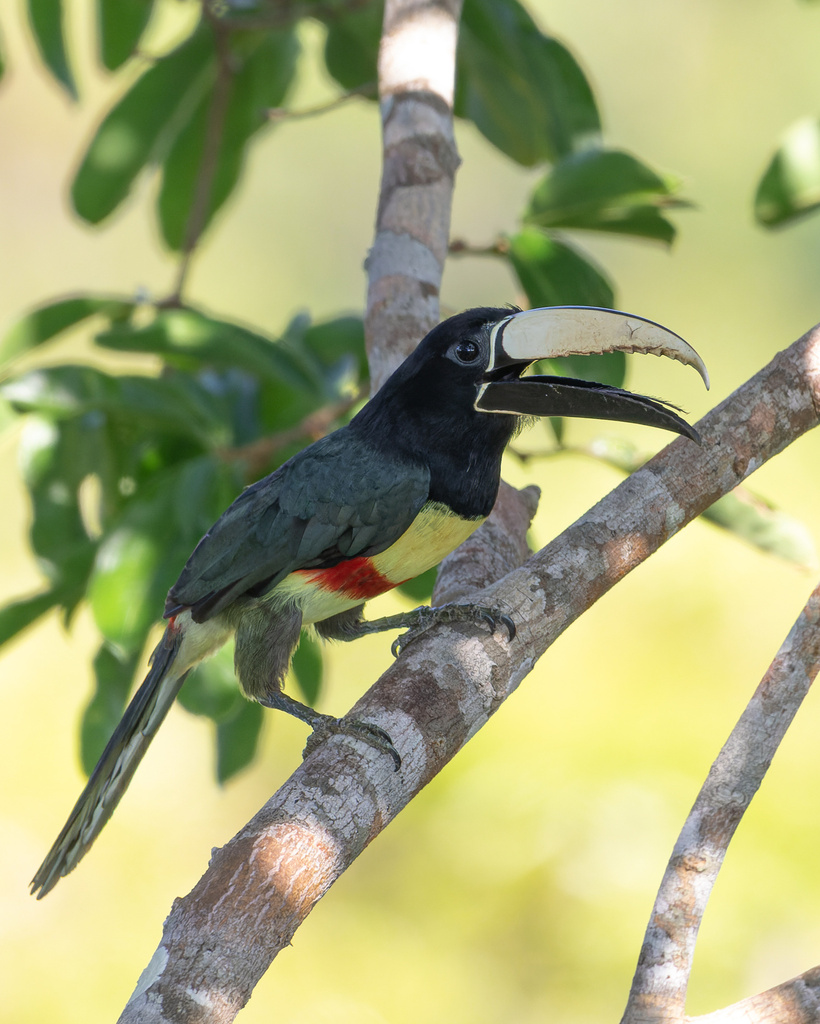
Black-necked Aracari
Photo © Paulo Mascaretti
Photo © Paulo Mascaretti — CC0 1.0 — Source: iNaturalist photo #226262268Identification
The black-necked aracari is a medium-sized toucan measuring 43 to 46 cm in length and weighing 177 to 325 grams. It is immediately recognizable by its distinctive plumage pattern: adults of the nominate subspecies display a black head, neck, and throat contrasting sharply with bright yellow underparts and a striking red band across the lower breast. The back is predominantly green with a conspicuous red rump. Males and females are identical in plumage, though females have slightly shorter bills. The bill itself is a striking feature—ivory-colored on the upper mandible with a black culmen and base, contrasting with a fully black lower mandible; a vertical white line marks the bill's base. The eye is encircled by blue-gray to black bare skin. Immature birds are duller, with sootier black and green plumage, paler red and yellow markings, and a browner bill lacking the distinctive basal white line.
Three recognized subspecies show subtle variation. Subspecies atricollis (found in Venezuela and the Guianas) has a wider brown stripe on the culmen and red-brown rather than black ear coverts. Subspecies wiedii (southeastern Brazil) displays chestnut coloring on the ear coverts, chin, and upper throat. These differences may be noted by keen-eyed birders comparing populations across the species' range.
Range & Habitat
The black-necked aracari is found across northern South America, with three subspecies occupying distinct but sometimes overlapping ranges. Subspecies atricollis inhabits eastern Venezuela, the Guianas, and northern Brazil north of the Amazon River and east of the Rio Negro. The nominate subspecies occurs in three separate populations within Brazil: a large area south of the Amazon between the Rio Madeira and Rio Maranhão extending southward to Mato Grosso and Goiás; populations in far-eastern Pernambuco and Alagoas; and southeastern populations in Minas Gerais and Espírito Santo. Subspecies wiedii ranges through southeastern Brazil from the range of the nominate southward to Paraná and Santa Catarina.
The species is highly adaptable, inhabiting a wide variety of semi-open landscapes including forest edges and clearings, wet forests, sand-ridge forests, secondary growth, woodlands, cerrado, gallery forests in savanna, and even fruit tree plantations. It primarily occurs at elevations from sea level to approximately 600 meters, though it reaches higher elevations in Venezuela and the southeastern portion of its range.
Behaviour & Diet
Black-necked aracaris are year-round residents throughout their range and are highly social, foraging in flocks of up to six birds—likely extended family groups—in the forest's upper levels and canopy. They are primarily frugivorous, feeding on fruits and playing an important ecological role as seed dispersers for fruit trees. However, their diet is supplemented with insects, and they have been observed predating nestling birds. Their vocal repertoire includes a common call described as "'tsee-eet' to 'sneet'" with variations extending to longer "tseeeeeee-it" calls, as well as a rattled 'bdd-dddit' that may be vocal or produced by bill-rattling.
The breeding season extends from November to August in most of the range, though in southern populations it occurs from September to February. They nest in tree cavities created either by woodpeckers or by broken branches, laying clutches of two to four eggs. Both parents share incubation duties, which last 16 to 17 days, and both care for young until fledging at approximately 23 days after hatching.
Best Time & Places to See It
The black-necked aracari is relatively common in many areas and is reliably found in several protected areas throughout its range. It is a year-round resident, making it possible to observe the species in any season, though local breeding activity may concentrate birds in specific locations from November to August depending on the region. The species' preference for semi-open habitats and forest edges makes it more accessible than many rainforest toucans. Forest edges, gallery forests, and areas with fruiting trees in cerrado habitats offer good viewing opportunities. The species' social nature—traveling in small flocks—increases the likelihood of encountering groups once one bird is located.
Photography Tips
The black-necked aracari's striking color pattern and moderate size make it an excellent photographic subject. The bird's foraging habit of moving through the upper canopy and edges means positioning yourself at appropriate heights or seeking vantage points overlooking fruiting trees will maximize photographic opportunities. Early morning activity is typically most productive. The bird's bold yellow and red underparts contrasting with its black head and green back photograph beautifully in good light, and the intricate bill pattern—with its ivory maxilla and basal white line—rewards close-focus work. Since birds often travel in small flocks, patience and attention to call notes will help you locate and follow groups. The bird's relatively common status and preference for semi-open habitats means photography opportunities are generally more predictable than for many other toucan species.
Tijuca National Park
Brazil
+317 birds+13 mammals
Where the Atlantic forest rises steeply from Rio de Janeiro's urban edge, Tijuca National Park encompasses a landscape of dramatic granite peaks, cascading waterfalls, and closed-canopy…
VIEW NATIONAL PARKViruá National Park
Brazil
+389 birds+6 mammals
Across the northern frontier of Roraima, where the forest canopy rises from ancient Amazonian lowlands, Viruá National Park protects nearly 3,700 square kilometres of terra firme…
VIEW NATIONAL PARKPau Brasil National Park
Brazil
+211 birds
Tropical Atlantic forest cloaks the rolling terrain of northeastern Bahia, where Pau Brasil National Park protects nearly 390 square kilometers of one of Brazil's most biodiverse…
VIEW NATIONAL PARKAmazônia National Park
Brazil
+439 birds+6 mammals
Where the Rio Amazonas and its tributaries weave through the heart of Pará state, a vast tapestry of rainforest stretches across 23,611 square kilometers of unbroken…
VIEW NATIONAL PARKJaú National Park
Brazil
+354 birds+3 mammals
Vast floodplain forests and blackwater rivers define this remote corner of western Amazonas, where the Rio Negro and its tributaries have carved an intricate mosaic of…
VIEW NATIONAL PARKAnavilhanas National Park
Brazil
+468 birds+8 mammals
Across the Rio Negro in central Amazonas, an archipelago of over a thousand islands rises from the world's largest rainforest river system, creating a labyrinth of…
VIEW NATIONAL PARKNo community photos yet. Log in to add the first one.
No community observations of this species yet.