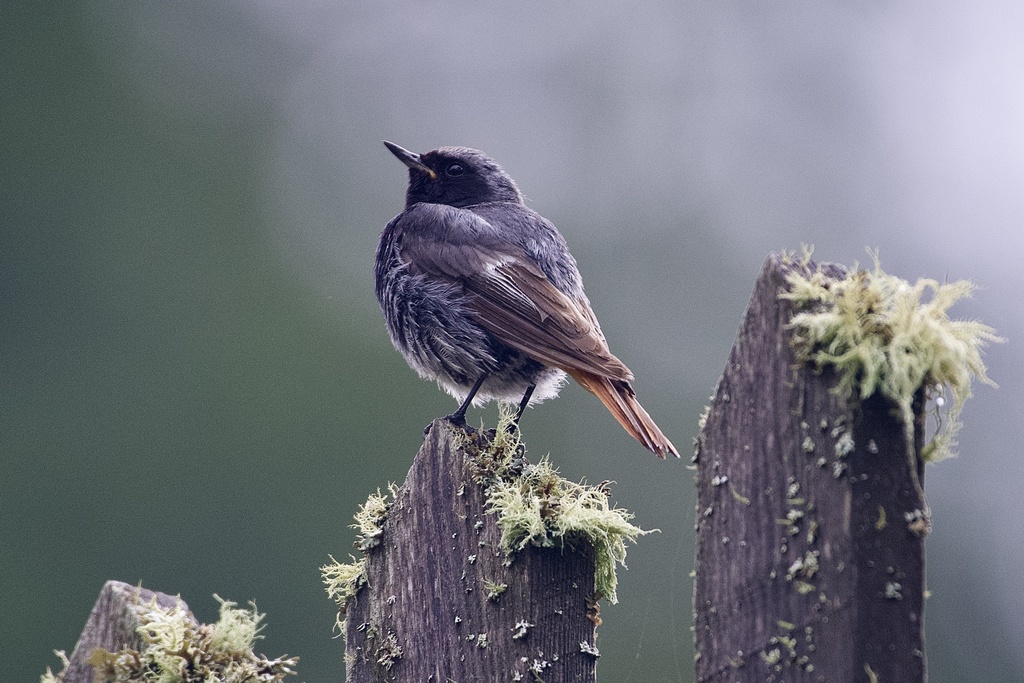
Black Redstart
Photo © Dario Taraborelli
Photo © Dario Taraborelli — CC0 1.0 — Source: iNaturalist photo #146649651Identification
The black redstart is a small passerine measuring 13–14.5 cm in length, similar in size to the common redstart. The most striking feature is the distinctive orange-red lower rump and tail, which contrasts sharply with the bird's darker plumage. Adult males are overall dark grey to black on the upperparts with a black breast, while females are grey to grey-brown overall, always retaining the orange-red lower rump and tail. A useful distinguishing feature is the grey axillaries and underwing coverts, which differ from the buff to orange-red underwing of the common redstart. Western subspecies males display a pale whitish panel on the wings formed by pale fringes on the secondaries, while eastern subspecies lack this feature, appearing all blackish on the wings.
Range & Habitat
The black redstart is a widespread breeder across rocky habitats throughout Eurasia and North Africa, from the British Isles and western Europe south to Morocco, and east to central China. Birds inhabiting the milder parts of this vast range are resident year-round, while those breeding in northern and eastern regions migrate seasonally. The species shows considerable geographic variation, with multiple subspecies distributed across distinct regions, from western European populations to eastern Asian forms extending into Mongolia and the Himalaya.
Behaviour & Diet
As a member of the Old World flycatcher family, the black redstart is an insectivorous bird, though specific details of its foraging behaviour and dietary preferences are not extensively documented in available sources. The species is adapted to rocky terrain and displays the characteristic behaviour typical of redstarts, though it differs markedly from the common redstart in ecological requirements and behaviour—differences significant enough that the two European species, despite occasionally producing apparently fertile hybrids, remain distinct in the field.
Best Time & Places to See It
Timing and location depend on which population you wish to observe. Resident birds in milder parts of Europe, North Africa, and western Asia can be seen year-round in suitable rocky habitats. For migratory northern and eastern populations, breeding season offers the best opportunities. The species is local in parts of its range, including the British Isles, so checking regional bird reports beforehand is advisable. Rocky outcrops, cliffs, and similar terrain throughout its Eurasian and North African range offer the most reliable viewing opportunities.
Photography Tips
The orange-red tail is the key feature to capture, as it provides striking contrast and is diagnostic for the species. The pale wing panel visible on western subspecies males is also worth documenting. Position yourself in rocky habitats during calm, clear conditions when the bird is most active. The dark plumage of males can be challenging to expose correctly—ensure sufficient light to reveal detail in the black and dark grey areas without losing the vibrant orange-red of the tail. Female and juvenile birds, being greyer and less contrasty, require careful exposure metering to show their subtle field marks clearly.
Abruzzo, Lazio and Molise National Park
Aggtelek National Park
Al Hoceima National Park
Alta Murgia National Park
Altai Tavan Bogd National Park
Altun Mountain National Nature Reserve
Appennino Lucano Val d’Agri Lagonegrese National Park
Appennino Tosco-Emiliano National Park
Asinara National Park
Nothing matches these filters.
No community observations of this species yet.