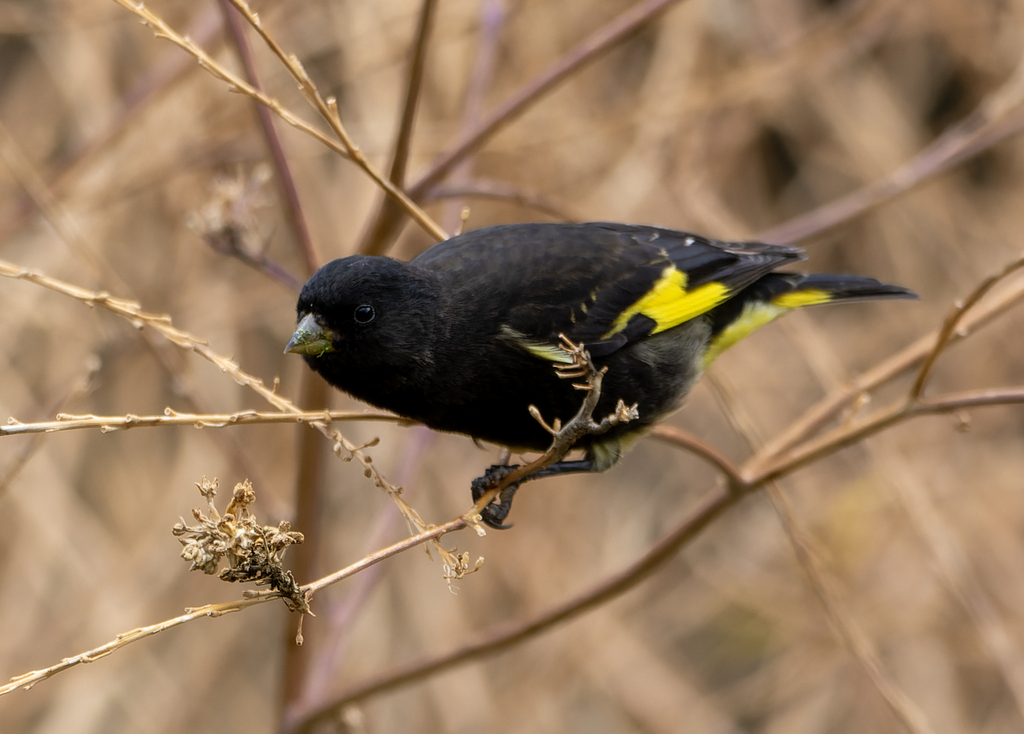
Black Siskin
Photo © David F. Belmonte
Photo © David F. Belmonte — CC BY 4.0 — Source: iNaturalist photo #589148669Identification
The black siskin is a small finch, measuring 12 to 13 cm in length and weighing approximately 15 to 17 grams. Males are almost entirely glossy black, with striking bright yellow markings: the sides of the tail feathers, the tips of the wing coverts, wide bands across the flight feathers, and the vent and undertail coverts are all bright yellow. Females are slightly browner than males, with paler yellow markings and variable underparts that range from yellow to dark-mottled breast and flanks. Juveniles resemble females but are duller and browner overall. Both sexes have black irises, dark horn maxillas, lighter horn mandibles, and dark brown or blackish-brown legs and feet. Where ranges overlap in Bolivia, the black siskin can be confused with the yellow-rumped siskin, which requires careful attention to plumage details for accurate identification.
Range & Habitat
The black siskin inhabits the Andes mountain range, found in Argentina, Bolivia, Chile, and Peru. Its range extends from eastern Ancash and western Huánuco departments in north-central Peru southward through western Bolivia to northern Chile's Antofagasta Region and west-central Argentina's Mendoza Province. The species occupies elevations between 1,800 and 4,800 meters overall, though in Peru it is found between 3,500 and 4,700 meters.
This species is characteristic of puna and Altiplano biomes, preferring rocky hillsides, crags, and gullies with grasses, cushion plants, and scattered shrubs and scrub. It also frequents woodland edges, cultivated areas, and human-inhabited regions, making it adaptable to various high-altitude habitats across its range.
Behaviour & Diet
The black siskin is primarily a seed-eater, foraging on the ground and in low vegetation. During breeding season, it feeds in pairs and small flocks, but after breeding it congregates in larger flocks that may include other siskin species. The species is generally a year-round resident, though some individuals move to lower elevations following the breeding season.
The black siskin's breeding season appears to span at least November to April, though many details of its breeding biology remain undocumented. Its song is not well known but resembles that of the yellow-rumped siskin. The species sings from elevated perches atop bushes or trees and also during flight. Its calls, typically given in flight, include "a descending tew, chew, and a hew-li?"
Best Time & Places to See It
The black siskin is considered uncommon to locally common throughout its range, and uncommon to fairly common in Peru. Its year-round residency means it can be encountered in its high-altitude habitat at any season, though larger flocks congregate after the breeding season, potentially offering better viewing opportunities. The species' preference for rocky hillsides and gullies in puna and Altiplano environments means targeting these habitat types will maximize encounter rates.
Photography Tips
Photographing the black siskin requires patience and attention to subtle plumage details. Males' glossy black plumage with contrasting bright yellow markings provide excellent photographic subjects, particularly when backlighting catches the yellow patches. Females and juveniles demand more careful exposure management due to their browner tones. Early morning light on high-altitude ridges and hillsides will best render the species' coloration. Watch for feeding flocks on the ground and in low vegetation, and listen for flight calls to locate active birds. The species' habit of singing from exposed perches offers additional opportunities for clear photographs.
Huascarán National Park
Independencia, Peru
+201 birds+5 mammals
Where granite peaks pierce the Andean sky above 6,000 metres, Huascarán National Park sprawls across more than 11,500 square kilometres of Peru's Cordillera Blanca, a landscape…
VIEW NATIONAL PARKSalar del Huasco National Park
Pica, Chile
+75 birds+2 mammals
High above the Atacama's shimmering flats, where the Andes grip the sky, lies a landscape of stark geological drama and surprising biological richness. Salar del Huasco…
VIEW NATIONAL PARKLauca National Park
Putre, Chile
+139 birds+17 mammals
Where the Andes rise toward the altiplano in Chile's far north, Lauca National Park sprawls across more than 3,000 square kilometres of some of South America's…
VIEW NATIONAL PARKReserva Nacional las Vicuñas
Putre, Chile
+87 birds+6 mammals
High desert plateaus interlace with volcanic ridges across this 4,204-square-kilometre expanse at the border between Chile and Bolivia, where altitudes exceed 3,500 metres and the climate…
VIEW NATIONAL PARKSalar de Surire Natural Monument
Putre, Chile
+61 birds
High across the Altiplano of northern Chile, where the Andes push toward 4,300 metres and the air thins to a crystalline clarity, lies a vast shallow…
VIEW NATURAL MONUMENTLos Cardones National Park
Argentina
+193 birds+6 mammals
Where the Andes descend into northwestern Argentina, Los Cardones National Park sprawls across nearly 1,200 square kilometres of one of South America's most distinctive high-altitude desert…
VIEW NATIONAL PARKNo community photos yet. Log in to add the first one.
No community observations of this species yet.