Identification
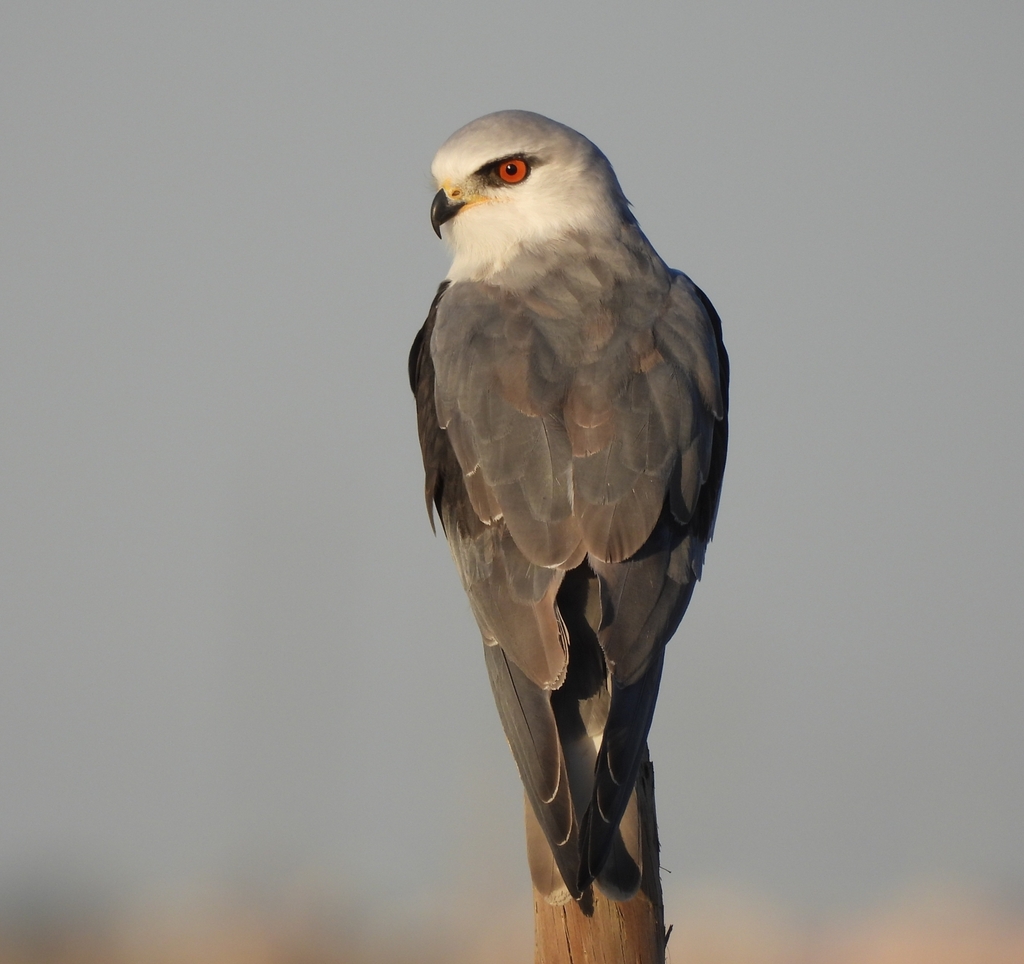
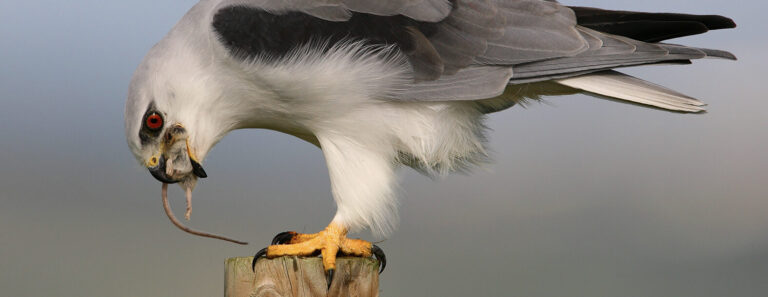
The black-winged kite is a distinctive small raptor with long falcon-like wings that extend beyond the tail when perched. Its plumage is predominantly grey or white with striking black shoulder patches, wing tips, and an eye stripe. In flight, the short, square tail is clearly visible and is notably not forked, distinguishing it from typical kites. The most arresting feature is its large forward-facing eyes with red irises positioned beneath a bony shelf—an owl-like characteristic unique among diurnal raptors. The sexes are alike in plumage, and when perched, often on roadside wires, they frequently adjust their wings and jerk their tails up and down in a characteristic balancing motion.
Range & Habitat
The black-winged kite is primarily a species of open land and semi-deserts across sub-Saharan Africa and tropical Asia. Three subspecies are recognized: the nominate caeruleus in southwest Iberia, Africa and Arabia; vociferus across Pakistan to east China, the Malay Peninsula and Indochina; and hypoleucus in the Greater and Lesser Sunda Islands, Philippines, Sulawesi and New Guinea. Although mainly found on plains, they occur at higher altitudes in Asian hill regions. Remarkably, the species has expanded its range northward in southern Europe, with established populations in Spain and Portugal and vagrants recorded as far north as Switzerland and England.
Behaviour & Diet
The black-winged kite is best known for its hovering behaviour over open grasslands, similar to kestrels. They are not migratory but show nomadism in response to weather and food availability. They are superbly adapted to exploit periodic rodent population upsurges and can raise multiple broods in a single year—an exceptional ability among birds of prey. Breeding occurs at different times across their range, though they appear not to breed in April and May in India. Males establish and defend territories with noisy courtship involving chases. Pairs nest in loose twig platforms where three or four pale creamy eggs spotted with deep red are laid. Both parents incubate the eggs, and males contribute significantly to foraging once chicks hatch.
Best Time & Places to See It
Open grasslands and semi-desert regions offer the best opportunities for sighting this kite. In Europe, Spain and Portugal now support established populations, with range expansion ongoing in southern regions. Across Africa and tropical Asia, plains habitats are most productive. The species shows nomadic movements in response to rodent population cycles, so timing visits to coincide with rodent peaks may increase sighting chances. In some parts of their range such as the Western Ghats, they are winter visitors, making this season particularly productive for observation.
Photography Tips
The black-winged kite's hovering hunting behaviour provides excellent photography opportunities—watch for birds suspended over open grassland, where their distinctive silhouette and contrasting plumage are clearly visible. Their habit of perching conspicuously on roadside wires allows for close approach and detailed shots of their remarkable owl-like forward-facing eyes and red irises. The long wings and relatively short square tail are key diagnostic features to capture. Early morning when they are most active for hunting and light conditions are optimal provides the best window for photography in their preferred open habitats.