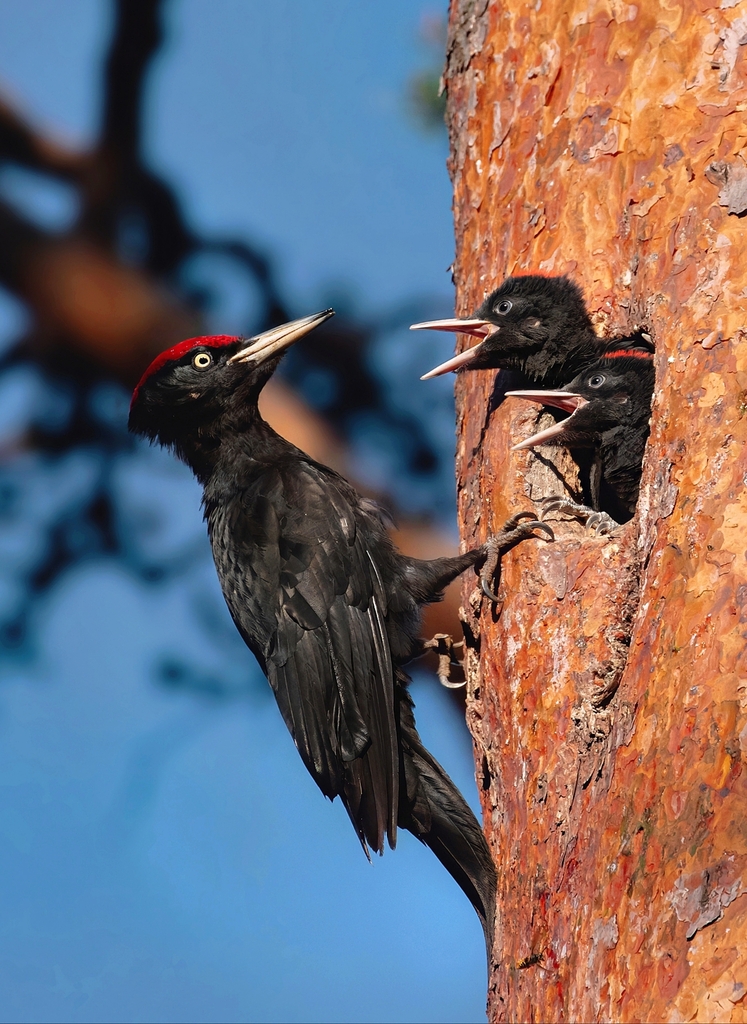
Black Woodpecker
Photo © Олеся
Photo © Олеся — CC BY 4.0 — Source: iNaturalist photo #514114015Identification
The black woodpecker is unmistakably the largest woodpecker in Europe and across much of Asia, measuring 45 to 55 cm long with a wingspan of 64 to 84 cm. Its plumage is entirely black except for a striking red crown—in males the entire crown is red, while females show red only on the top of the hindcrown. The bird's piercing yellow eyes, crow-like proportions, and powerful 5 to 6.7 cm bill are instantly recognizable. Juveniles are similar but less glossy, with duller red crowns and paler grey throats.
The black woodpecker's voice is distinctive: a loud, high-pitched kree-kree-kree call delivered in short bursts, or a screech-like shrill in flight. Unlike other woodpeckers, it flies with slow, unsteady-seeming wing beats and its head held high rather than in the typical dipping, bounding pattern. The combination of massive size, all-black plumage, and vibrant red crown makes confusion with other species unlikely.
Range & Habitat
The black woodpecker is distributed across the northern Palearctic, with its range expanding. It spreads eastward from Spain across all of continental Europe (excluding Great Britain, Ireland, and northernmost Scandinavia) and extends through parts of Asia including Korea, Japan, China, and the Middle East (Iran and Kazakhstan). The southern limits are Spain and Italy, though vagrants have been recorded in Portugal. The species is noticeably absent from the British Isles, though approximately 80 sightings have been reported there.
This woodpecker is mainly found in forested regions, preferring extensive mature woodland including coniferous, boreal, and subtropical forests. It occurs throughout mountainous and lowland forests at elevations between 100 and 2,400 meters. During the non-breeding season it may visit marginal woods near human habitations. The species is non-migratory and requires old-growth forest or large forest stands for residence.
Behaviour & Diet
The black woodpecker's diet consists almost entirely of carpenter ants, which it extracts by hammering dead trees with its powerful bill. Its large size and great physical power allow it to access prey deep within tree trunks—an advantage unavailable to smaller woodpecker species. The bird possesses specially adapted neck muscles, short stumpy legs, long sharp claws, and very stiff tail feathers that position it perfectly for this demanding work.
For nesting, the bird typically selects a tree with fungal disease such as heart rot, though it will sometimes use a living, healthy tree. The female lays a single clutch of two to eight eggs (average four to six) in a nest hole—usually excavated in a live poplar or pine tree—where the breeding pair take turns incubating. The large cavities created by black woodpeckers provide essential nesting and shelter sites for numerous other bird and mammal species, earning it the designation of "keystone" species in many of its habitats. The woodpecker also helps protect forests by controlling populations of wood-boring insects.
Best Time & Places to See It
The black woodpecker is non-migratory, so it can potentially be seen year-round throughout its range. The species is most likely to be encountered in extensive, mature forests across continental Europe from Spain eastward, and in suitable forest habitats across parts of Asia. During the non-breeding season, birds may venture into marginal woods closer to human habitations, potentially improving sighting opportunities. Mountainous and lowland forests between 100 and 2,400 meters elevation all offer possibilities.
Look for this species in old-growth or large forest stands with dead or partially diseased trees—the habitat it requires and where it spends most of its time foraging and nesting. Listen for its distinctive loud, high-pitched kree-kree-kree calls or screech-like shrill, which can alert you to the bird's presence before visual contact.
Photography Tips
The black woodpecker's large size, bold all-black plumage, and vivid red crown make it a striking photographic subject. Position yourself in mature forest habitat where you may locate birds foraging on dead trees or accessing nesting sites. The bird's distinctive flight with slow, unsteady-seeming wing beats and raised head differs markedly from other woodpeckers, offering an opportunity to capture characteristic behavior in flight.
The piercing yellow eyes and contrast between black plumage and red crown provide excellent compositional elements. Early mornings when the bird is most active may yield the best light and behavioral opportunities. Patient observation near old nesting sites or trees bearing the characteristic large rectangular cavities the species creates increases your chances of an encounter with this impressive, crow-sized woodpecker.
The Classic Tour – 3 hours – all year round
Nothing matches these filters.
Aggtelek National Park
Alpilles Regional Nature Park
Åsnens National Park
Aspromonte National Park
Avesnois Regional Nature Park
Baikal National Park
Baima Snow Mountain National Nature Reserve
Baronnies Provençales Regional Nature Park
Bavarian Forest National Park
Nothing matches these filters.
No community photos yet. Log in to add the first one.