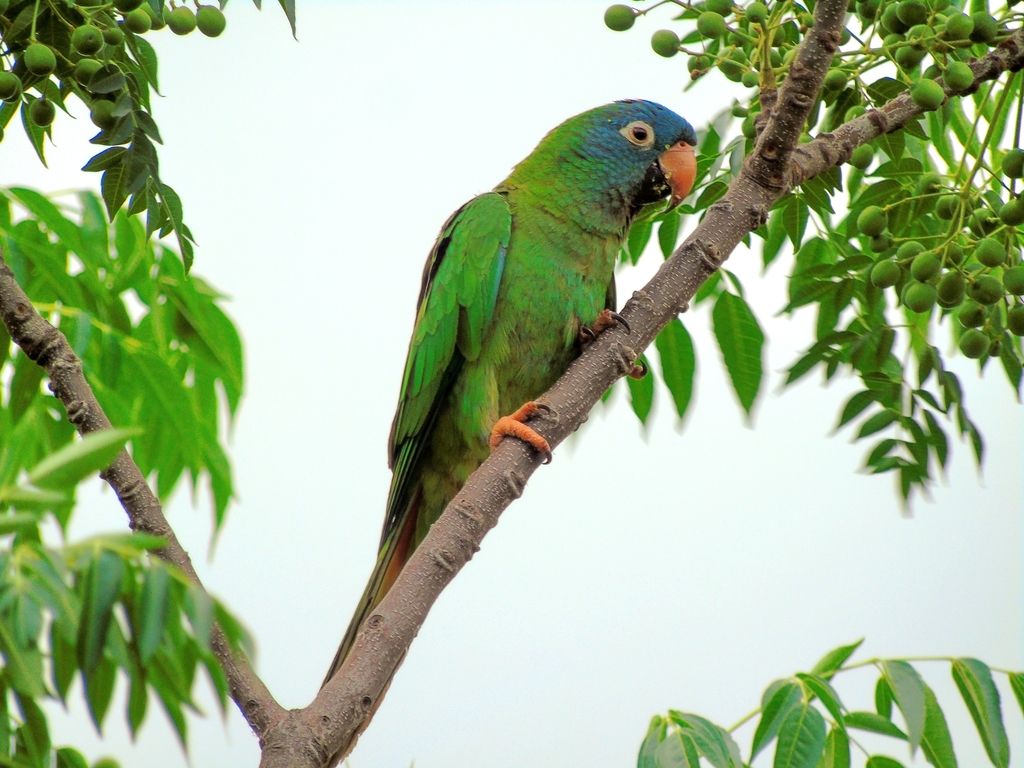
Blue-crowned Parakeet
Photo © Sol Quipildor
Photo © Sol Quipildor — CC BY 4.0 — Source: iNaturalist photo #452047394Identification
The blue-crowned parakeet is a medium-sized parrot measuring approximately 37 cm (14.5 inches) in length and weighing between 140 and 190 grams. Despite its common name, the species is predominantly green, with distinctive dull blue coloring on the forehead, crown, cheeks, and ears in the nominate subspecies, though blue markings are less pronounced in other subspecies. A characteristic ring of white featherless skin surrounds each eye, though this appears bright orange-yellow in the neumanni subspecies found in the wild. The breast feathers may be tinged with blue but are typically green to yellow-green. When extended, the wings reveal blue-brown coloring that becomes chestnut on the outer flight feathers, while the tail feathers display green on top and maroon to red-brown underneath, iridescencing to bright orange and scarlet under full-spectrum light. The bird sports a distinctive pale, horn-colored upper mandible that tapers to a needle-sharp, grey-black tip. Legs are pink-brown with grey-brown claws.
Range & Habitat
The blue-crowned parakeet is a Neotropical species native to large parts of South America, ranging from eastern Colombia through to Curaçao in the southern Caribbean, and extending south to the northern regions of Argentina. The species demonstrates a preference for savanna-like habitats, woodland areas, and forest margins, deliberately avoiding the dense humid forests characteristic of the Amazon basin. This habitat preference makes them more accessible to birdwatchers and photographers across their range compared to species confined to deep forest interiors.
Behaviour & Diet
Blue-crowned parakeets are notably social birds with considerable intelligence and energy. In captivity, they have earned a reputation as relatively good talkers compared to other conures, and they are known for their vocal abilities—both their capacity for mimicry and their tendency to be loud. The species exhibits strong pair bonds and breeding behavior centered on tree cavities, where females typically lay three to four white eggs. Incubation lasts approximately 26 days, with chicks fledging around 52 days after hatching.
Best Time & Places to See It
Given their widespread distribution across savanna, woodland, and forest margin habitats from Colombia to northern Argentina, blue-crowned parakeets are likely to be encountered throughout their range in open and semi-open country. Their preference for accessible woodland and savanna habitats rather than dense forest makes them more observable than many parrot species. Local guides in their South American range can direct travelers to known feeding and roosting areas where these vocal birds are regularly spotted.
Photography Tips
The blue-crowned parakeet's predominantly green plumage requires careful exposure management to avoid underexposure in dappled woodland light. The striking blue head markings and the iridescent red-orange underside of the tail provide excellent photographic subjects, particularly when extended in flight or during display. The bright eye-ring provides useful compositional contrast. Early morning and late afternoon light will best reveal the iridescence in the tail feathers. Patient observers waiting near fruiting trees or water sources in their woodland habitat will have excellent opportunities for photography, as these social birds are often active and vocal in small flocks.
Everglades National Park
Monroe County, United States
+345 birds+22 mammals
Where freshwater marsh meets subtropical sky, the Everglades sprawls across southwestern Florida as one of North America's most expansive wetland ecosystems. Spanning over 13,000 square kilometers,…
VIEW NATIONAL PARKNatural Bahía Portete Kaurrele National Park
Colombia
+80 birds
Where the Caribbean coast of La Guajira rises to meet arid scrubland and seasonal wetlands, Natural Bahía Portete Kaurrele National Park spans 251 square kilometres of…
VIEW NATIONAL PARKNatural Sierra de la Macarena National Park
Vista Hermosa, Colombia
+566 birds+15 mammals
Across nearly 20,000 square kilometres of Colombia's Meta Department, the terrain rises from lowland savanna into Andean foothills through a mosaic of gallery forests, palm-fringed wetlands,…
VIEW NATIONAL PARKChapada dos Guimarães National Park
Brazil
+450 birds+1 mammals
Where weathered sandstone plateaus rise above the cerrado grasslands of central Brazil, Chapada dos Guimarães National Park protects 624 square kilometres of ecological transition zone that…
VIEW NATIONAL PARKPantanal Matogrossense National Park
Brazil
+322 birds+17 mammals
Where the flooded forests of central Brazil meet vast seasonally inundated grasslands, Pantanal Matogrossense National Park sprawls across nearly 2,900 square kilometers of one of the…
VIEW NATIONAL PARKEspacio Natural Remolar-Filipinas
El Prat del Llobregat, Spain
+297 birds+7 mammals
Where the Llobregat River delta meets the Mediterranean, a patchwork of salt marshes, reed beds, and shallow lagoons creates one of Catalonia's most dynamic wetland ecosystems.…
VIEW NATURE RESERVERío Pilcomayo National Park
Argentina
+271 birds+13 mammals
Where the Río Pilcomayo cuts through northeastern Argentina's subtropical lowlands, a sprawling mosaic of wetlands, grasslands, and seasonally flooded forests creates one of South America's most…
VIEW NATIONAL PARKEl Rey National Park
Municipio de Las Lajitas, Argentina
+317 birds+4 mammals
Where the eastern slopes of the Andes descend into northwestern Argentina's subtropical transition zone, El Rey National Park unfolds across 841 square kilometers of dramatically varied…
VIEW NATIONAL PARKCalilegua National Park
Municipio de Calilegua, Argentina
+288 birds+8 mammals
Where the eastern Andean slopes plunge into northwestern Argentina's humid subtropics, nearly 2,645 square kilometers of steep terrain and luxuriant forest compose one of South America's…
VIEW NATIONAL PARKSierra de las Quijadas National Park
Argentina
+168 birds+5 mammals
Sandstone cliffs and deeply incised canyons define this 1,137-square-kilometre expanse in San Luis Province, where the dry Chacoan landscape of central Argentina reveals an unexpected ecological…
VIEW NATIONAL PARKParque Provincial Pampa del Indio
Laguna Limpia, Argentina
+231 birds+4 mammals
Across the flat horizons of Chaco Province, where the Paraná River system spills into vast wetlands and grasslands, Parque Provincial Pampa del Indio protects one of…
VIEW NATURE RESERVEChaco National Park
Municipio de Presidencia de la Plaza, Argentina
+258 birds+7 mammals
Across the humid subtropical lowlands of northeastern Argentina, where the Paraná River basin feeds vast seasonal wetlands and gallery forests, Chaco National Park protects one of…
VIEW NATIONAL PARKMerritt Island National Wildlife Refuge
Brevard County, United States
+341 birds+19 mammals
Brackish marshes and palmetto scrub define this wildlife sanctuary spanning the coastal lowlands of central Florida, where the Atlantic tide meets freshwater systems in a dynamic…
VIEW WILDLIFE SANCTUARYPelican Island National Wildlife Refuge
Windsor, United States
+265 birds+4 mammals
Where Florida's Indian River widens into a brackish estuary, a small island sanctuary commands the attention of waterbirds across the Atlantic Flyway. Pelican Island National Wildlife…
VIEW WILDLIFE SANCTUARYNo community photos yet. Log in to add the first one.
No community observations of this species yet.