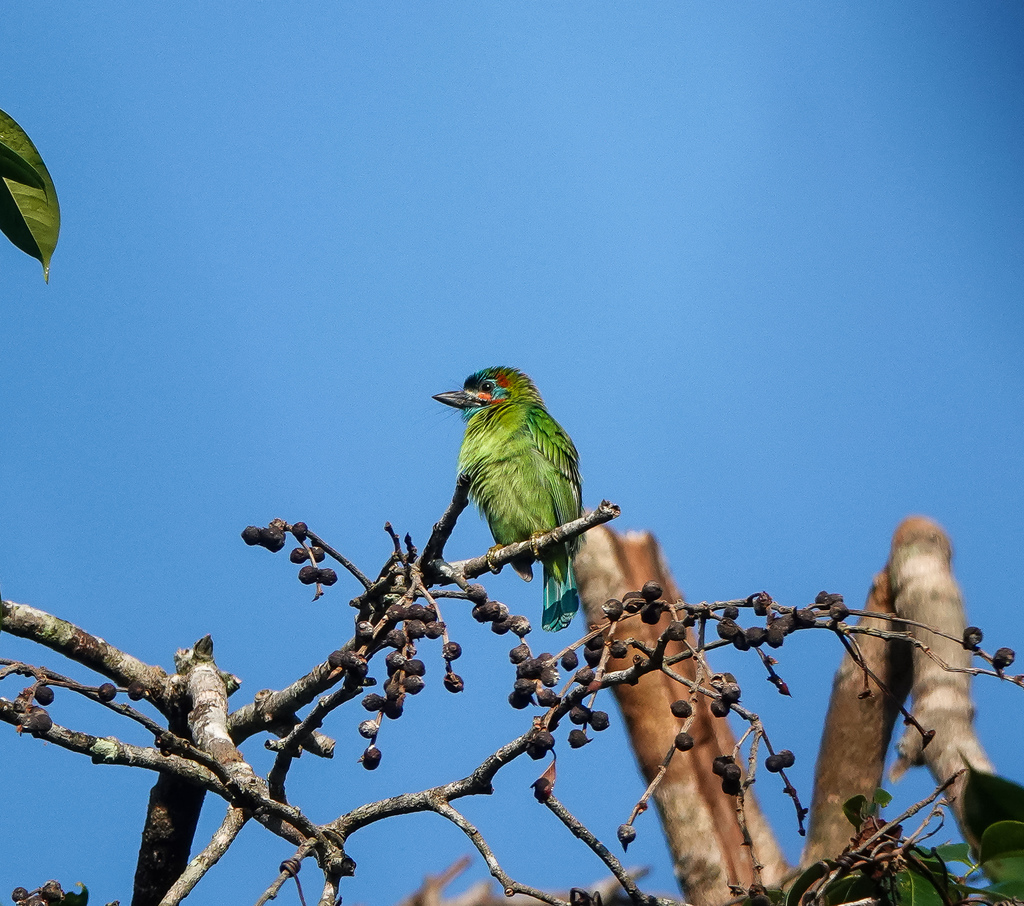
Blue-eared Barbet
Photo © Rejoice Gassah
Photo © Rejoice Gassah — CC BY 4.0 — Source: iNaturalist #110643569Identification
The blue-eared barbet is a compact, plump bird measuring 16–17 cm in length, with the stocky build characteristic of barbets: a short neck, large head, and short tail. Its most striking features are its verditer-blue throat and ear-coverts, which contrast beautifully with its predominantly green plumage. Crimson-coloured spots adorn the cheeks, and a distinctive black band runs between the throat and breast. The bill is dark.
Sexual and age-related differences are worth noting for field identification. Adult males display a black forehead, while females have a duller head pattern with a more orange tint to the patches above and below the ear-coverts. Juveniles show a green head with some blue on the ear-coverts and throat. The species is vocal, with the male's territorial call being a repeated loud ko-turr, and other calls including a distinctive "policeman whistle" sound.
Range & Habitat
The blue-eared barbet is a resident breeder across mainland Southeast Asia, with its range extending from eastern Nepal through northeast India to southern Thailand and Indochina. This wide distribution and stable population have resulted in its classification as Least Concern on the IUCN Red List. Three subspecies are recognized: P. c. cyanotis from southeastern Nepal, Bangladesh and northeastern India to Myanmar, northern Thailand and southern China; P. c. orientalis from eastern Thailand to Cambodia, Laos and Vietnam; and P. c. stuarti from peninsular Thailand.
The species favours shrublands and forests, typically found at elevations up to 1,600 metres. It is a cavity-nester, excavating or using existing tree cavities for breeding.
Behaviour & Diet
Like other barbets, the blue-eared barbet is a resident species that maintains territories year-round. The male advertises and defends its territory through vocalization, producing its characteristic loud ko-turr call repeatedly. These vocal displays, along with the species' distinctive "policeman whistle" calls, make it relatively easy to locate by ear in suitable habitat.
As a cavity-nesting species, the blue-eared barbet relies on tree holes for breeding, though specific details about its diet and foraging behaviour are not extensively documented in available sources.
Best Time & Places to See It
The blue-eared barbet's wide distribution across mainland Southeast Asia offers multiple opportunities for observation. Its range encompasses areas from the hills of eastern Nepal and northeast India westward through Myanmar, northern Thailand, Laos, Cambodia, and Vietnam to peninsular Thailand. The species' status as a permanent resident means it can be encountered throughout the year in suitable habitat.
Birders and wildlife travellers should focus on shrubland and forest areas at elevations up to 1,600 metres. The bird's vocal nature—particularly the loud territorial call of males—makes it easier to locate by listening carefully in appropriate habitat.
Photography Tips
The blue-eared barbet's compact size, vibrant colouring, and bold facial markings make it an attractive photographic subject. The contrast between its green plumage, blue ear-coverts and throat, and crimson cheek spots provides excellent colour composition opportunities. Its relatively short tail and sturdy posture mean it often presents well-proportioned subjects in frame.
Since the species is vocal and territorial, patient observers who locate birds by their distinctive ko-turr calls will have better opportunities for photography. Early morning sessions in suitable forest and shrubland habitat offer optimal lighting conditions for capturing the bird's vivid colouration.
Phou Khao Khouay National Protected Area
Thaphabath District, Thailand
+113 birds
Where the Annamite Mountains descend into central Thailand's monsoon forests, Phou Khao Khouay National Protected Area sprawls across rugged limestone terrain interlaced with river valleys and…
VIEW NATIONAL PARKHat Noppharat Thara-Mu Ko Phi Phi National Park
Ao Nang, Thailand
+253 birds+9 mammals
Where limestone karsts rise dramatically from turquoise waters, Hat Noppharat Thara-Mu Ko Phi Phi National Park unfolds across a mosaic of beach, mangrove forest, and island…
VIEW NATIONAL PARKKhao Yai National Park
Prachantakham District, Thailand
+377 birds+46 mammals
Evergreen dipterocarp forest blankets the rolling terrain of this national park in eastern Thailand, where limestone hills rise abruptly from the forest floor and seasonal streams…
VIEW NATIONAL PARKKhao Laem Ya-Mu Ko Samet National Park
Mueang Rayong District, Thailand
+159 birds+3 mammals
Where limestone hills meet the Gulf of Thailand, Khao Laem Ya–Mu Ko Samet National Park stitches together a mosaic of terrestrial and marine worlds that few…
VIEW NATIONAL PARKKhao Laem National Park
Sangkhla Buri District, Thailand
+197 birds
Where the Vajiralongkorn Reservoir sprawls across the forested valleys of Kanchanaburi's northern borderlands, Khao Laem National Park protects a landscape where limestone ridges rise dramatically from…
VIEW NATIONAL PARKKaziranga National Park
Kohora, India
+422 birds+26 mammals
Dawn breaks over the floodplains of the Brahmaputra, where tall grasslands stretch endlessly beneath monsoon-heavy skies. This sprawling wilderness of northeastern Assam is a mosaic of…
VIEW NATIONAL PARKXishuangbanna National Nature Reserve
Xishuangbanna Dai Autonomous Prefecture, China
+173 birds+2 mammals
Where subtropical monsoon forests meet the margins of the Yunnan plateau, Xishuangbanna National Nature Reserve sprawls across a landscape of dramatic relief—deep river valleys carved by…
VIEW NATURE RESERVEGaoligong Mountain National Nature Reserve
Nujiang Lisu Autonomous Prefecture, China
+443 birds+13 mammals
VIEW NATURE RESERVENo community photos yet. Log in to add the first one.
No community observations of this species yet.