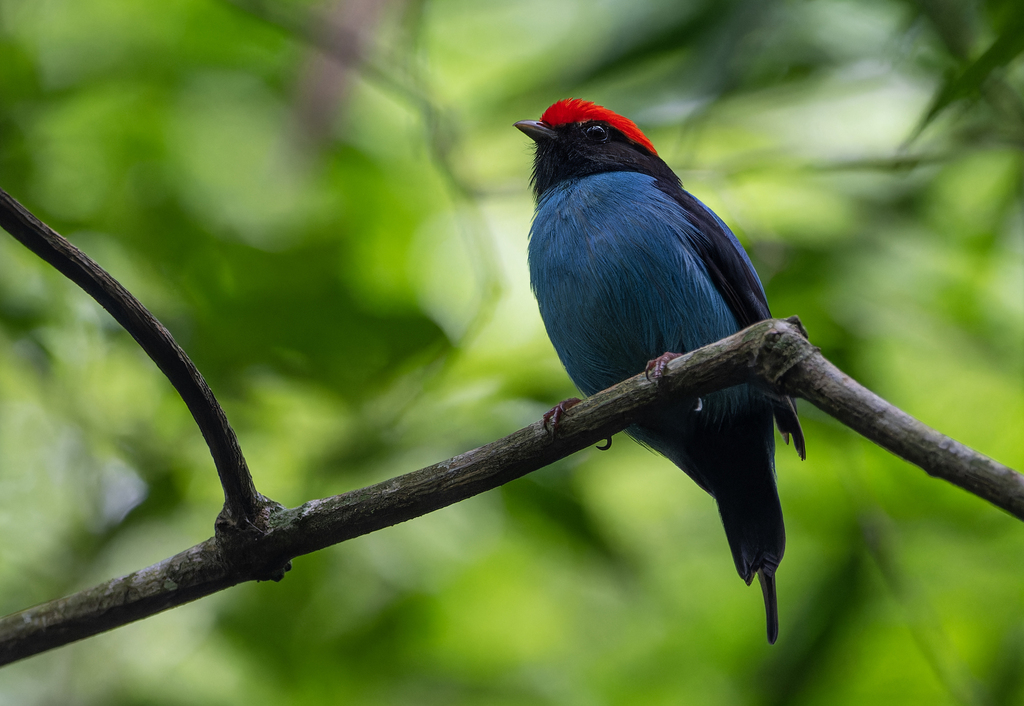
Blue Manakin
Photo © David F. Belmonte
Photo © David F. Belmonte — CC BY 4.0 — Source: iNaturalist photo #446171536Identification
The blue manakin is a small, sparrow-sized bird measuring around 15 cm in length and weighing approximately 25.6 g, making it among the largest members of the diminutive manakin family. The striking male is unmistakable: his entire body gleams bright blue, contrasting sharply with a jet-black head, wings, and tail, topped by a brilliant red crown. Both sexes possess elongated central tail feathers. The female presents a much duller appearance, displaying greenish-brown plumage overall. Juvenile males resemble females initially, gradually acquiring the red crown first, followed by black facial markings, and finally the full adult male plumage.
Range & Habitat
This species is endemic to southeastern South America, found throughout the Atlantic Forest region of southeastern Brazil, eastern Paraguay, and far northeastern Argentina. It thrives in subtropical and tropical moist lowland forests, montane forests at various elevations, and even in heavily degraded former forest areas. The species is generally common within appropriate habitats throughout its range. Males establish small territories of around 100 m², with one to five males per territory typically consisting of one alpha male, one beta male, and a few gamma males. Within each territory, four to six horizontal display perches—vines, branches, or lianas positioned approximately one meter above ground—serve as performance stages.
Behaviour & Diet
Blue manakins are famous for their elaborate lek system and coordinated display behaviour. Males gather at traditional arenas where they sing and perform distinctive "dances" to attract females. The alpha and beta males actively maintain their display perches, removing moss, leaves, and twigs to expose bright white surfaces that enhance their visual appeal. The species exhibits pronounced hypergamous behaviour, with females strongly preferring particular males; consequently, up to 90% of male blue manakins never successfully mate, a remarkable reproductive skew typical of lekking species.
Best Time & Places to See It
The blue manakin is a common resident throughout the Atlantic Forest of southeastern Brazil, eastern Paraguay, and northeastern Argentina. Since it is not migratory and maintains stable populations year-round, this species can be encountered at any season within suitable forest habitats. The most productive approach is to locate active lek sites during the breeding season, when males are most vocal and visually active in their display performances. Look for the species in moist lowland and montane forests, particularly in areas with well-developed understory vegetation and appropriate display perches.
Photography Tips
The brilliant blue plumage of males offers excellent photographic contrast, particularly when backlit or photographed against dark forest foliage. Position yourself near active lek sites during dawn hours when males are most active. The small size and rapid movements of displaying males demand fast shutter speeds (at least 1/1000th of a second) and a telephoto lens. Exercise patience and use blind or concealed positioning to avoid disturbing displaying birds. Females and juveniles blend remarkably well with foliage, requiring careful scanning and good knowledge of their behaviour to locate successfully. The red crown of males provides a striking focal point for composition.
Araucárias National Park
Campos Gerais National Park
Carlos Botelho State Park
Ibitipoca State Park
Iguaçu National Park
Iguazú National Park
Ilha do Cardoso State Park
Intervales State Park
Itatiaia National Park
Nothing matches these filters.
No community photos yet. Log in to add the first one.
No community observations of this species yet.