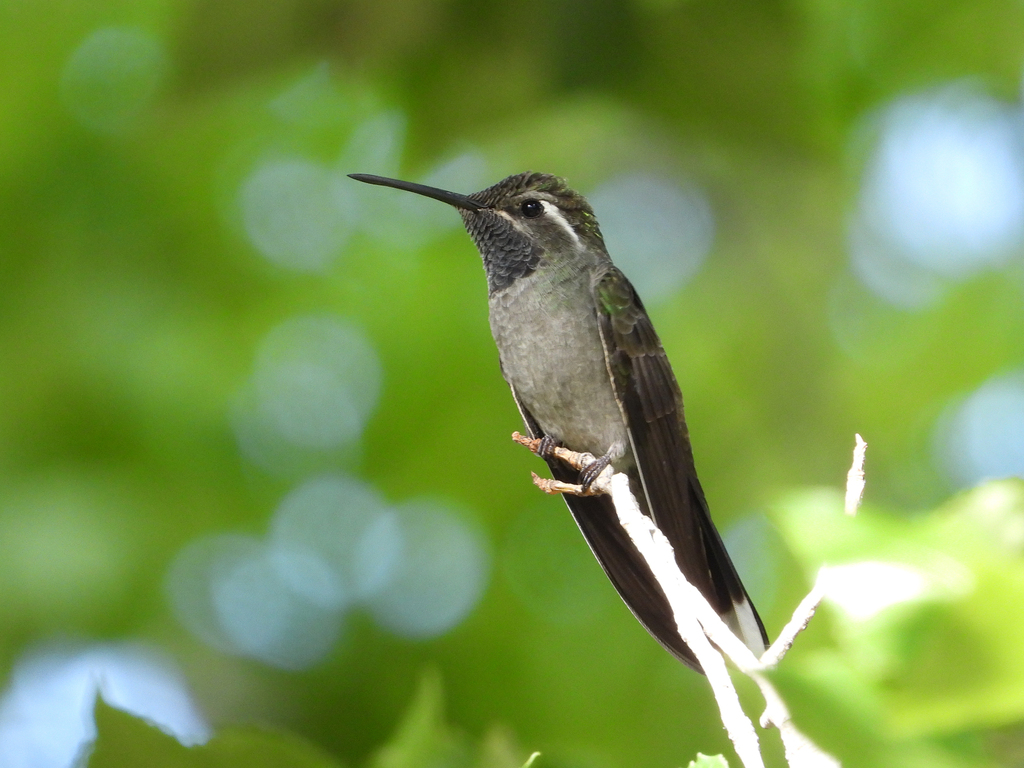
Blue-throated Mountaingem
Photo © James M. Maley
Photo © James M. Maley — CC BY 4.0 — Source: iNaturalist photo #296591906Identification
The blue-throated mountaingem is the largest hummingbird found in the United States, measuring 11.2 to 12.8 cm (4.4 to 5.0 in) long, with males averaging 8.4 g and females 6.8 g. Both sexes are immediately recognizable by a conspicuous white stripe behind the eye and a narrower stripe extending backward from the corner of the bill beneath a blackish cheek patch. Both sexes possess a medium-length black bill, though females' bills are longer than males'.
Adult males display an iridescent cobalt to cerulean blue gorget (throat patch) bordered by a narrow buffy gray margin, making them unmistakable in good light. Females lack the gorget entirely and have medium gray underparts. The bird's upperparts are mostly bright greenish bronze, becoming dark bronzy olive on the rump, with the tail black and tipped white on the outer feathers. Three subspecies exist with subtle variations: the nominate is largest with the longest bill and greenish-bronze upperparts; L. c. phasmorus is smallest with bright green upperparts; and L. c. bessophilus falls between the two in size and coloration.
Range & Habitat
The blue-throated mountaingem is found in the United States and Mexico across a wide elevational range. The nominate subspecies occupies the largest range, extending from Mexico's Sierra Madre Oriental and central plateau south to Oaxaca. The subspecies L. c. bessophilus occurs in southeastern Arizona and northwestern Mexico (Sonora, Chihuahua, and Durango), while L. c. phasmorus breeds in the Chisos Mountains of southern Texas, with its non-breeding range unknown.
This species favors moist forest landscapes across its range. In the US and northern Mexico, it inhabits riparian forests (often in canyons), pine-oak forests, and mixed coniferous forests. Central and southern Mexico populations prefer coniferous forests. In Arizona, it frequents "sky island" mountain ranges, seldom below 1,300 m elevation, while near Mexico City it occurs between 3,600 and 3,900 m, and in Oaxaca between 2,500 and 3,000 m.
Behaviour & Diet
The blue-throated mountaingem is highly migratory in northern populations, with northern subspecies withdrawing south in winter, though exact locations remain unknown. A few individuals overwinter at feeders in southeastern Arizona. Central and southern Mexican populations likely move to lower elevations in winter, though this has not been fully documented.
The species forages for nectar at diverse flowering plants that vary across its range, and is common at sugar-water feeders. It hovers while feeding and may defend patches of large flowers. During breeding season and winter, when flowers are scarce, it supplements its diet with small arthropods captured by hawking in sustained flight or gleaning from bark and foliage. In winter, it also feeds on sap from wells created by the Red-naped sapsucker. Female mountaingems construct nests alone from soft plant fibers cemented with spider silk, camouflaged with moss or lichen, typically attached to tree branches or placed on human-made substrates like wires or nails under eaves. Females incubate two white eggs for 17 to 19 days, with fledging 24 to 26 days after hatching. Two clutches per season are common, and three have been documented.
Best Time & Places to See It
In the United States, southeastern Arizona offers the most reliable opportunities to see this species, particularly in the "sky island" mountain ranges at higher elevations. The Chisos Mountains of southern Texas host L. c. phasmorus during its breeding season. In Mexico, the species occurs widely in suitable montane habitats from the Sierra Madre Oriental south through the central plateau to Oaxaca, with populations withdrawing to lower elevations in winter.
Breeding seasons vary throughout the range but generally extend from February in southern regions (Veracruz) to September in some areas, with Arizona birds beginning egg-laying in mid-April and higher Mexican elevations commencing in late May or June. Sugar-water feeders attract this species readily, making them valuable for observation. Winter months may see birds at lower elevations and at sap wells created by sapsuckers.
Photography Tips
Male blue-throated mountaingems present outstanding photographic opportunities thanks to their iridescent cobalt gorget, which displays brilliantly when backlit or sidelit. Position yourself to capture the gorget's metallic blue iridescence, and include the distinctive white facial stripes for positive identification. The bird's relatively large size for a hummingbird makes it easier to photograph than smaller species.
Since the species is common at sugar-water feeders, establish a feeding station and use high-speed flash or fast shutter speeds (1/2000 sec or faster) to freeze wing beats during hovering. Position feeders against natural backgrounds to isolate your subject and showcase field marks. Early morning and late afternoon provide the best light for capturing the metallic throat patch. In mountain canyon habitats, look for birds along flowering plants near water sources, where morning light often illuminates the gorget spectacularly.
Big Bend National Park
Brewster County, United States
+345 birds+34 mammals
Where the Chisos Mountains rise abruptly from the Sonoran Desert floor, Big Bend National Park spans over 7,300 square kilometers of one of North America's most…
VIEW NATIONAL PARKSaguaro National Park
Rincon Valley, United States
+354 birds+40 mammals
Where the Sonoran Desert meets sky-island mountains, two geographically separated districts of Saguaro National Park sprawl across nearly two thousand square kilometers of Arizona's most iconic…
VIEW NATIONAL PARKCarlsbad Caverns National Park
Eddy County, United States
+309 birds+18 mammals
Beneath the Chihuahuan Desert floor of southern New Mexico lies one of North America's most spectacular subterranean landscapes. Carlsbad Caverns National Park encompasses over 518 square…
VIEW NATIONAL PARKParque Nacional Cerro de la Estrella
Mexico
+126 birds+4 mammals
Where volcanic peaks rise sharply above Mexico City's sprawling metropolis, Parque Nacional Cerro de la Estrella offers a rare glimpse of high-altitude terrain within one of…
VIEW NATIONAL PARKParque Nacional Benito Juárez
San Andrés Huayápam, Mexico
+128 birds+4 mammals
High in the Sierra Madre del Sur of Oaxaca, where cloud forest mingles with pine woodland and the terrain climbs steeply through ravines carved by mountain…
VIEW NATIONAL PARKTutuaca
Tosanachi, Mexico
+147 birds+13 mammals
Where copper canyons plunge deeper than the Grand Canyon itself, Mexico's remote Sierra Madre Occidental unfolds in dramatic vertical relief. Tutuaca anchors this wilderness realm, a…
VIEW PROTECTED LANDSCAPEGuadalupe Mountains National Park
Culberson County, United States
+262 birds+14 mammals
Where fossil-laden limestone ridges thrust skyward above the Chihuahuan Desert floor, Guadalupe Mountains National Park reveals a landscape sculpted by ancient seas and relentless aridity. These…
VIEW NATIONAL PARKNo community photos yet. Log in to add the first one.
No community observations of this species yet.