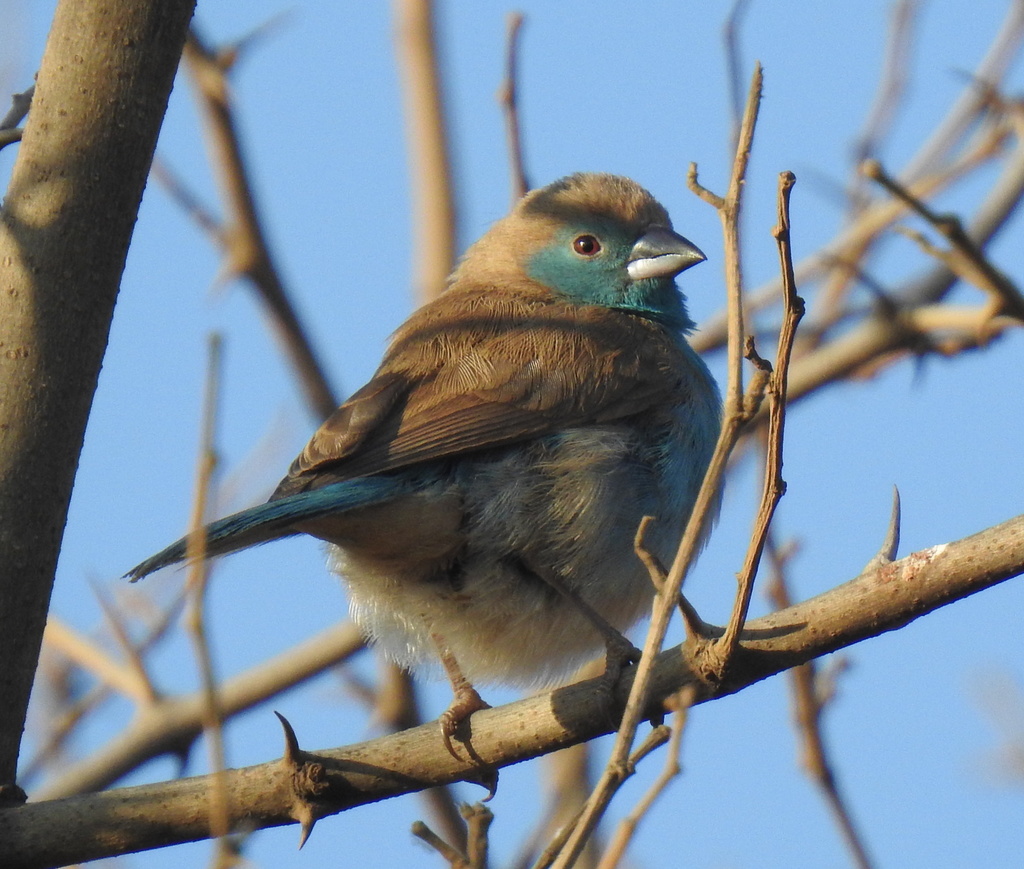
Blue Waxbill
Photo © Matthew Fainman
Photo © Matthew Fainman — CC BY 4.0 — Source: iNaturalist #90542382Identification
The blue waxbill is a small finch measuring 12–13 cm in length, instantly recognizable by its striking powder-blue coloration on the face, breast, rump, and flanks, contrasting with pale brown upperparts. Males are noticeably more vibrant than females, whose blue is confined to the rump, tail, head, and upper breast, with buffy-brown underparts. The soft call—a repeated 'seee-seee'—often betrays the bird's presence as it flits through low vegetation.
Range & Habitat
This common Southern African species has a wide distribution stretching from Cabinda and the Congo in the northwest, east to Kenya and Tanzania, and south to northern South Africa. The species may also occur on São Tomé and Zanzibar, possibly through introduction. Blue waxbills show flexible habitat preferences, favoring well-watered and semi-arid savanna where umbrella thorns grow abundantly, but they readily occupy forest edges, cultivated land with natural growth, and mopane woodland.
Behaviour & Diet
These finches are primarily granivorous, extracting grass seeds directly from inflorescences, supplemented with termites and other insects; they have also been recorded feeding on fallen fruits. Blue waxbills breed year-round, with egg-laying peaking in January following the rains. Both sexes construct distinctive oval nests with side entrance tunnels from grass stems and feathers, typically placing them in bushes or trees—sometimes near wasp nests, possibly to detect the presence of deterrent arboreal ants. Clutches of 2–7 eggs are incubated by both parents for 11–12 days, and chicks fledge after 17–21 days.
Outside breeding season, blue waxbills are normally seen in pairs or small family groups, though they readily form larger flocks that often join mixed feeding assemblies of other estrildid finches.
Best Time & Places to See It
The blue waxbill's year-round presence and common status make it relatively reliable to find throughout its Southern African range. The breeding season, with activity peaking around January in the south, offers excellent opportunities for observing nesting behavior and family parties. Look in semi-arid savanna with umbrella thorns, along forest edges, and in cultivated areas with natural vegetation growth. Early morning visits to known feeding areas will yield the best sightings.
Photography Tips
The blue waxbill's small size and preference for low scrub and bush vegetation present both challenges and opportunities. Position yourself low and use patient, quiet approaches to avoid disturbing feeding birds. Males' vibrant blue plumage photographs beautifully in morning light, particularly when perched on seed heads. Capturing the characteristic side-profile view of the head's blue face markings requires careful positioning. Early morning or late afternoon light will enhance the subtle powder-blue coloration that distinguishes this species from similar finches.
Mapungubwe National Park
Musina Local Municipality, South Africa
+358 birds+29 mammals
Where the Limpopo River cuts through sandstone ridges at the convergence of South Africa, Botswana, and Zimbabwe, Mapungubwe National Park preserves a landscape of profound ecological…
VIEW NATIONAL PARKChobe National Park
Botswana
+446 birds+45 mammals
Where the Chobe River cuts a sinuous path through northern Botswana, the landscape transforms into one of Africa's most dynamic wetland-savanna mosaics. This national park encompasses…
VIEW NATIONAL PARKKhaudum National Park
Botswana
+213 birds+13 mammals
Where the Okavango's northern tributaries meander through miombo woodland and riverine forest, Khaudum National Park unfolds across a landscape of profound ecological richness and isolation. This…
VIEW NATIONAL PARKTarangire National Park
Tanzania
+527 birds+50 mammals
Acacia woodland and grassland sweep across the Manyara Region where the Tarangire River carves through low hills and volcanic soils, creating one of East Africa's most…
VIEW NATIONAL PARKPilanesberg National Park
Moses Kotane Local Municipality, South Africa
+364 birds+49 mammals
Granite peaks and volcanic ridges rise unexpectedly from the savanna floor across this 734-square-kilometre expanse in the North West province, creating a landscape of profound ecological…
VIEW NATIONAL PARKMokala National Park
Siyancuma Local Municipality, South Africa
+246 birds+35 mammals
Across the semi-arid savanna of the Northern Cape, where red earth meets sparse acacia woodland and open grassland punctuated by rocky outcrops, lies a landscape shaped…
VIEW NATIONAL PARKKruger National Park
Ba-Phalaborwa Local Municipality, South Africa
+540 birds+91 mammals
Across the low-lying savanna of northeastern South Africa unfolds one of Africa's largest and most ecologically intact protected areas, where acacia woodlands merge into mopane scrub…
VIEW NATIONAL PARKMountain Zebra National Park
Inxuba Yethemba Local Municipality, South Africa
+265 birds+35 mammals
Across the windswept plateaus and deeply incised valleys of the Eastern Cape's interior, Mountain Zebra National Park unfolds as a landscape of geological drama and ecological…
VIEW NATIONAL PARKAddo Elephant National Park
Sundays River Valley Local Municipality, South Africa
+388 birds+55 mammals
Where the Eastern Cape's semi-arid scrublands meet transitional woodland, Addo sprawls across 13,478 square kilometres of one of southern Africa's most biodiverse landscapes. The terrain rises…
VIEW NATIONAL PARKIthala Game Reserve
uPhongolo Local Municipality, South Africa
+328 birds+26 mammals
Rolling thornbush savanna and acacia woodland dominate the landscape of this 494-square-kilometre national park in KwaZulu-Natal's uPhongolo Local Municipality, where granite outcrops punctuate grassland plateaus and…
VIEW NATIONAL PARKMarakele National Park
Modimolle Local Municipality, South Africa
+341 birds+36 mammals
Granite ridges and sprawling grasslands dominate this 1,176-square-kilometre reserve in Limpopo's heartland, where bushveld transitions between rocky outcrops and open savanna. The park's rugged topography creates…
VIEW NATIONAL PARKKhaudum National Park
Namibia
+221 birds+13 mammals
Where the Kavango River flows through northeastern Namibia, vast miombo woodlands and riverine forests create one of southern Africa's most remote and biodiverse wilderness corridors. Khaudum…
VIEW NATIONAL PARKNkasa Rupara National Park
Namibia
+283 birds+17 mammals
Where the Zambezi's floodplains spill across the border between Namibia and Botswana, Nkasa Rupara National Park unfolds across 518 square kilometers of wetland and woodland mosaic.…
VIEW NATIONAL PARKEtosha National Park
Namibia
+356 birds+58 mammals
Across northern Namibia's stark semi-arid plateau, a vast shallow depression transforms seasonally into one of Africa's most dramatic wildlife theaters. Etosha National Park, encompassing more than…
VIEW NATIONAL PARKMakgadikgadi Pans National Park
Gucta, Botswana
+272 birds+27 mammals
Where salt-crusted flatlands stretch endlessly toward a shimmering horizon, one of Africa's most extraordinary ecosystems awakens with the rains. The Makgadikgadi Pans comprise vast mineral-rich basins…
VIEW NATIONAL PARKNo community photos yet. Log in to add the first one.
No community observations of this species yet.