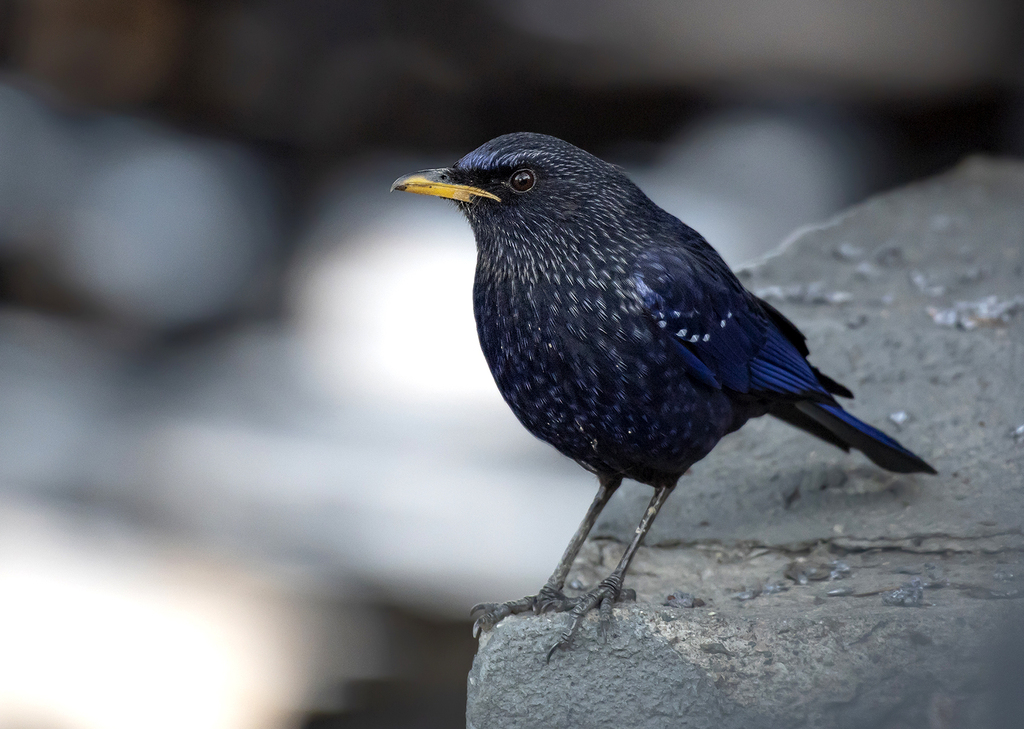
Blue Whistling Thrush
Photo © Griha Hasanov
Photo © Griha Hasanov — CC BY 4.0 — Source: iNaturalist photo #261628361Identification
The blue whistling thrush is a striking bird with dark violet-blue plumage adorned with pale blue to white spangles on the tips of its feathers, creating a distinctive shimmering effect across the body. The wing coverts display a slightly different shade of blue, with white spots visible on the median coverts. Males and females are similar in appearance. At 29–35 cm in length, this is the largest species in the Old World flycatcher family, weighing between 136 and 231 grams depending on subspecies and geography. The bill is black in the nominate subspecies found in central and eastern China, but yellow and contrasting in the other five subspecies. The legs are black in all populations.
Range & Habitat
This widely distributed species is found across the mountains of Central Asia, South Asia, China, and Southeast Asia, with its range extending from Afghanistan and Kazakhstan through the Himalayas to Indonesia and the Philippines. It inhabits temperate forests and subtropical or tropical moist montane forests, typically along the Tian Shan and Himalayan ranges. In the Himalayas, populations make altitudinal movements, descending in winter, while birds in northern China are summer visitors that migrate away during the colder months.
Behaviour & Diet
Usually solitary or in pairs, blue whistling thrushes are active foragers that hop on rocks in quick spurts, turning over leaves and small stones while cocking their heads to spot prey movements. They are renowned for their loud, human-like whistling song delivered during the darkness of dawn and dusk, particularly during the breeding season from April to August when few other birds are calling. Their alarm call is a shrill kree. These birds feed primarily on the ground, often along streams and in damp places, where they hunt for snails, crabs, insects, earthworms, and fruit. Snails and crabs are typically battered against rocks before consumption.
Best Time & Places to See It
Dawn and dusk hours offer the best opportunities to encounter and hear this species, particularly during the breeding season. Mountainous regions throughout its extensive range—from Central Asian mountains through the Himalayas to Southeast Asian highlands—provide suitable habitat. In the Himalayas, winter visits may yield sightings at lower elevations, while northern China locations are most rewarding during the summer months. Look for the species near streams and rocky areas in montane forests where damp ground attracts their preferred prey.
Photography Tips
The blue whistling thrush's vibrant violet-blue plumage with pale spangles photographs beautifully in soft, diffuse light, which accentuates the shimmering effect of its feathers. Position yourself near streams and rocky habitats during dawn and dusk hours when the bird is most active and vocal. Exercise patience and use a slow shutter speed with a sturdy tripod, as the bird's quick, jerky movements and preference for low-light conditions present technical challenges. The bird's habit of spreading and drooping its tail when alarmed can provide distinctive poses for documentation.
Baima Snow Mountain National Nature Reserve
Banke National Park
Bardiya National Park
Caohai National Nature Reserve
Chitwan National Park
Doi Inthanon National Park
Gangotri National Park
Gaoligong Mountain National Nature Reserve
Giant Panda National Park
Nothing matches these filters.
No community photos yet. Log in to add the first one.
No community observations of this species yet.