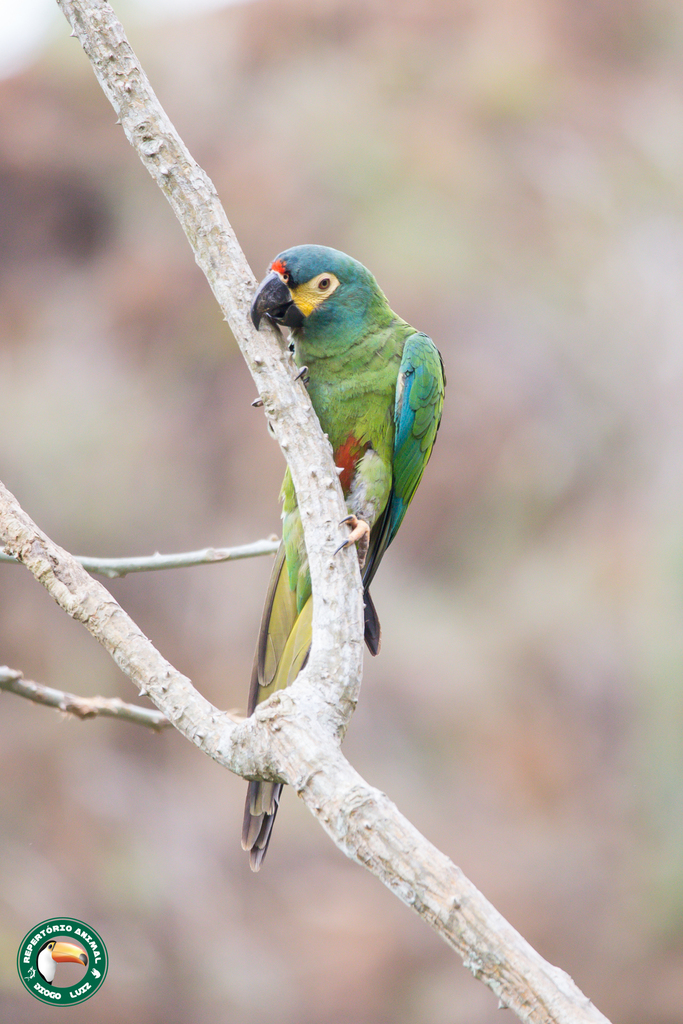
Blue-winged Macaw
Photo © Diogo Luiz
Photo © Diogo Luiz — CC BY 4.0 — Source: iNaturalist photo #56788335The blue-winged macaw (Primolius maracana), in aviculture more commonly known as Illiger's macaw, is a species of small macaw (sometimes called a mini-macaw) found in central and eastern South America. The second name is in honor of the German ornithologist Johann Karl Wilhelm Illiger. It was previously placed in the genera Ara or Propyrrhura. Blue-winged macaws have been known to reach an age of 50–60 years. == Description == It has a total length of approximately 36–43 cm (14–17 in). It has a moderately sized black bill, a long tail and a mainly green plumage. The upperside of the remiges and primary coverts are blue, as indicated by its common name. The underside of the wings is yellowish, the tail-tip, crown and cheeks are bluish, and the tail-base and small belly-patch are red. The iris is amber. It and the red-bellied macaw are the only macaws where the bare facial-skin is yellowish, but this often fades to white in captivity. Unlike the red-bellied macaw, the blue-winged has a red lower abdomen and a red lower back. In the wild, its flight pattern is said to be a distinctive 'jerky, rearing motion.' == Habitat and food == The blue-winged macaw occurs…
Tijuca National Park
Brazil
+317 birds+13 mammals
Where the Atlantic forest rises steeply from Rio de Janeiro's urban edge, Tijuca National Park encompasses a landscape of dramatic granite peaks, cascading waterfalls, and closed-canopy…
VIEW NATIONAL PARKSerra do Cipó National Park
Brazil
+379 birds+5 mammals
Where granite escarpments rise above the Atlantic Forest transition zone in southeastern Brazil, Serra do Cipó National Park unfolds across a landscape of dramatic ridges, cascading…
VIEW NATIONAL PARKItatiaia National Park
Brazil
+519 birds+12 mammals
Where granite peaks pierce the Atlantic rainforest canopy in southeastern Brazil, Itatiaia National Park rises as one of the country's oldest and most ecologically vital protected…
VIEW NATIONAL PARKSerra da Bocaina National Park
Brazil
+441 birds+5 mammals
Where the escarpment of the Serra da Bocaina rises sharply from the Atlantic coastal plain, tropical rainforest cloaks steep mountainsides that climb toward peaks exceeding 2,000…
VIEW NATIONAL PARKSerra dos Órgãos National Park
Brazil
+446 birds+13 mammals
Granite peaks thrust skyward through the Atlantic Forest canopy in the mountains immediately north of Rio de Janeiro, their bare rock faces rising above a landscape…
VIEW NATIONAL PARKChapada dos Guimarães National Park
Brazil
+450 birds+1 mammals
Where weathered sandstone plateaus rise above the cerrado grasslands of central Brazil, Chapada dos Guimarães National Park protects 624 square kilometres of ecological transition zone that…
VIEW NATIONAL PARKChapada dos Veadeiros National Park
Brazil
+324 birds+6 mammals
Where granite plateaus rise above the cerrado savanna in central Brazil, Chapada dos Veadeiros National Park unfolds across 6,665 square kilometres of some of the world's…
VIEW NATIONAL PARKChapada Diamantina National Park
Brazil
+346 birds+5 mammals
Where granite peaks and sandstone cliffs rise abruptly from the Brazilian interior, Chapada Diamantina National Park sprawls across 4,215 square kilometers of some of Brazil's most…
VIEW NATIONAL PARKSerra do Gandarela National Park
Brazil
+333 birds+3 mammals
Where granite massifs rise through Atlantic Forest in southeastern Brazil's highlands, Serra do Gandarela National Park protects nearly 1,000 square kilometres of montane terrain that few…
VIEW NATIONAL PARKNo community photos yet. Log in to add the first one.
No community observations of this species yet.