Identification
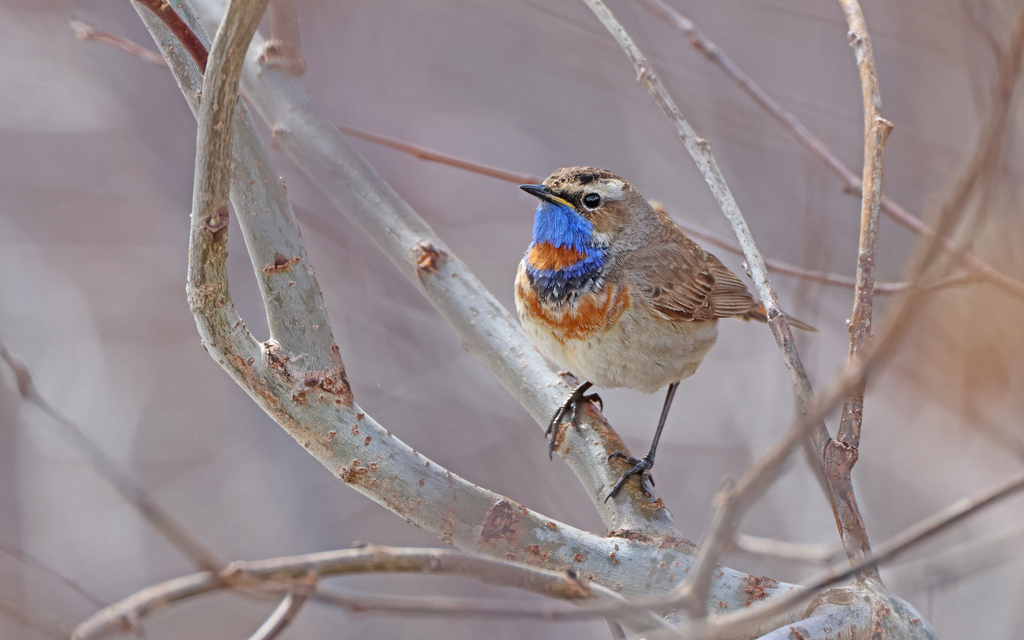
The bluethroat is a small passerine roughly the size of a European robin, measuring 13–14 cm in length. It is plain brown above, with a distinctive tail that is brown with black outer corners and red basal side patches. A strong white supercilium is another key identifying feature. Males are unmistakable in breeding plumage, displaying a striking throat pattern: a vivid glossy blue throat bordered below by a narrow black band, with a broad brick-red band beneath. Many males have a central spot in the middle of the blue throat, either red or white depending on subspecies. Females and juveniles are much more subdued, typically showing only a blackish crescent and minimal blue on an otherwise cream throat and breast. After summer moult, males' throat patterns are temporarily obscured by pale tips on fresh feathers, which gradually abrade to reveal brighter plumage by late winter and early spring.
Range & Habitat
The bluethroat is a migratory species with a wide Palearctic distribution. It breeds across Europe from Scandinavia to western Alaska, with populations favouring wet birch woods and bushy swamps in the north, and lowland reedbeds in central Europe. The species nests in tussocks or low in dense bushes. In winter, bluethroats are found across a vast range including the Iberian Peninsula, the northern half of Africa, and southern Asia, notably the Indian subcontinent, the Middle East, and Pakistan. Different subspecies show distinct breeding and wintering patterns, with some populations travelling as far south as India while others winter in Africa or the Middle East.
Behaviour & Diet
The bluethroat is an insectivorous species that feeds on small invertebrates. Males are accomplished songsters, with a varied and highly imitative song that varies between individuals and populations. Their call is a typical chat-like "chack" noise. The species undergoes a complete moult beginning in July after breeding, which is completed within 40–45 days before migration begins. Despite the striking visual differences between subspecies and between sexes, recent genetic studies have revealed only limited variation between the forms, confirming that all populations represent a single species.
Best Time & Places to See It
Timing depends on location and subspecies. In breeding areas across northern and central Europe and the Palearctic, bluethroats are present from late spring through summer. Spring is an excellent time to observe males displaying their colourful throat plumage and hear their impressive songs. Winter observers should look in the Mediterranean region, North Africa, and southern Asia. The species' preference for wet habitats—birch woods, bushy swamps, and reedbeds—means that searching near wetlands and marshes will improve your chances of encounters.
Photography Tips
Spring and early summer offer the best opportunities to photograph males in their brightest plumage, before the post-breeding moult dims their appearance with pale feather tips. Position yourself near their preferred habitats of reedbeds and scrubby wetlands where males are likely to perch openly while singing. Males in breeding plumage are remarkably striking and photograph well when illuminated in good light, which will showcase the vivid blue throat and red breast bands. Be aware that females and juveniles are far more cryptic and subtle in appearance, requiring patience and careful observation to locate and photograph effectively.