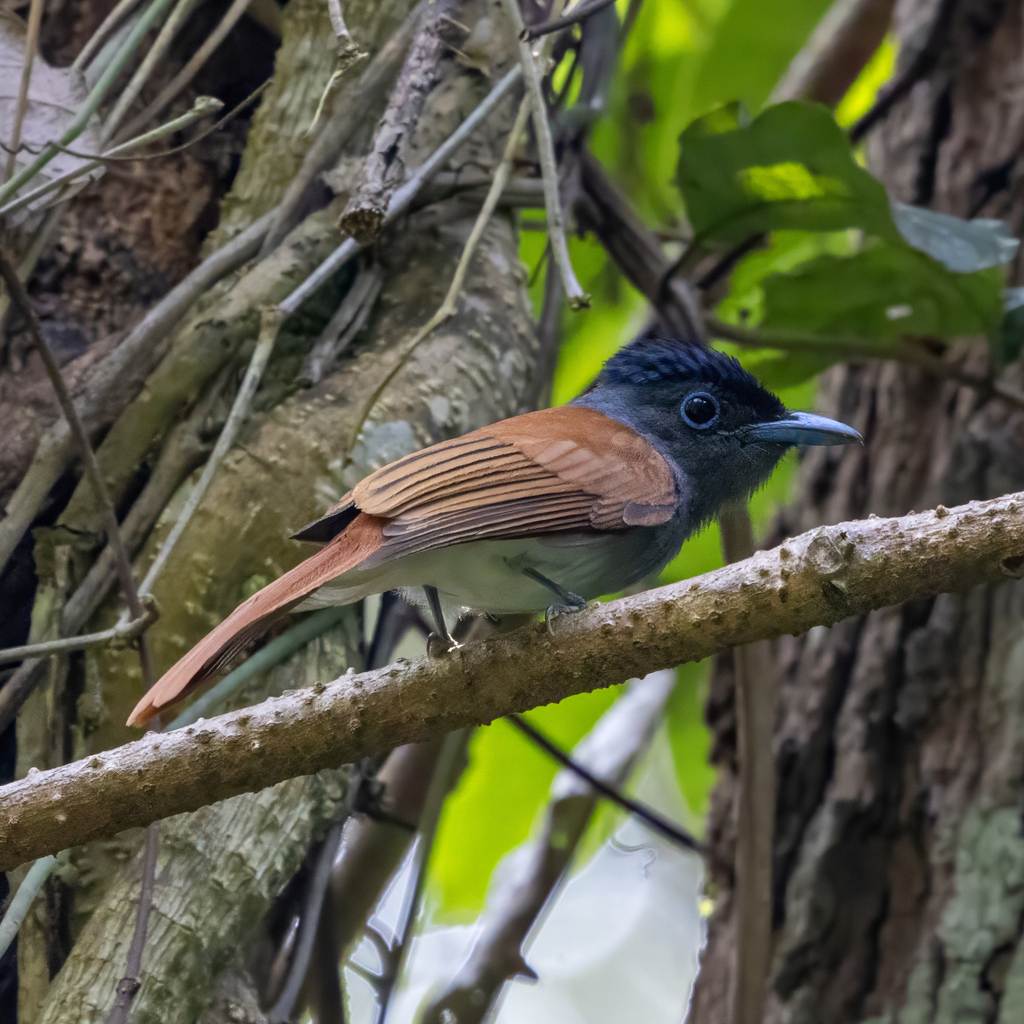
Blyth’s Paradise Flycatcher
Photo © Dan Vickers
Photo © Dan Vickers — CC BY 4.0 — Source: iNaturalist #342567292Identification
Blyth's Paradise Flycatcher is a striking member of the monarch flycatcher family, instantly recognizable by its dimorphic plumage—males occur in both rufous and white color morphs, while females resemble non-breeding rufous males. All birds share a distinctive dark head crowned with a small, triangular crest and a characteristic blue eye-ring. The most dramatic feature is the breeding male's elongated central tail streamers, which extend nearly twice the length of its body, creating an unmistakable silhouette in flight.
Identification can be challenging where ranges overlap with similar species. Key distinguishing features include the short, rounded crest (compared to the longer, pointed crest of the Indian Paradise Flycatcher), a pale rufous undertail in rufous morphs (versus white in the Amur Paradise Flycatcher or black in the Black Paradise Flycatcher), and a gradual transition to grey on the underparts lacking the sharp contrast seen in congeners. The song is a distinctive ringing series of "wiwiwiwiwiwiwi" notes, while the call is a nasal "ji-jeh" or "ji-jeh-jeh."
Range & Habitat
This species is native to a broad swath of tropical and subtropical Asia, from northeast India through Indochina, and southward to Sumatra and Borneo. Ten recognized subspecies occupy distinct geographic populations across this range, reflecting the species' considerable distributional span. Some populations undertake migratory movements, particularly those breeding in northern regions.
Blyth's Paradise Flycatcher favors evergreen broadleaf forests and forest edges, including secondary growth, gardens, and plantations. It typically occupies lowland and foothill regions, making it accessible to travelers exploring the forest understory and edge habitats across its range.
Behaviour & Diet
As a flycatcher, this species is an aerial insectivore, sallying from perches to catch insects in flight—a behavior typical of the monarch flycatcher family. Its elongated tail streamers, particularly prominent in breeding males, likely serve important roles in display and mate attraction, though the specific behavioral contexts of courtship and territorial defense are not detailed in available literature.
The bird's vocalizations—its ringing song and nasal calls—feature prominently in its behavioral repertoire, particularly during breeding season. Its presence in gardens and secondary growth indicates adaptability to human-modified landscapes, though it remains primarily associated with forest habitats.
Best Time & Places to See It
Travelers seeking Blyth's Paradise Flycatcher should focus on evergreen forests and forest edges throughout its native range spanning northeast India, Myanmar, Thailand, Laos, Cambodia, Vietnam, Malaysia, Sumatra, and Borneo. Each geographic region supports distinct subspecies, so birders targeting specific populations should research regional subspecific distributions.
The species' presence in secondary growth and gardens makes it potentially more accessible than strictly forest-dependent species. Timing visits during breeding season may increase sightings, as males become more vocal and conspicuous. Early morning hours, when insectivorous birds are most active, offer the best opportunities for observation.
Photography Tips
The elongated tail streamers of breeding males present both a challenge and an opportunity for photographers. Position yourself with backlighting to emphasize the streaming tail feathers against bright sky, and use fast shutter speeds (1/1000s or faster) to freeze the bird's aerial movements as it hunts insects. The blue eye-ring and dark head provide excellent focal points—ensure sharp focus on the eye.
Capturing both color morphs requires patience and multiple visits, as individual males consistently display one morph or the other. Use telephoto lenses (400mm or longer) and shoot from sheltered positions near productive feeding perches in forest edge habitats. The ringing song provides auditory cues to help locate birds; approach cautiously to avoid flushing them before achieving optimal photographic positions.
Orang National Park
Rangagarapathar, India
+298 birds+1 mammals
Where the Brahmaputra's floodplains meet the foothills of Assam, Orang National Park unfolds across a mosaic of riverine grasslands, forests and wetlands that pulse with the…
VIEW NATIONAL PARKHat Noppharat Thara-Mu Ko Phi Phi National Park
Ao Nang, Thailand
+253 birds+9 mammals
Where limestone karsts rise dramatically from turquoise waters, Hat Noppharat Thara-Mu Ko Phi Phi National Park unfolds across a mosaic of beach, mangrove forest, and island…
VIEW NATIONAL PARKKhao Laem Ya-Mu Ko Samet National Park
Mueang Rayong District, Thailand
+159 birds+3 mammals
Where limestone hills meet the Gulf of Thailand, Khao Laem Ya–Mu Ko Samet National Park stitches together a mosaic of terrestrial and marine worlds that few…
VIEW NATIONAL PARKKaziranga National Park
Kohora, India
+422 birds+26 mammals
Dawn breaks over the floodplains of the Brahmaputra, where tall grasslands stretch endlessly beneath monsoon-heavy skies. This sprawling wilderness of northeastern Assam is a mosaic of…
VIEW NATIONAL PARKBako National Park
Kuching, Malaysia
+210 birds+17 mammals
Weathered sandstone cliffs rise dramatically from the South China Sea, their ochre faces sculpted by millennia of wind and tide into a landscape of extraordinary geological…
VIEW NATIONAL PARKTaman Negara National Park
Kampong Samas, Malaysia
+393 birds+48 mammals
Where ancient rainforest meets limestone peaks, one of Southeast Asia's oldest protected wilderness preserves sprawls across 4,343 square kilometers of primordial landscape. Dipterocarp giants tower overhead,…
VIEW NATIONAL PARKPenang National Park
Balik Pulau, Malaysia
+107 birds+2 mammals
Granite peaks rise abruptly from the Andaman Sea where tropical rainforest clings to steep slopes in one of Malaysia's oldest protected landscapes. Mangrove forests fringe the…
VIEW NATIONAL PARKTaman Negara Bukit Lambir National Park
Miri, Malaysia
+153 birds+7 mammals
Rainforest cascades down sandstone ridges where crystal streams carve through ancient geology, creating a landscape of profound biological richness in Sarawak's interior. This 68-square-kilometre sanctuary protects…
VIEW NATIONAL PARKGunung Mulu National Park
Long Seridan, Malaysia
+280 birds+39 mammals
Where granite monoliths pierce the rainforest canopy of Sarawak, an ancient limestone karst landscape reveals one of Southeast Asia's most biodiverse strongholds. Soaring peaks cloaked in…
VIEW NATIONAL PARKKerinci Seblat National Park
Kerinci, Indonesia
+228 birds+16 mammals
Across nearly 67,000 square kilometres of Sumatra's spine, a mountainous realm of equatorial rainforest rises from steaming lowlands to volcanic peaks shrouded in cloud. Kerinci Seblat…
VIEW NATIONAL PARKGunung Palung National Park
Kayong Utara, Indonesia
+38 birds+1 mammals
Rainforest swells across the steep terrain of West Kalimantan, where ancient volcanic ridges rise abruptly from lowland swamps and weathered plateaus. Gunung Palung National Park encompasses…
VIEW NATIONAL PARKWay Kambas National Park
Lampung Timur, Indonesia
+237 birds+20 mammals
Across the low swamplands of eastern Lampung, where freshwater wetlands merge into tidal mangrove forests along the Sunda Strait, sprawls one of Sumatra's most vital sanctuaries.…
VIEW NATIONAL PARKXishuangbanna National Nature Reserve
Xishuangbanna Dai Autonomous Prefecture, China
+173 birds+2 mammals
Where subtropical monsoon forests meet the margins of the Yunnan plateau, Xishuangbanna National Nature Reserve sprawls across a landscape of dramatic relief—deep river valleys carved by…
VIEW NATURE RESERVEGaoligong Mountain National Nature Reserve
Nujiang Lisu Autonomous Prefecture, China
+443 birds+13 mammals
VIEW NATURE RESERVENo community photos yet. Log in to add the first one.
No community observations of this species yet.