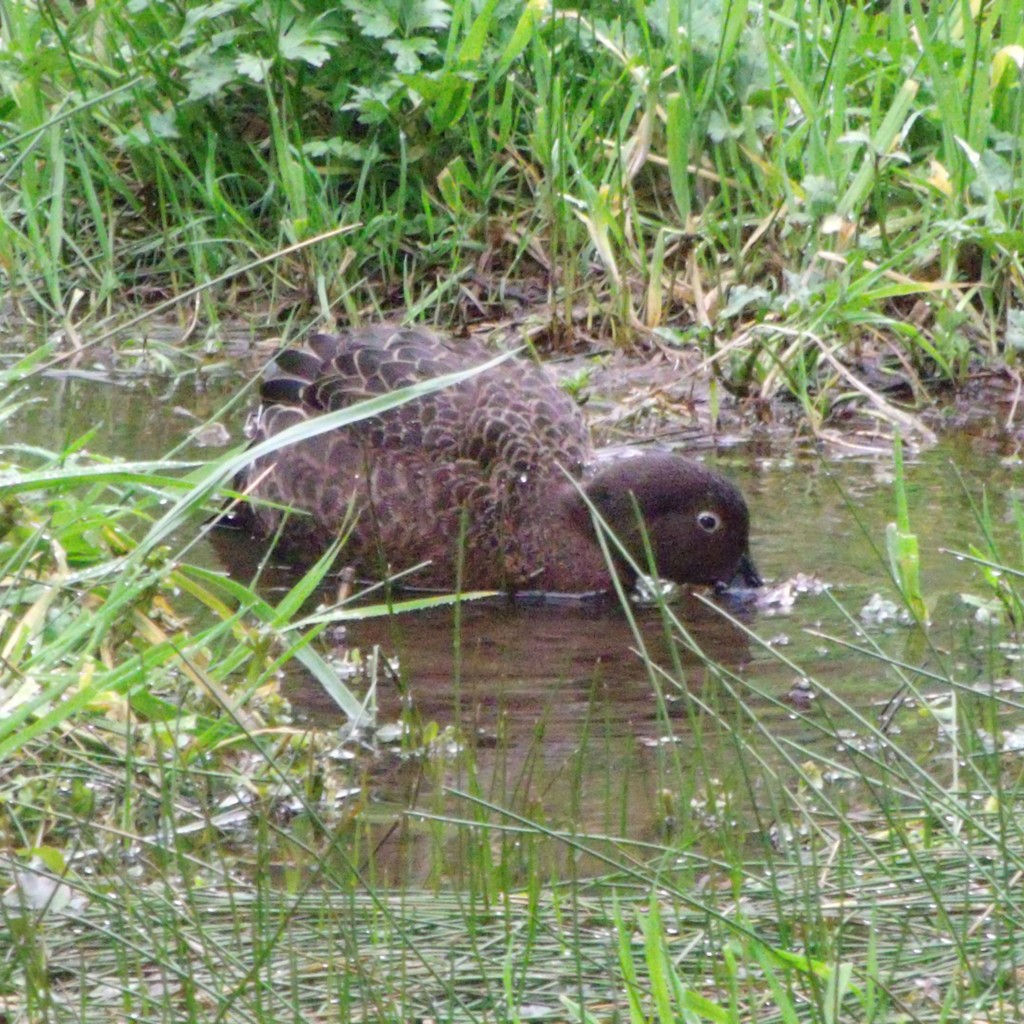
Brown Teal
Photo © wild_wind
Photo © wild_wind — CC BY 4.0 — Source: iNaturalist #17018248Identification
The brown teal is a small dabbling duck native to New Zealand, where it is known by the Māori name pāteke. Outside the breeding season, males, females, and juveniles are virtually indistinguishable, all displaying a distinctive white ring around the eyes, mottled brown colouration on the head and throat. During breeding season, males undergo a striking transformation, developing a green head, chestnut breast, and white stripes along each side of the body, sometimes accompanied by a white neck band, though the intensity of these breeding colours varies among individuals.
Range & habitat
Once widespread across the New Zealand mainland, the brown teal is now endangered and found predominantly on offshore islands and in mainland predator-proof sanctuaries. The species disappeared from most of its former range due to introduced predators such as cats, dogs, and rats, which readily preyed on these unwary, weakly flying birds. Today, brown teal occur in scattered locations including offshore islands and protected areas such as Tawharanui Regional Park. In the South Island, populations exist in Fiordland and, since 2017, in the Awapoto River within Abel Tasman National Park, where captive-bred birds have been successfully released and are breeding in the wild.
Behaviour & diet
Brown teal are notably nocturnal for dabbling ducks—an evolutionary adaptation to natural daytime predators including the New Zealand falcon, Eyles' harrier, and southern skuas. During daylight hours, they shelter in streams, venturing onto land at night to forage. The species feeds by dabbling and upending, consuming primarily aquatic invertebrates including insects, larvae, and crustaceans, with a particular fondness for molluscs. They consume small shellfish whole, crushing them in their gizzard, while some birds have developed a remarkable, undocumented feeding technique for larger cockles, using a jackhammer-like pumping motion to force their soft bills between shells and extract the flesh.
Best time & places to see it
Observing brown teal presents a genuine challenge due to their scarcity and nocturnal habits. Fewer than 1,000 adult birds remain in the wild. The best opportunities lie at designated sanctuaries and protected areas where populations have been established through captive breeding and reintroduction programmes. Tawharanui Regional Park on the mainland and various offshore islands represent reliable locations. The Awapoto River in Abel Tasman National Park offers another promising site since the successful reintroduction of nearly 300 birds beginning in 2017. Early morning or evening visits, when the ducks may be more active transitioning between daytime refuges and nocturnal feeding grounds, offer the greatest chance of encounters.
Photography tips
Photographing brown teal requires patience and an understanding of their behaviour. Since they are largely nocturnal and spend daylight hours sheltering near water, position yourself near streams and water refuges during early dawn or late afternoon. Use a telephoto lens to maintain distance—these are unwary birds but easily disturbed. Breeding season males offer the most visually striking subjects, with their emerald heads and chestnut breasts providing excellent colour contrast. The white eye-ring visible on all birds year-round makes a useful focal point for sharp focus. Low-light conditions during dawn or dusk will require faster film speeds or higher ISO settings, but capture the natural lighting conditions when these birds are most likely to be active.
No community photos yet. Log in to add the first one.
No community observations of this species yet.