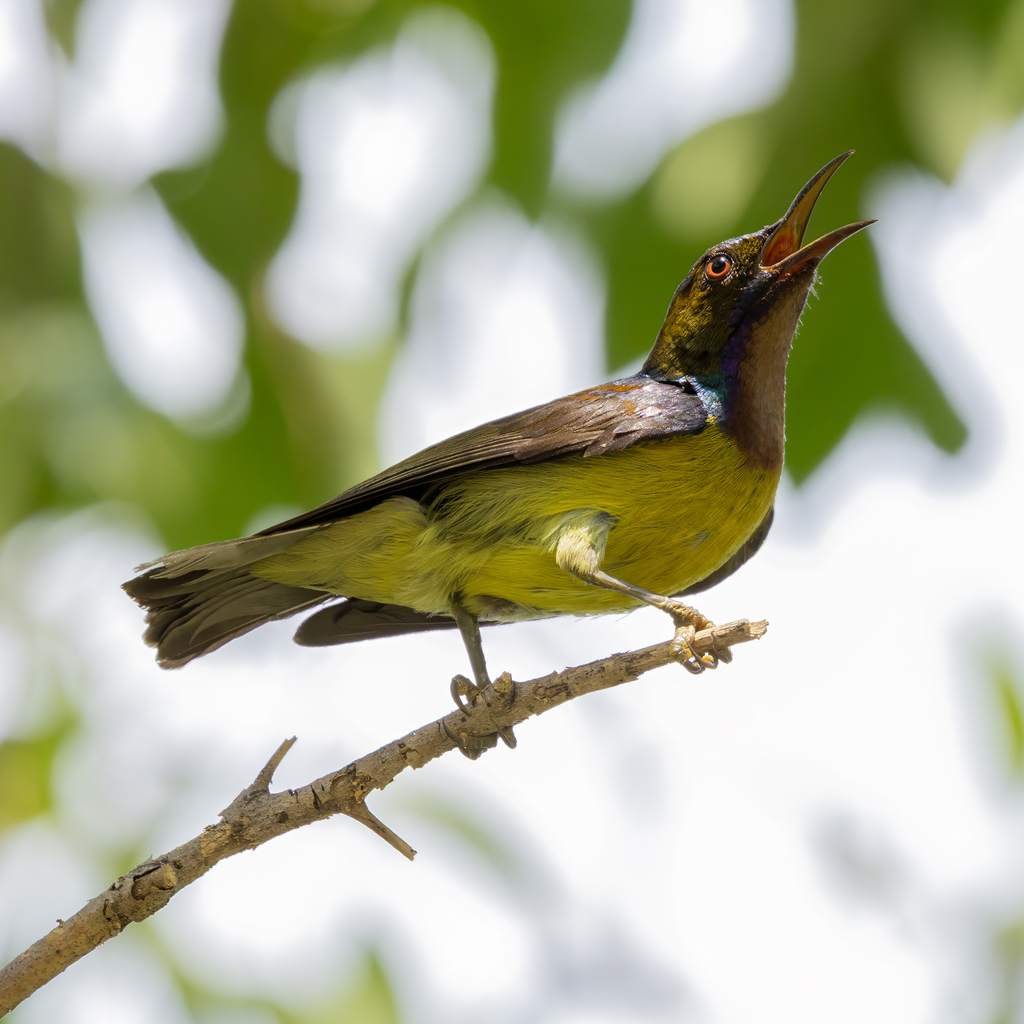
Brown-throated Sunbird
Photo © Dan Vickers
Photo © Dan Vickers — CC BY 4.0 — Source: iNaturalist #341867882Identification
The brown-throated sunbird is a relatively large, heavy sunbird measuring approximately 14 centimetres in length, with a mass of 7.4–13.5 grams. Its most distinctive feature is a thick, substantial bill—characteristic of the sunbird family. Sexual dimorphism is pronounced: males display iridescent green and purple upperparts with chestnut markings on the wing-coverts and scapulars, and are primarily yellow below, creating a striking contrast. Females are considerably duller, with olive-green upperparts and yellowish underparts. Males are on average slightly larger than females.
Range & Habitat
The brown-throated sunbird is found across a wide range of semi-open habitats throughout south-east Asia, with its distribution extending from Myanmar eastward to the Lesser Sundas and throughout the western Philippines. The species is represented by numerous recognized subspecies across its range, occupying mainland Southeast Asia, Sumatra, Borneo, Java, Bali, Palawan, Mindanao, Sulawesi, and various island groups including the Sulu Archipelago and Visayas. It should be noted that the grey-throated sunbird, which occurs in the remaining parts of the Philippines, was historically considered a subspecies but is now recognized as distinct, with consistent differences in both measurements and plumage and no evidence of intergradation between the two forms.
Behaviour & Diet
Like most members of its family, the brown-throated sunbird is primarily nectarivorous, dedicating much of its time to feeding on nectar from flowering plants and trees. However, its diet is more varied than many sunbird species: adults will also supplement their nectar intake with small fruits and berries when available. Juveniles are fed on insects, reflecting the higher protein demands of developing chicks during the breeding season.
Best Time & Places to See It
The brown-throated sunbird's wide geographic distribution across semi-open habitats throughout south-east Asia makes it accessible to travellers across the region. The species' preference for semi-open environments means it is often visible in gardens, open woodlands, and scrubby areas rather than dense forest, making it more approachable than many forest-interior species. Its occurrence across numerous island groups and mainland areas provides multiple opportunities for observation across the region.
Photography Tips
The dramatic sexual dimorphism of this species makes it rewarding for wildlife photographers. Males, with their iridescent green and purple plumage contrasted against bright yellow underparts and chestnut wing-coverts, are particularly photogenic and benefit from strong, directional light to showcase their iridescence. The bird's relatively large size and heavy bill make it well-suited to telephoto photography. Since the species feeds on nectar, positioning yourself near flowering plants during peak flowering periods may provide opportunities for active feeding shots, which capture natural behaviour effectively.
Bako National Park
Bogani Nani Wartabone National Park
Doi Inthanon National Park
Gunung Ciremai National Park
Gunung Mulu National Park
Gunung Palung National Park
Hat Noppharat Thara-Mu Ko Phi Phi National Park
Kerinci Seblat National Park
Khao Laem National Park
Nothing matches these filters.
No community photos yet. Log in to add the first one.
No community observations of this species yet.