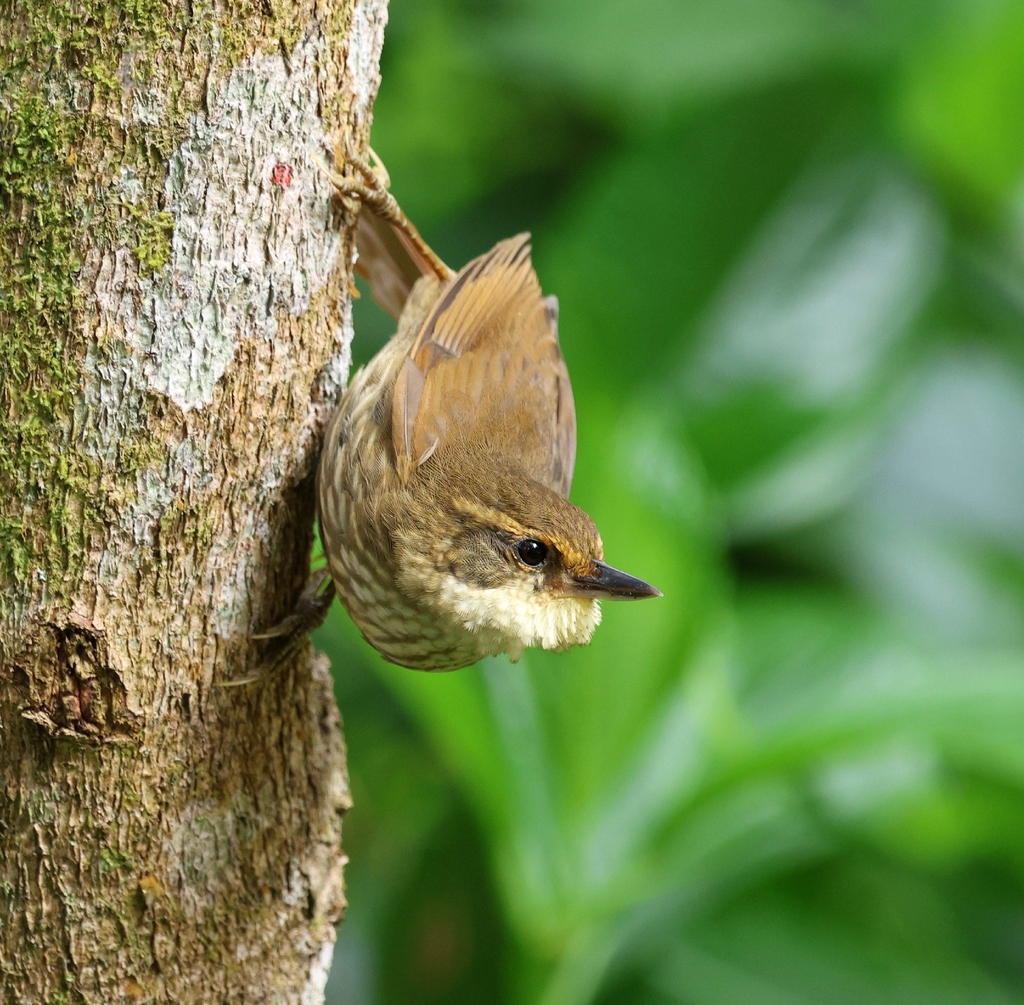
Buff-browed Foliage-gleaner
Photo © Miguel
Photo © Miguel — CC BY-SA 4.0 — Source: iNaturalist #330194177Identification
The buff-browed foliage-gleaner is a medium-sized ovenbird measuring 17–18 cm long and weighing 22–33 g. Its most distinctive feature is a buff-coloured eyering and supercilium (eyebrow stripe) that extends to the nape, which gives the species its common name. The plumage is predominantly olive-brown above, with a dull rufous tail and rich olivaceous-brown wings. The underparts are whitey-buff with olive-brown feathering that creates a characteristic scalloped appearance on the breast, while the belly shows buffy-whitish streaks that fade toward the rear. Both sexes look identical. The bill is thick and slightly upcurved—typical of foliage-gleaners—with a brown-to-black upper mandible and whitish-to-blue-gray lower mandible. Subspecies vary subtly in plumage tones: S. r. cabanisi (Andes) shows richer ochraceous tones, while S. r. acrita (Atlantic Forest) has a paler supercilium and more chestnut-toned tail.
Range & Habitat
This species has a distinctly fragmented distribution across two separate regions of South America. Andean populations range from extreme southern Ecuador southward through Peru and Bolivia into northwestern Argentina (La Rioja Province), inhabiting montane evergreen and secondary forests typically between 1,300–2,500 m elevation. Atlantic Forest populations occur in southeastern Brazil, Paraguay, Uruguay, and northeastern Argentina, where they favour lowland tropical evergreen forest, gallery forest, and secondary growth up to 2,000 m. The species shows a preference for areas with Chusquea bamboo in the Andes. It is a year-round resident throughout both ranges, never migrating.
Behaviour & Diet
The buff-browed foliage-gleaner is an arthropod specialist, foraging singly or in pairs, and frequently joining mixed-species feeding flocks. It typically works the forest undergrowth, though it occasionally descends to ground level or ventures into the subcanopy, gleaning prey methodically from dead leaves, debris, epiphytes, and branches. Breeding occurs at different times in different regions: August in Peru and November in southeastern populations. The species nests in cavities, including old woodpecker holes, rotting branches, building walls, and even vertical pipes; the one described nest was a cup of small twigs. Clutches contain two to four eggs, though incubation period and fledging details remain undocumented. The song is distinctive—a loud, fast, accelerating series starting faintly ('kuh-kuh-kuh') before rising and becoming louder and quavering, sometimes descending at the end. Call notes include 'kssr' and an alarm call of 'set' or 'setet'.
Best Time & Places to See It
The buff-browed foliage-gleaner is fairly common to common throughout most of its range, making it a reliable sighting for travellers visiting appropriate habitat. In the Andes, seek it in montane cloud forests and bamboo-rich secondary growth in Peru, Bolivia, and Ecuador; in the southern cone, it inhabits gallery forests and lowland evergreen woodlands from Paraguay through southern Brazil to Uruguay and Argentina. The species occurs in numerous protected areas across its range. Best viewing opportunities come during the breeding season (August in the north, November in the south), when birds are more vocal and active. Being a year-round resident, it can be found in any season, though patience is required in northern Peru and Paraguay where populations are notably scarcer.
Photography Tips
The buff-browed foliage-gleaner's preference for undergrowth and its habit of gleaning among dead leaves and debris present both challenges and opportunities for photographers. Use a fast shutter speed (1/500 s or faster) to freeze movement as the bird hops and picks through vegetation. The species' dull, streaked plumage provides excellent camouflage; look for it in shaded areas and be prepared with ISO settings suited to dim forest light. Its vocalizations—particularly the loud, accelerating song—are excellent locating tools; use playback cautiously and sparingly to bring birds into view. Position yourself low to photograph birds working the undergrowth, and watch for them joining mixed flocks, which often pause longer in more open spaces. The buff eyebrow and supercilium are key identifying marks; frame shots to capture this facial pattern clearly. Early morning often provides the best combination of bird activity and adequate forest light for photography.
Araucárias National Park
Baritú National Park
Calilegua National Park
Campos Gerais National Park
Carlos Botelho State Park
Cordillera Azul National Park
El Palmar National Park
El Rey National Park
Ibitipoca State Park
Nothing matches these filters.
No community photos yet. Log in to add the first one.
No community observations of this species yet.