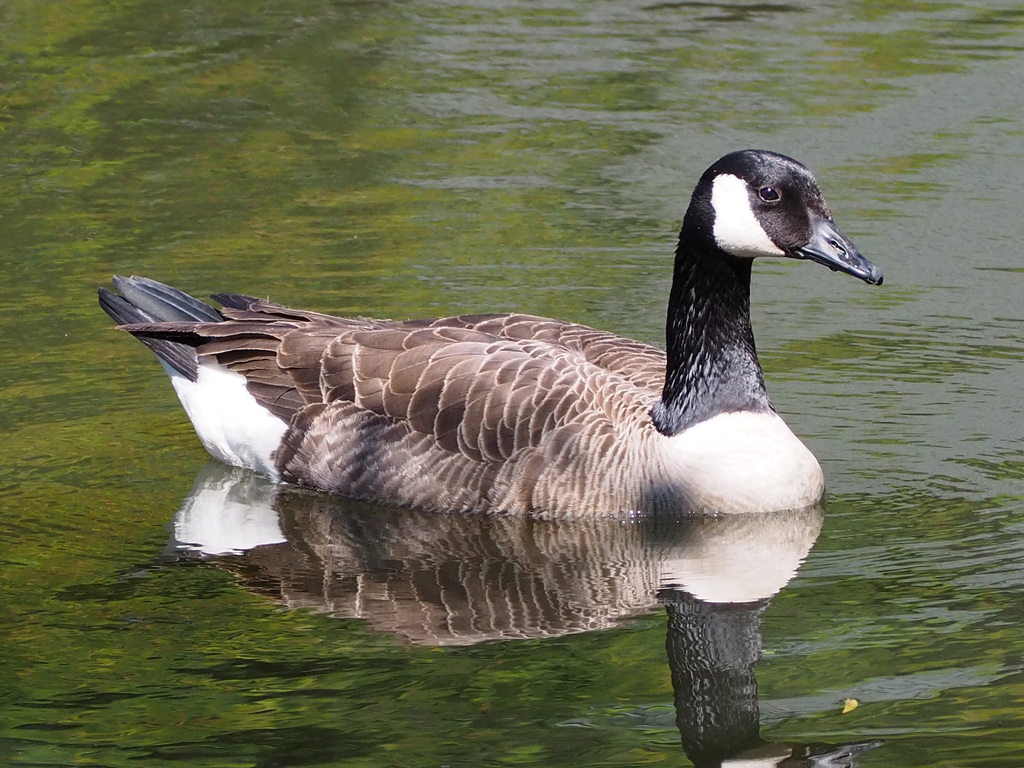
Canada Goose
Photo © Zygy
Photo © Zygy — CC0 1.0 — Source: iNaturalist photo #76223579Identification
The Canada goose is unmistakable among North American waterfowl, distinguished by its large size and striking plumage pattern. The bird displays a jet-black head and neck with a distinctive white "chinstrap" marking that runs beneath the chin and extends up the cheeks. The body is brown, contrasting sharply with the dark upper parts. Canada geese range from 75 to 110 cm in length with wingspans of 127–185 cm, making them among the largest goose species. Seven recognized subspecies vary in size and plumage details, though all share the characteristic black-and-white head pattern. Some individuals may display unusual plumage variations, including pepper-spotted or brown necks. The similar-looking cackling goose can be distinguished by its smaller size, shorter neck, and smaller bill, though size overlap occurs between smaller Canada geese and larger cackling geese.
Range & Habitat
Native to the Arctic and temperate regions of North America, Canada geese are occasionally found during migration across the Atlantic in northern Europe. The species has been introduced to France, the United Kingdom, Ireland, Scandinavia, New Zealand, Japan, Chile, Argentina, and the Falkland Islands. Like most geese, Canada geese are primarily herbivorous and normally migratory. They are typically found on or close to fresh water but are equally common in brackish marshes, estuaries, and lagoons. The species has proven extremely adept at living in human-altered areas, establishing breeding colonies in urban and cultivated habitats that provide abundant food and shelter from natural predators.
Behaviour & Diet
Canada geese are primarily herbivorous, feeding on vegetation in their aquatic and terrestrial habitats. The species is notably migratory, though populations in urban and cultivated areas have become increasingly sedentary. Their success in human-modified landscapes has led to complex interactions with people. Canada geese are known for aggressive territorial behavior toward both humans and other animals, and they frequently stalk and beg for food in parks and public spaces. Their prevalence in human-altered habitats, combined with their abundant excrement, depredation of crops, vocalization, and aggressive behavior, has resulted in the species often being considered a pest, particularly where artificial feeding policies have encouraged habituation to humans.
Best Time & Places to See It
Canada geese are readily observed year-round in parks, lakesides, and urban waterways throughout North America, particularly in areas where they have established breeding colonies. Spring and fall migrations offer excellent opportunities to observe large flocks in transit across northern regions and at wetland stopover sites. Fresh water lakes, ponds, and marshes provide reliable viewing locations, as do brackish estuaries and lagoons. The species' comfort in human-dominated landscapes makes it accessible to observers in urban and suburban settings, where parks with open water and grassy areas concentrate populations.
Photography Tips
The Canada goose's bold black-and-white head pattern and large size make it a rewarding photography subject. Photograph birds in early morning or late afternoon light to capture detail in both the dark head and brown body plumage. Flocks in flight during migration provide dramatic opportunities; shoot against overcast skies to avoid harsh backlighting on the birds' dark plumage. Close-up portraits should focus on the distinctive chinstrap and head markings. Behavior shots—such as feeding, nesting activity, or territorial displays—convey the species' character. Urban park settings may offer tamer birds habituated to human presence, allowing closer approach than wild populations.
Saskatchewan Whooping Crane Tour 2027
Nothing matches these filters.
Tombstone Territorial Park
Abel Tasman National Park
Acadia National Park
Alaska Maritime National Wildlife Refuge
Algonquin Provincial Park
Alligator River National Wildlife Refuge
Aoraki / Mount Cook National Park
Arches National Park
Arctic National Wildlife Refuge
Nothing matches these filters.
No community photos yet. Log in to add the first one.
No community observations of this species yet.