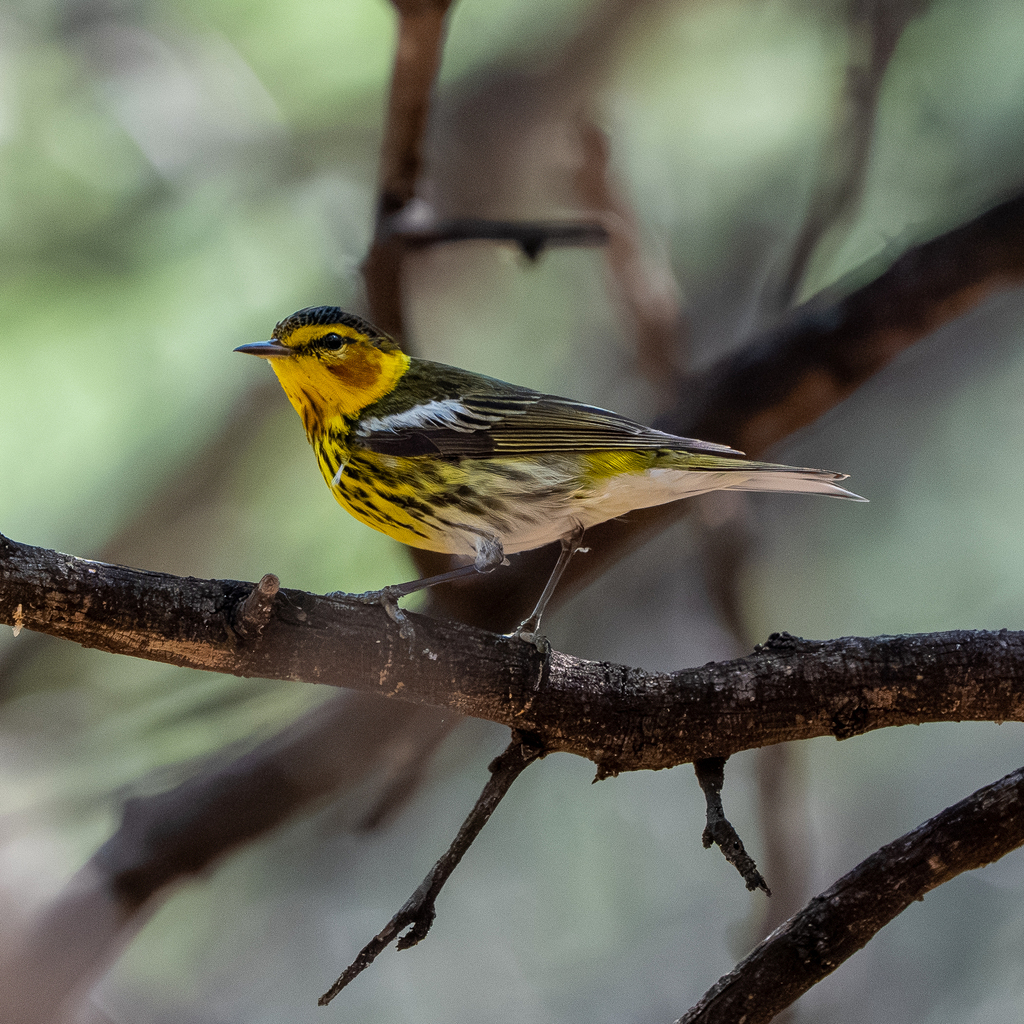
Cape May Warbler
Photo © Anthony Batista
Photo © Anthony Batista — CC BY 4.0 — Source: iNaturalist #264407769Identification
The Cape May Warbler is a small, mid-sized New World warbler measuring 12–14 cm in length with a wingspan of 19–22 cm. Adult males are distinctively marked with a brown back, yellowish rump, and dark brown crown. The underparts are bright yellow heavily streaked with black—a pattern reflected in the species name tigrina, meaning "striped like a tiger." The throat and nape are brilliant yellow, and the face displays a striking chestnut patch framed in yellow with a black eyestripe. A narrow white wing bar is always visible. Females and immature males show washed-out versions of the male's plumage, lacking the bold head pattern but retaining the yellowish rump and white wing bar.
Range & Habitat
This warbler breeds across northern North America, spanning all but the westernmost parts of southern Canada, the Great Lakes region, and New England. It is a migratory species, wintering in the West Indies. The bird is an extremely rare vagrant to western Europe, with only two British records as of 2013. During breeding season, it favors the edges of coniferous woodlands, particularly dense black spruce stands where it nests near tree trunks in thick foliage.
Behaviour & Diet
Cape May Warblers are insectivorous, gleaning insects from the tips of conifer branches or catching them in flight. They possess a unique adaptation among warblers: a tubular tongue that allows them to feed on berry juice and nectar, particularly important during winter months. Clutch size is notably variable, ranging from 4–9 eggs in a cup nest, with larger clutches produced during years when spruce budworm populations peak. This species can lay the largest clutch of any New World warbler, an adaptation to food abundance. The song is a simple, high-pitched repetition of "tsi" notes, usually delivered from high perches, with a thin "sip" call.
Best Time & Places to See It
Look for Cape May Warblers during migration periods and in their breeding range across northeastern North America. They favor coniferous forests, particularly spruce-dominated stands. The bird's preference for high perches and dense foliage means patience and careful scanning are required. During winter, look in the Caribbean islands where the species is more readily observed.
Photography Tips
The striking face pattern of breeding males—the chestnut cheeks framed in yellow with the black eyestripe—makes them excellent subjects. Position yourself to capture backlighting that highlights the yellow underparts and rump. High perch singing behavior provides good photographic opportunities, though the bird's small size requires patience and a telephoto lens. Early morning light during breeding season will best render the male's vibrant colors and distinctive plumage patterns.
Nothing matches these filters.
Acadia National Park
Alaska Maritime National Wildlife Refuge
Algonquin Provincial Park
Alligator River National Wildlife Refuge
Arenal Volcano National Park
Arrecifes de Cozumel National Park
Banff National Park
Bic National Park
Big Bend National Park
Nothing matches these filters.
No community photos yet. Log in to add the first one.
No community observations of this species yet.