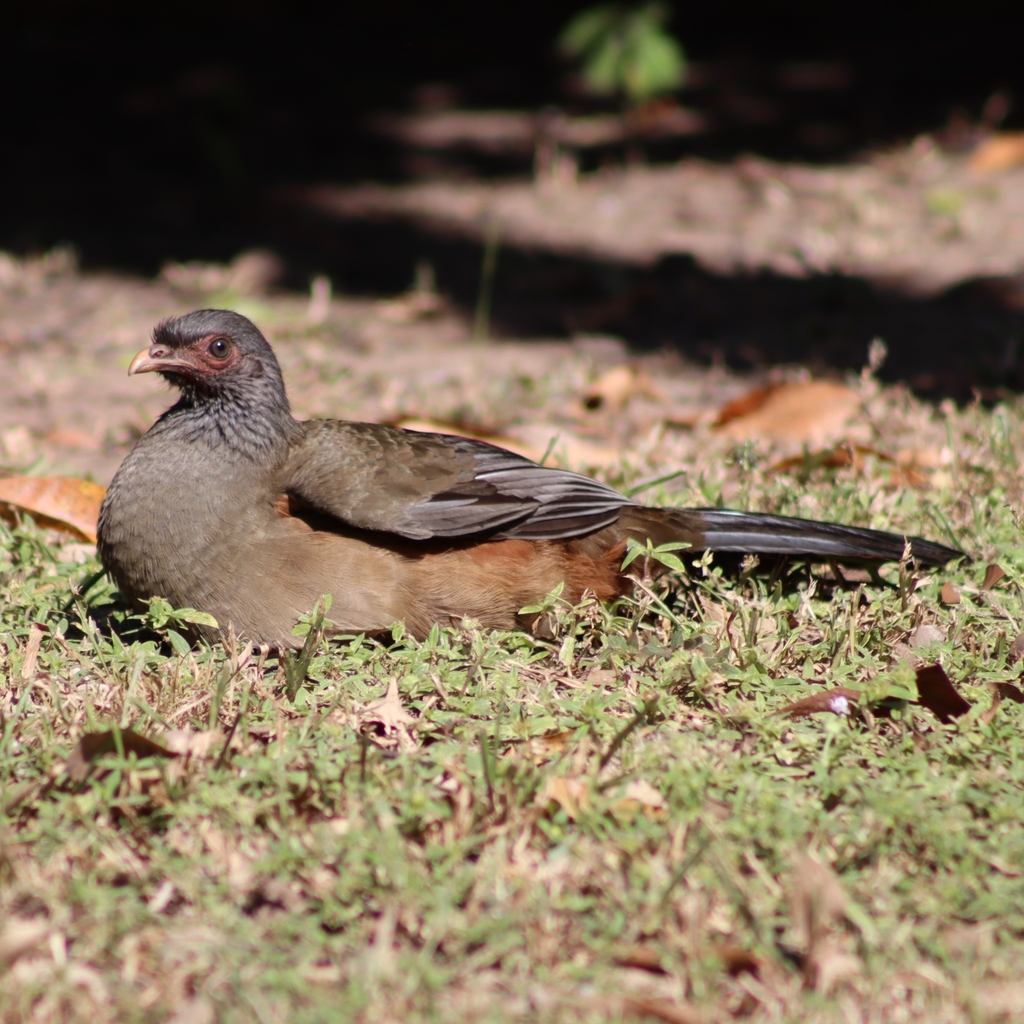
Chaco Chachalaca
Photo © Thomaz Ricardo Favreto Sinani
Photo © Thomaz Ricardo Favreto Sinani — CC BY 4.0 — Source: iNaturalist #225809789Identification
The Chaco chachalaca is a medium-sized bird measuring 50 to 56 cm in length and weighing between 479 to 678 grams. The nominate subspecies displays gray plumage on the head, back, and breast, with a tan to brown belly. A distinctive feature is the bare pinkish-red skin encircling the eye. The subspecies O. c. pantanalensis is noticeably browner overall, with more purplish facial skin rather than pinkish. These subtle differences between subspecies can help birdwatchers identify which population they are observing.
Range & Habitat
The Chaco chachalaca is distributed across five South American countries: Argentina, Bolivia, Brazil, Paraguay, and possibly Uruguay. The nominate subspecies inhabits the Gran Chaco region of eastern Bolivia, western Paraguay, and northern Argentina, while O. c. pantanalensis is found in southwestern Mato Grosso and Mato Grosso do Sul in Brazil, with unconfirmed reports from neighboring regions.
This adaptable species occupies diverse lowland habitats including swamp forest and scrub, dry subtropical forest, semi-deciduous and gallery forest, and palm groves. It thrives in both mature and secondary forest environments. Elevation preferences vary by region: in Brazil and Paraguay it remains at low elevations, but in Argentina it can be found at elevations reaching approximately 1,000 meters.
Behaviour & Diet
The Chaco chachalaca is a gregarious species, typically foraging in small groups, though flocks of up to 30 birds have been documented in forest settings. In agricultural areas far from forest cover, groups of up to 150 have been observed. The birds usually feed in the tree canopy but descend to ground level in areas with minimal undergrowth. Their diet consists primarily of fruits and leaves throughout the year, supplemented with invertebrates—particularly caterpillars—when seasonally available.
Breeding season in Argentina extends from October to February, beginning as early as August in Bolivia. Females construct simple loose platforms of sticks and stems, sometimes lined with leaves, typically positioned 2.5 to 4 meters above the ground in dense bushes or trees. Clutch size ranges from two to four eggs, which the female incubates alone. The species is highly vocal, particularly in early morning, producing a distinctive harsh, raucous call rendered as "chata-ra-ta" or complex variations. Additional vocalizations include insistent calls, ascending whistles, alarm chacks, and dog-like yelping.
Best Time & Places to See It
The Chaco chachalaca is generally common throughout its range, making it a reliable species for wildlife travelers. Early morning offers the best opportunity to encounter these birds, as this is when they are most vocal and active. The breeding season from October to February in Argentina provides excellent viewing opportunities, particularly when birds are more active and vocal.
Travelers should focus on lowland forest habitats, gallery forests, and palm groves across Argentina, Paraguay, and Bolivia. The species' tolerance for secondary forest means it can be found in regenerating habitats alongside primary forest. In some regions, agricultural areas adjacent to forest cover may also yield sightings of larger feeding flocks.
Photography Tips
Early morning light provides optimal conditions for photographing Chaco chachalacas during their most vocal and active period. Position yourself near suitable habitat—dense bushes, trees, and forest edges—where small groups are likely to forage. The bird's distinctive bare facial skin and plumage coloration are key identifying features worth capturing clearly.
Since birds often feed in tree canopies, a telephoto lens is essential for capturing detailed shots without disturbing them. The species' gregarious nature means multiple individuals may appear in a single frame. Patient observation of feeding groups in agricultural areas or forest margins may reward photographers with opportunities to document their behavior and interactions.
Chapada dos Guimarães National Park
Brazil
+450 birds+1 mammals
Where weathered sandstone plateaus rise above the cerrado grasslands of central Brazil, Chapada dos Guimarães National Park protects 624 square kilometres of ecological transition zone that…
VIEW NATIONAL PARKPantanal Matogrossense National Park
Brazil
+322 birds+17 mammals
Where the flooded forests of central Brazil meet vast seasonally inundated grasslands, Pantanal Matogrossense National Park sprawls across nearly 2,900 square kilometers of one of the…
VIEW NATIONAL PARKRío Pilcomayo National Park
Argentina
+271 birds+13 mammals
Where the Río Pilcomayo cuts through northeastern Argentina's subtropical lowlands, a sprawling mosaic of wetlands, grasslands, and seasonally flooded forests creates one of South America's most…
VIEW NATIONAL PARKEl Rey National Park
Municipio de Las Lajitas, Argentina
+317 birds+4 mammals
Where the eastern slopes of the Andes descend into northwestern Argentina's subtropical transition zone, El Rey National Park unfolds across 841 square kilometers of dramatically varied…
VIEW NATIONAL PARKCalilegua National Park
Municipio de Calilegua, Argentina
+288 birds+8 mammals
Where the eastern Andean slopes plunge into northwestern Argentina's humid subtropics, nearly 2,645 square kilometers of steep terrain and luxuriant forest compose one of South America's…
VIEW NATIONAL PARKParque Provincial Pampa del Indio
Laguna Limpia, Argentina
+231 birds+4 mammals
Across the flat horizons of Chaco Province, where the Paraná River system spills into vast wetlands and grasslands, Parque Provincial Pampa del Indio protects one of…
VIEW NATURE RESERVENo community photos yet. Log in to add the first one.
No community observations of this species yet.