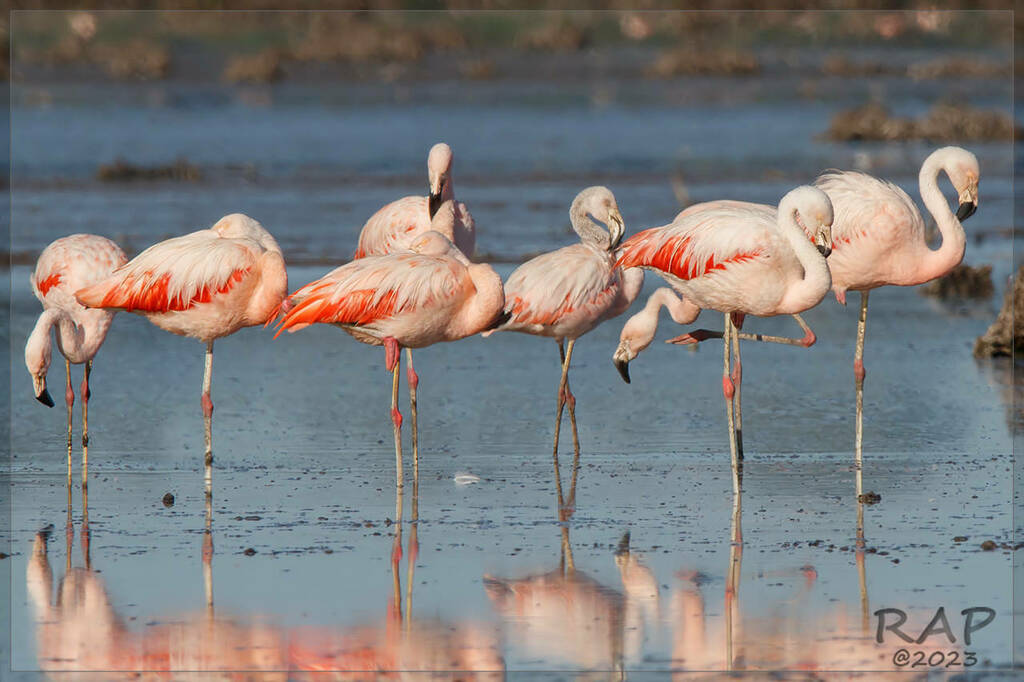
Chilean Flamingo
Photo © RAP
Photo © RAP — CC BY 4.0 — Source: iNaturalist photo #263265663Identification
The Chilean flamingo is a large wading bird standing 110–130 cm tall, closely related to the American flamingo and greater flamingo but distinguishable by several key features. Its plumage is pinker than the greater flamingo but less vivid than the American flamingo. The most reliable identifying marks are its grayish legs with pink joints and its distinctive bill, which is black for more than half its length. Chilean flamingos are also noticeably shorter than American flamingos—about a foot smaller.
Young chicks lack pink coloration entirely, appearing instead gray or peach-colored. They gradually acquire their characteristic pink hue as carotenoid pigments from their diet accumulate in their feathers over 2–3 years. Chilean flamingos reach sexual maturity at 6 years old and are among the longest-lived birds, with lifespans reaching up to 50 years in the wild.
Range & Habitat
Chilean flamingos breed across South America from Ecuador and Peru south to Chile and Argentina, with populations also found eastward in Brazil. These birds are highly specialized, restricting themselves almost exclusively to salt lagoons and soda lakes—alkaline and hypersaline wetlands that offer their preferred feeding conditions but remain vulnerable to disturbance.
Habitat degradation poses the greatest conservation threat to the species. Mining operations and irrigation projects cause rapid and severe habitat loss, while water pollution directly impacts the lagoons and lakes these flamingos depend on for survival. The species is currently listed as Near Threatened on the IUCN Red List.
Behaviour & Diet
Chilean flamingos are intensely social birds, gathering in flocks that can number tens of thousands of individuals. They communicate constantly through vocalizations—honking, grunting, and goose-like calls—with each bird possessing a unique call that allows parents to recognize their offspring among thousands of others. Body language also plays an important role in their social life, with flamingos spending 3.5 to 7 hours daily preening their feathers to maintain waterproofing and flight capability.
These filter feeders have evolved remarkable specialized bills with comb-like structures that allow them to extract food from shallow water while feeding upside down. They consume mainly algae, plankton, crustaceans, insects, and mollusks, processing up to 10% of their body weight daily. Using powerful tongue muscles, they manipulate water through their bill's lamellae to filter different food sizes. Their characteristically long legs serve dual purposes: they help stir up sediment to dislodge prey organisms, and strong evidence suggests standing on one leg reduces heat loss during prolonged feeding sessions in cold water.
Best Time & Places to See It
Chilean flamingos are best observed at their breeding colonies during favorable environmental conditions, when large flocks gather in the salt lagoons and soda lakes of western South America. The birds' dependence on these specific alkaline wetlands makes them somewhat predictable in location, though habitat disturbance means populations can fluctuate significantly. Visit areas within their range in Ecuador, Peru, Chile, and Argentina where salt lagoons and soda lakes remain protected and relatively undisturbed.
Flamingos require crowded breeding conditions to stimulate reproduction, meaning the largest and most active flocks tend to concentrate in prime habitat areas during breeding season. However, their sensitivity to human disturbance means visiting requires respectful distance and local guidance to avoid disrupting these vulnerable populations.
Photography Tips
Photograph Chilean flamingos in early morning or late afternoon light when the low angle emphasizes their distinctive pink plumage and grayish legs with pink joints. Wide-angle shots capturing the sheer scale of large flocks convey their social nature effectively. Focus on their characteristic feeding posture—head inverted in shallow water—which showcases their unique specialized anatomy.
During breeding season, capture the dramatic courtship displays: head flagging (synchronized head-swiveling) and wing salutes (rapid wing opening and closing) are visually striking behaviors. Include the habitat context of salt lagoons and soda lakes to tell the complete story. Always maintain respectful distance to avoid disturbing these Near Threatened birds, and obtain local guidance before approaching breeding colonies.
Schleswig-Holsteinisches Wattenmeer National Park
Germany
+378 birds+49 mammals
Where the North Sea ebbs and flows across a vast expanse of exposed mud and sand, the Schleswig-Holsteinisches Wattenmeer National Park reveals one of Europe's most…
VIEW NATIONAL PARKParque Nacional de Galápagos
Santo Tomás, Ecuador
+139 birds+23 mammals
Volcanic peaks and weathered lava fields dominate this remote archipelago in the Pacific, where the interplay of cold ocean currents and tropical latitude creates an ecological…
VIEW ISLAND & ARCHIPELAGOPeixe National Park Lagoon
Brazil
+293 birds+4 mammals
Where the coastal plains of Rio Grande do Sul meet the Atlantic, Peixe National Park Lagoon sprawls across nearly 2,200 square kilometres of shallow waters, reed…
VIEW NATIONAL PARKHuascarán National Park
Independencia, Peru
+201 birds+5 mammals
Where granite peaks pierce the Andean sky above 6,000 metres, Huascarán National Park sprawls across more than 11,500 square kilometres of Peru's Cordillera Blanca, a landscape…
VIEW NATIONAL PARKCamargue Regional Nature Park
Saintes-Maries-de-la-Mer, France
+378 birds+48 mammals
Where the Rhône Delta sprawls into the Mediterranean, a landscape of stark and haunting beauty emerges—vast salt marshes punctuated by shallow lagoons, reed beds, and scrubland…
VIEW NATURAL PARKSalar del Huasco National Park
Pica, Chile
+75 birds+2 mammals
High above the Atacama's shimmering flats, where the Andes grip the sky, lies a landscape of stark geological drama and surprising biological richness. Salar del Huasco…
VIEW NATIONAL PARKTorres del Paine National Park
Torres del Paine, Chile
+143 birds+10 mammals
Where granite spires pierce the Patagonian sky, Torres del Paine commands one of South America's most dramatic landscapes. Across 4,106 square kilometres of southern Chile, jagged…
VIEW NATIONAL PARKLaja National Park Lagoon
Antuco, Chile
+123 birds+1 mammals
Where the Andes descend into the Biobío Region's temperate forests, a vast lagoon fills the caldera of the extinct Antuco volcano, cradled by steep native woodland…
VIEW NATIONAL PARKLauca National Park
Putre, Chile
+139 birds+17 mammals
Where the Andes rise toward the altiplano in Chile's far north, Lauca National Park sprawls across more than 3,000 square kilometres of some of South America's…
VIEW NATIONAL PARKCerro Castillo National Park
Coyhaique, Chile
+89 birds+3 mammals
Granite peaks and windswept steppe converge across this vast Patagonian landscape, where the Andes' eastern flank drops into terrain sculpted by ice age glaciers and relentless…
VIEW NATIONAL PARKPatagonia National Park
Cochrane, Chile
+133 birds+8 mammals
Where the Andes meet the Patagonian steppe, vast grasslands and shrublands sweep across rolling terrain carved by ancient glaciation, their contours softened by distance and dramatic…
VIEW NATIONAL PARKReserva Nacional las Vicuñas
Putre, Chile
+87 birds+6 mammals
High desert plateaus interlace with volcanic ridges across this 4,204-square-kilometre expanse at the border between Chile and Bolivia, where altitudes exceed 3,500 metres and the climate…
VIEW NATIONAL PARKSalar de Surire Natural Monument
Putre, Chile
+61 birds
High across the Altiplano of northern Chile, where the Andes push toward 4,300 metres and the air thins to a crystalline clarity, lies a vast shallow…
VIEW NATURAL MONUMENTReserva Nacional Magallanes
Punta Arenas, Chile
+78 birds+2 mammals
Where windswept steppe meets sub-Antarctic forest near the southern tip of continental South America, Reserva Nacional Magallanes unfolds across roughly 352 square kilometres of profound ecological…
VIEW NATIONAL PARKParque Provincial Península de Magallanes
Argentina
+125 birds+4 mammals
Granite peaks and windswept steppe converge across this 415-square-kilometre peninsula jutting into the cold Atlantic waters of southern Patagonia, where the Magallanes landscape embodies the raw,…
VIEW NATIONAL PARKMonte León National Park
Argentina
+100 birds+4 mammals
Where the Patagonian steppe meets the Atlantic, Monte León National Park protects a landscape of windswept coastal cliffs, rocky outcrops, and semi-arid grassland spanning over 1,200…
VIEW NATIONAL PARKLos Glaciares National Park
Argentina
+121 birds+3 mammals
Where granite peaks and sprawling ice fields dominate the landscape, Los Glaciares National Park encompasses over ten thousand square kilometres of Patagonian wilderness in southern Argentina.…
VIEW NATIONAL PARKCampos del Tuyú National Park
Argentina
+169 birds+5 mammals
Subtropical forest graces the borderlands where Misiones Province meets Paraguay, a landscape shaped by the Paraná Plateau's weathered topography and the warm, humid climate of northeastern…
VIEW NATIONAL PARKPerito Moreno National Park
Argentina
+78 birds
Where the Patagonian steppe descends into a landscape carved by ancient ice, Perito Moreno National Park sprawls across nearly 1,590 square kilometres of some of South…
VIEW NATIONAL PARKNahuel Huapi National Park
Argentina
+124 birds+11 mammals
Where the Andes descend toward Patagonia, vast glacial lakes cut through a landscape of southern beech forest and granite peaks, creating one of South America's most…
VIEW NATIONAL PARKLanín National Park
Argentina
+128 birds+7 mammals
Where the volcanic spine of the Andes plunges into Patagonian steppe, Lanín National Park sprawls across nearly 4,700 square kilometers of one of Argentina's most visually…
VIEW NATIONAL PARKLago Puelo National Park
Argentina
+109 birds+1 mammals
Where temperate forests descend to crystalline waters in the foothills of the Andes, Lago Puelo National Park sprawls across nearly 300 square kilometers of pristine wilderness…
VIEW NATIONAL PARKLos Alerces National Park
Argentina
+84 birds+3 mammals
Where the temperate rainforests of southern Patagonia sweep down towards crystalline lakes, Los Alerces National Park unfolds across nearly 3,000 square kilometres of one of South…
VIEW NATIONAL PARKDon Edwards San Francisco Bay National Wildlife Refuge
Fremont, United States
+286 birds+20 mammals
Where the San Francisco Bay's shallow margins dissolve into tidal salt marshes and mudflats, this wildlife sanctuary preserves one of California's most ecologically vital estuarine systems.…
VIEW WILDLIFE SANCTUARYNo community photos yet. Log in to add the first one.
No community observations of this species yet.