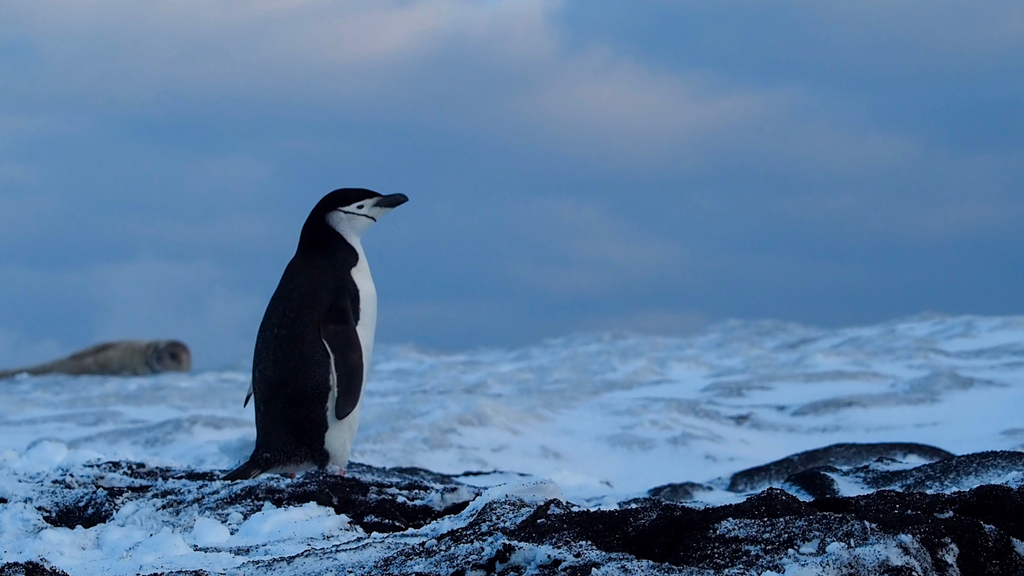
Chinstrap Penguin
Photo © Ellen Rykers
Photo © Ellen Rykers — CC BY 4.0 — Source: iNaturalist photo #25625437Identification
The chinstrap penguin is a medium-sized penguin, 68–76 cm long and weighing 3.2–5.3 kg, with males larger than females. Its most distinctive feature is the narrow black band running under its head like a helmet strap—hence the name. The bird has a white face extending behind reddish-brown eyes, a white chin and throat, and a short black bill. Its back is black and underside white, providing effective camouflage from above and below. The flippers are black with white edges and white inner sides, while the strong legs and webbed feet are striking pink. Its short, stumpy legs produce a characteristic waddling gait on land.
Range & Habitat
Chinstrap penguins have a circumpolar distribution throughout the Southern Ocean. They breed in Antarctica, Argentina, Bouvet Island, Chile, the French Southern Territories, and South Georgia and the South Sandwich Islands, with vagrant individuals occasionally recorded in New Zealand, Saint Helena, Tristan da Cunha, and South Africa. They inhabit various islands and shores in the Southern Pacific and Antarctic Oceans, building circular stone nests in breeding colonies.
Behaviour & Diet
These penguins feed on small fish, krill, shrimp, and squid, swimming up to 80 km offshore daily to hunt. Tightly packed feathers, thick blubber, and specialized blood vessels in their flippers and legs enable them to thrive in freezing waters. Chinstraps are notably the most aggressive penguin species, defending nesting grounds vigorously against predators, humans, and other penguin species. They lay two eggs in stone nests, with both parents incubating in six-day shifts. Chicks hatch after 37 days, fledge around 50–60 days old, and famously microsleep over 10,000 times daily in four-second intervals, accumulating about 11 hours of sleep per hemisphere.
Best Time & Places to See It
The breeding season offers the best opportunity to observe chinstraps at their colonies in South Georgia, the South Sandwich Islands, and Antarctic Peninsula regions. Their loud, harsh calls make them easy to locate during this period. Shore-based visits to breeding colonies provide excellent viewing opportunities, though visitors should maintain respectful distance from these temperamental birds and their nesting sites.
Photography Tips
The chinstrap's striking facial markings and bold countershading make it highly photogenic. Photograph against the blue ocean or ice to showcase the white underside and black back. The waddling gait on land offers amusing action shots. During breeding season, capture nesting behavior and the fluffy grey-and-white chicks. Use fast shutter speeds to freeze movement in water. The pink feet and reddish eyes provide excellent detail shots. Early morning or late afternoon light enhances the contrast between their dark and light plumage.
Deception Island
Gabriel de Castilla Base, Antarctica
+26 birds+10 mammals
Steaming geothermal vents pierce a landscape of blackened volcanic sand and ice, where the earth's raw power still trembles beneath your feet. This horseshoe-shaped caldera, flooded…
VIEW ISLAND & ARCHIPELAGOCuverville Island
Cuverville Island, Antarctica
+19 birds+10 mammals
Granite peaks and sculpted ice define this windswept archipelago off the Antarctic Peninsula, where steep rocky shores plunge into waters thick with drifting brash ice. Cuverville…
VIEW ISLAND & ARCHIPELAGONeko Harbour
Neko Harbour, Antarctica
+18 birds+10 mammals
Towering peaks of fractured ice rise abruptly from gunmetal waters, their faces scarred by millennia of glacial advance and retreat. This pocket of the Antarctic Peninsula…
VIEW PROTECTED LANDSCAPEParadise Bay
Brown Station, Antarctica
+18 birds+9 mammals
Where the Antarctic Peninsula's rugged coastline meets the Southern Ocean, Brown Station stands sentinel over Paradise Bay—a protected landscape of ice-carved inlets, towering glacial faces, and…
VIEW PROTECTED LANDSCAPEBrown Bluff
Brown Bluff, Antarctica
+23 birds+9 mammals
Where rust-colored volcanic peaks pierce the Antarctic Peninsula's icy realm, a geologist's dreamscape unfolds beneath towering cliffs of iron oxide and ancient lava. Brown Bluff rises…
VIEW PROTECTED LANDSCAPEPort Lockroy
Port Lockroy, Antarctica
+19 birds+9 mammals
Towering peaks of black rock pierce through Antarctic pack ice on the Gerlache Strait, where one of the continent's most accessible harbors cradles a living microcosm…
VIEW PROTECTED LANDSCAPEHalf Moon Island
Cámara Base, Antarctica
+25 birds+8 mammals
Jagged volcanic peaks rise from the cobalt waters of the South Shetland Islands, their slopes carpeted in moss and lichen where hardy vegetation clings to windswept…
VIEW ISLAND & ARCHIPELAGOPetermann Island
Petermann Island, Antarctica
+16 birds+9 mammals
Icebound cliffs rise dramatically from the Bellingshausen Sea, their weathered faces sculpted by millennia of Antarctic wind and tide. This slender wedge of rock and ice,…
VIEW ISLAND & ARCHIPELAGOPaulet Island
Paulet Island, Antarctica
+20 birds+6 mammals
Windswept ice and weathered rock converge at this remote Antarctic outcrop, where jagged peaks pierce through perpetual pack ice and glacial moraines descend toward cobalt waters.…
VIEW ISLAND & ARCHIPELAGODanco Island
Danco Island, Antarctica
+17 birds+10 mammals
Dramatic black rock pierces the Antarctic Peninsula's icy waters, crowned with permanent snow and ringed by calving glaciers that thunder into the sea. This volcanic outcrop…
VIEW ISLAND & ARCHIPELAGOWilhelmina Bay
Wilhelmina Bay, Antarctica
+20 birds+10 mammals
Sheer cliffs of black volcanic rock plunge into waters so pristine they reflect the Antarctic sky like polished obsidian. This remote western Antarctic inlet, ringed by…
VIEW PROTECTED LANDSCAPELemaire Channel
Orne Harbour, Antarctica
+25 birds+13 mammals
Where granite peaks plunge into steel-grey waters, the Lemaire Channel carves one of Antarctica's most dramatic passages. This narrow strait, squeezed between the Antarctic Peninsula and…
VIEW PROTECTED LANDSCAPESalisbury Plain
South Georgia, South Georgia and the South Sandwich Islands
+33 birds+4 mammals
Where tussock grasses bow to relentless Antarctic winds and glacial meltwater carves braided channels through obsidian volcanic soil, one of Earth's most remote wildlife sanctuaries reveals…
VIEW PROTECTED LANDSCAPESt. Andrews Bay
South Georgia, South Georgia and the South Sandwich Islands
+34 birds+6 mammals
Where windswept tundra dissolves into obsidian beaches, one of the planet's most extraordinary wildlife theaters unfolds across St. Andrews Bay. This remote corner of South Georgia…
VIEW PROTECTED LANDSCAPEFortuna Bay
Stromness, South Georgia and the South Sandwich Islands
+37 birds+5 mammals
Where tussock grasslands sweep down to black-sand beaches and elephant seals haul out in thunderous colonies, the raw sub-Antarctic landscape reveals itself in its most dramatic…
VIEW PROTECTED LANDSCAPEPrion Island
Prince Olav Harbour, South Georgia and the South Sandwich Islands
+36 birds+2 mammals
Windswept tussock grasslands rise sharply from boulder-strewn beaches where the Southern Ocean hurls its grey swells against black volcanic rock. This remote speck in South Georgia's…
VIEW ISLAND & ARCHIPELAGOCooper Bay
Cooper Bay, South Georgia and the South Sandwich Islands
+28 birds+5 mammals
Where black-sand beaches meet towering cliffs striped with cascading meltwater, one of the Southern Ocean's most dramatic amphitheaters reveals itself. Cooper Bay cuts a deep indent…
VIEW PROTECTED LANDSCAPEElsehul Bay
Bird Island Station, South Georgia and the South Sandwich Islands
+33 birds+4 mammals
Granite peaks rise sheer from the Southern Ocean, their weathered faces streaked with cascading meltwater and cloaked in tussock grass that bends beneath relentless winds. This…
VIEW PROTECTED LANDSCAPENo community photos yet. Log in to add the first one.
No community observations of this species yet.