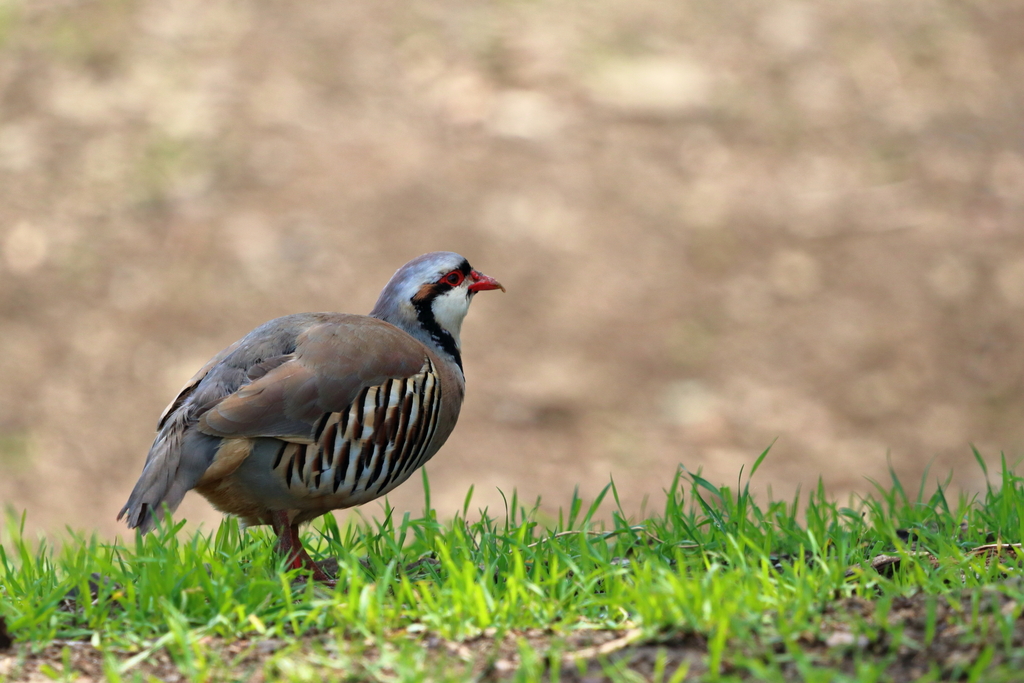
Chukar Partridge
Photo © Donsky
Photo © Donsky — CC BY 4.0 — Source: iNaturalist photo #499460116Identification
The chukar partridge is a rotund gamebird measuring 32–35 cm in length, immediately recognizable by its distinctive facial markings and colourful plumage. The bird's most striking feature is a sharply defined black gorget (throat band) that runs from the forehead across the eye and down the head, framing a white face and throat like a necklace. The back is light brown, the breast grey, and the belly buff-coloured, with rufous-streaked flanks adding warmth to the overall appearance. Bright coral-red bill and legs complete this attractive package. Sexes are similar in plumage, though females are slightly smaller and lack the male's leg spur.
The chukar's distinctive call—a noisy "chuck-chuck-chukar-chukar"—is how the species gets its name and makes identification by sound straightforward in the field. This partridge is very similar to the rock partridge, but the chukar is noticeably browner on the back and has a yellowish tinge to the foreneck. The sharply defined gorget also distinguishes it from the red-legged partridge, whose black collar breaks into dark streaks near the breast.
Range & Habitat
Native to Asia, the chukar partridge occupies a wide but fragmented range across the Middle East and temperate Asia, from Israel, Jordan, Lebanon, and Syria eastward through Turkey, Iran, Afghanistan, Pakistan, and India, along the inner ranges of the western Himalayas to Nepal. The species also occurs in parts of southeastern Europe including Bulgaria and Greece, and barely extends into Africa on the Sinai Peninsula. In its native range, the chukar favours rocky open hillsides with grass, scattered scrub, or cultivation. Altitude varies considerably: in Israel and Jordan it occurs as low as 400 metres below sea level in the Dead Sea area, while in eastern regions it typically inhabits elevations of 2,000 to 4,000 metres, except in Pakistan where it descends to around 600 metres. Importantly, the species avoids areas of high humidity or rainfall.
The chukar's appeal as a gamebird has led to widespread introductions across the globe, with feral populations now established in parts of North America (particularly the Rocky Mountains, Great Basin, and high desert areas of California), Canada, Chile, Argentina, New Zealand, and Hawaii. In North America, introduced populations thrive in dry, rocky terrain, especially around the Columbia Basin and the Snake River region of Washington and Oregon. A small population persists on Robben Island in South Africa since its introduction there in 1964.
Behaviour & Diet
The chukar partridge is an upland gamebird well-adapted to rocky, arid terrain. Its fast flight and ability to fly considerable distances make it a challenging quarry for hunters, and recovery of shot birds can be difficult. The species' population numbers are largely influenced by weather patterns during the breeding season rather than by hunting pressure or habitat loss, suggesting it is relatively resilient to such disturbances. The bird's noisy, distinctive call makes it conspicuous during the breeding season.
One conservation concern worth noting is the chukar's readiness to interbreed with the red-legged partridge. Captive-bred hybrids have been released in various regions for hunting purposes, and this practice has been banned in several countries, including the United Kingdom, due to the threat posed to wild populations of both parent species.
Best Time & Places to See It
For travellers and photographers hoping to encounter wild chukar partridges, the native range across the Middle East and Asia remains the most reliable destination. In the western Palearctic, rocky hillsides and upland areas of Turkey, Iran, Afghanistan, Pakistan, and the Indian Himalayas offer the best opportunities. The species is present year-round throughout much of its range, though breeding season activity—marked by increased calling and visibility—occurs during the warmer months and may offer better viewing chances.
In North America, where introduced populations are well-established, the dry, rocky terrain of the western United States, particularly around the Columbia Basin and Snake River areas of Washington and Oregon, provides accessible opportunities to observe feral populations. New Zealand also hosts established populations in suitable habitat. The chukar's preference for rocky open hillsides means they are often visible in relatively open terrain, though their fast flight and ability to disappear quickly into scrub require patience and sharp eyes.
Photography Tips
The chukar's striking facial markings and colourful plumage make it an attractive photographic subject. The bird's bright coral-red bill and legs provide excellent colour contrast against the lighter plumage tones. Early morning or late afternoon light will enhance the subtle shades of brown, grey, and buff on the back and underparts, while also highlighting the distinctive black gorget and white face markings.
Be prepared for challenging shooting conditions: the chukar's preference for rocky, open hillsides often means you will be working in harsh, direct sunlight with limited cover. The bird's fast flight and tendency to flee quickly into scrub demands a fast shutter speed and continuous autofocus. Patience and stealth are essential when approaching these wary gamebirds, and early morning when birds are feeding may provide the best photographic opportunities before they become alert and flush.
Schleswig-Holsteinisches Wattenmeer National Park
Germany
+378 birds+49 mammals
Where the North Sea ebbs and flows across a vast expanse of exposed mud and sand, the Schleswig-Holsteinisches Wattenmeer National Park reveals one of Europe's most…
VIEW NATIONAL PARKGangotri National Park
Bhatwari, India
+119 birds+1 mammals
Where the Bhagirathi River carves through the western Himalayas in northern Uttarakhand, Gangotri National Park rises across steep alpine terrain that defines the boundary between temperate…
VIEW NATIONAL PARKCanyonlands National Park
Wayne County, United States
+186 birds+15 mammals
Where the Colorado River has carved an intricate labyrinth through the high desert plateau of southeastern Utah, Canyonlands National Park sprawls across nearly 3,030 square kilometres…
VIEW NATIONAL PARKPinnacles National Park
San Benito County, United States
+197 birds+33 mammals
Jagged volcanic spires thrust from chaparral-covered ridges across 222 square kilometers of central California's inner Coast Ranges, their pale stone crowns catching the afternoon light like…
VIEW NATIONAL PARKJoshua Tree National Park
Riverside County, United States
+221 birds+23 mammals
Across 5,610 square kilometers of Riverside County's high desert, a landscape of geological drama unfolds where granite monoliths pierce through bajadas of creosote scrub and Joshua…
VIEW NATIONAL PARKGreat Basin National Park
White Pine County, United States
+170 birds+19 mammals
Where the Great Basin's high desert plateaus rise above 10,000 feet, ancient bristlecone pines endure on moonscape ridges of limestone and quartzite, creating one of North…
VIEW NATIONAL PARKArches National Park
Grand County, United States
+185 birds+20 mammals
Where rust-red sandstone fins rise abruptly from high desert scrubland, Arches National Park spans 548 square kilometers of one of North America's most sculptural landscapes. The…
VIEW NATIONAL PARKZion National Park
Washington County, United States
+244 birds+30 mammals
Towering sandstone cliffs in shades of crimson, rust, and cream rise abruptly from the Virgin River's winding canyon floor, their sculpted faces bearing witness to millions…
VIEW NATIONAL PARKMesa Verde National Park
Montezuma County, United States
+166 birds+10 mammals
Across the high desert plateau of southwestern Colorado, where sandstone mesas rise abruptly from piñon-juniper scrubland, Mesa Verde National Park preserves one of North America's most…
VIEW NATIONAL PARKCapitol Reef National Park
Garfield County, United States
+196 birds+22 mammals
Wrinkled ridges of crimson and gold sandstone rise from the floor of south-central Utah, their weathered faces carved by the Fremont River into one of the…
VIEW NATIONAL PARKHawaiʻi Volcanoes National Park
Hawaiʻi County, United States
+84 birds+2 mammals
Where volcanic slopes descend toward the Pacific across more than five thousand square kilometers, Hawaiʻi Volcanoes National Park presents one of Earth's most dynamic laboratories of…
VIEW NATIONAL PARKBlack Canyon of the Gunnison National Park
Montrose County, United States
+169 birds+13 mammals
Where the Gunnison River has carved one of North America's steepest and most dramatic canyons, ancient metamorphic rock walls plunge nearly 2,000 feet in places, creating…
VIEW NATIONAL PARKSequoia National Park
Tulare County, United States
+187 birds+27 mammals
Granite peaks rising above 3,600 meters dominate the southern Sierra Nevada, where Sequoia National Park sprawls across one of North America's most vertically compressed wilderness zones.…
VIEW NATIONAL PARKKings Canyon National Park
Fresno County, United States
+186 birds+20 mammals
Where granite peaks fracture the Sierra Nevada skyline and the Kings River has carved one of North America's most dramatic canyons, a landscape of extreme relief…
VIEW NATIONAL PARKDeath Valley National Park
Inyo County, United States
+339 birds+25 mammals
Across nearly 3.5 million acres of southeastern California's Inyo County, vast salt flats meet sculpted badlands and alluvial fans in a landscape so extreme it defines…
VIEW NATIONAL PARKHautes-Gorges-De-La-Rivière-Malbaie National Park
Mont-Élie, Canada
+140 birds+8 mammals
Where the Rivière-Malbaie carves through the Laurentian highlands, steep-sided gorges rise dramatically above Quebec's coastal hinterland, their ancient bedrock sculpted by millennia of water and ice.…
VIEW NATIONAL PARKMont-Tremblant National Park
Lac-des-Dix-Milles, Canada
+200 birds+12 mammals
Where the Laurentian plateau rises in central Quebec, a landscape of boreal forest and glacially carved lakes unfolds across nearly 3,100 square kilometres of protected wilderness.…
VIEW NATIONAL PARKTusheti National Park
Shavtskala, Georgia
+97 birds+4 mammals
Where granite peaks pierce the Caucasian sky at over 4,600 meters, ancient river valleys carve their way through one of Europe's most untamed wilderness regions. Tusheti's…
VIEW NATIONAL PARKJavakheti National Park
Bozali, Georgia
+138 birds
Dawn breaks over a high-altitude plateau where volcanic peaks pierce the Caucasian sky, their slopes cloaked in alpine meadows that stretch toward horizons of impossible clarity.…
VIEW NATIONAL PARKTuscan Archipelago National Park
Rio, Italy
+174 birds+8 mammals
Where the Tyrrhenian Sea fragments into granite and schist islands, the Arcipelago Toscano National Park protects one of the Mediterranean's most biodiverse maritime realms. Scattered across…
VIEW NATIONAL PARKMonti Sibillini National Park
Castelsantangelo sul Nera, Italy
+113 birds+11 mammals
Where the Apennines rear their limestone spine across central Italy, the Sibillini Mountains National Park reveals a landscape of dramatic vertical relief, high plateaus, and deeply…
VIEW NATIONAL PARKNanda Devi National Park
Garpak, India
+218 birds+5 mammals
Where the Himalayas surge into their most dramatic alpine amphitheater, a wilderness of raw geological power unfolds across 624 square kilometers of pristine terrain. Nanda Devi,…
VIEW NATIONAL PARKHemis National Park
Raigahar Dhar, India
+131 birds+13 mammals
Where granite gorges cleave through the Himalayas at dizzying altitudes, a vast wilderness of alpine desert unfolds across the rain shadow of Ladakh. Hemis sprawls across…
VIEW NATIONAL PARKGobi Gurvan Saikhan National Park
Tsagaan Subarga Hural, Mongolia
+183 birds+23 mammals
Where rust-coloured badlands rise from the southern Gobi steppe, the terrain transforms into a landscape of geological drama that few visitors expect to find in Mongolia's…
VIEW NATIONAL PARKMount Ainos National Park
Sami Municipal Unit, Greece
+118 birds+1 mammals
Where limestone and conglomerate peaks rise dramatically above the Ionian Sea, Mount Ainos commands the landscape of Kefalonia with a rugged majesty that few Mediterranean summits…
VIEW NATIONAL PARKMount Parnitha National Park
Municipal Unit of Acharnes, Greece
+137 birds+4 mammals
Where pine-clad ridges rise abruptly from the Attica plains, Mount Parnitha National Park unfolds across nearly 4,000 hectares of Mediterranean mountain wilderness. The park's defining character…
VIEW NATIONAL PARKSounio National Park
Municipal Unit of Ayios Konstantinos, Greece
+103 birds
Where rocky headlands plunge into the Aegean Sea along Attica's southeastern coast, Sounio National Park preserves a landscape shaped by millennia of human presence yet alive…
VIEW NATIONAL PARKBryce Canyon National Park
Tropic, United States
+202 birds+20 mammals
Hoodoos rise like a forest of stone pillars from an amphitheater carved into Utah's high plateau, where the Paunsaugunt elevates the landscape to over 9,000 feet…
VIEW NATIONAL PARKGrand Canyon National Park
United States
+277 birds+35 mammals
A mile-deep chasm of rust-red rock and purple shadow cuts through the high desert plateau of northern Arizona, revealing nearly two billion years of geological history…
VIEW NATIONAL PARKHaleakalā National Park
Maui County, United States
+66 birds+4 mammals
Ascending from sea level to over 10,000 feet across a mere thirty miles, Haleakalā National Park commands one of the Pacific's most dramatic elevation gradients, where…
VIEW NATIONAL PARKMalheur National Wildlife Refuge
Harney County, United States
+309 birds+24 mammals
Across the high desert plateau of southeastern Oregon, where sagebrush scrubland stretches toward distant ridgelines under an enormous sky, lies a sanctuary shaped by water in…
VIEW WILDLIFE SANCTUARYTule Lake National Wildlife Refuge
Siskiyou County, United States
+255 birds+9 mammals
Across the high volcanic plateau of northeastern California, where summer heat scorches the alkali flats and winter winds sweep unobstructed through open water and marsh, Tule…
VIEW WILDLIFE SANCTUARYBear River Migratory Bird Refuge
Box Elder County, United States
+254 birds+9 mammals
Where the Bear River winds through the semi-arid basin country of northwestern Utah, a sprawling wildlife sanctuary transforms the high desert into a haven for migratory…
VIEW WILDLIFE SANCTUARYSeedskadee National Wildlife Refuge
Sweetwater County, United States
+209 birds+8 mammals
Where the Green River carves through the high-desert basin of southwestern Wyoming, Seedskadee National Wildlife Sanctuary preserves one of the West's most vital riparian corridors. The…
VIEW WILDLIFE SANCTUARYNo community photos yet. Log in to add the first one.
No community observations of this species yet.