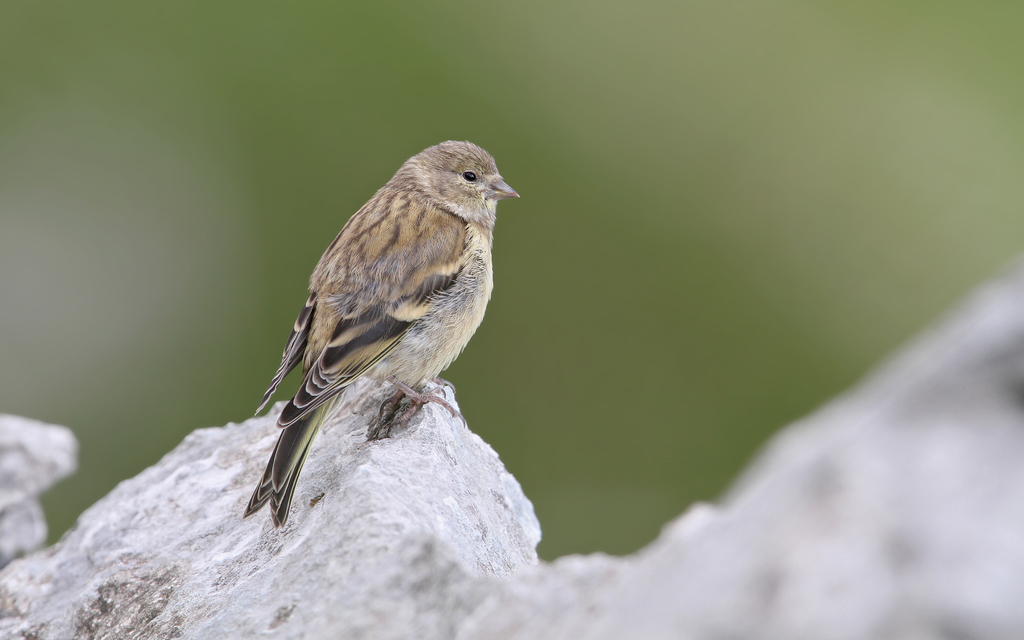
Citril Finch
Photo © Christoph Moning
Photo © Christoph Moning — CC BY 4.0 — Source: iNaturalist photo #101434836Identification
The Citril Finch is a tiny songbird measuring just 12 cm in length and weighing around 12.5 g, making it a delicate presence in alpine landscapes. It is greyish above with a distinctive brown-tinged back marked by black streaks. The most striking features are its bright yellow underparts, double yellow wing bars, and a prominent yellow face mask that gives the bird an instantly recognizable appearance. The song is a silvery twittering that resembles its close relatives, the European Goldfinch and European Serin, while its main call is a distinctive tee-ee, similar to the Eurasian Siskin.
The sexes are very similar in appearance, though young females may show duller yellow on the underparts. Juvenile birds lack the vibrant yellow and green plumage of adults, instead appearing brownish—a useful distinction when identifying young birds in the field. Its small size, yellow coloring, and compact build make it unmistakable once you've learned its key features.
Range & Habitat
The Citril Finch is a resident breeder in the mountains of southwestern Europe, with its range extending from Spain eastward to the Alps, and northward to the Black Forest in southwestern Germany. This alpine specialist is highly restricted in its habitat preferences, favoring subalpine coniferous forests and Alpine meadows where it can nest among conifers such as pines and spruces. Unlike its close relative, the Corsican Finch, which inhabits a broader range of elevations and habitats, the mainland Citril Finch remains largely faithful to these montane coniferous zones.
Behaviour & Diet
The Citril Finch shares characteristics common to its genus, being closely related to the European Goldfinch and belonging to the true finch family. As a resident breeder in European mountains, it maintains territories throughout the year in its preferred alpine and subalpine environments. Its diet and detailed foraging behavior reflect its adaptation to mountain ecosystems, though specific feeding preferences are typical of finches that exploit seeds and small vegetation in their high-altitude habitats.
Best Time & Places to See It
To encounter the Citril Finch, head to the mountain ranges of southwestern Europe during the breeding season. Key locations include the Alps, Spanish mountains, and the Black Forest of Germany. The bird's status as a year-round resident in these regions means sightings are possible throughout the year, though spring and summer offer the best opportunities for observation when breeding birds are most active and vocal. Look for them in subalpine coniferous forests and adjacent Alpine meadows.
Photography Tips
The Citril Finch's small size and mountain habitat demand patience and appropriate equipment. Use a telephoto lens to capture the bird's striking yellow face mask, wing bars, and underparts without disturbing it. Early morning light in alpine meadows is ideal for photographing the bird's vibrant plumage. Focus on perched birds singing from conifers, as this is when they are most conspicuous. The contrast between the greyish-brown back and bright yellow underparts provides excellent photographic opportunities when properly lit.
Monfragüe National Park
Torrejón el Rubio, Spain
+219 birds+10 mammals
Where the Tagus River cuts through limestone plateaus in central Extremadura, Monfragüe National Park rises as a fortress of Mediterranean and Atlantic woodland, its dramatic rocky…
VIEW NATIONAL PARKPicos de Europa National Park
Posada de Valdeón, Spain
+166 birds+26 mammals
Where limestone massifs rise abruptly from the Castilian plateau, the Picos de Europa create one of Spain's most dramatic mountain wilderness areas. The park's jagged peaks,…
VIEW NATIONAL PARKCañón del Río Lobos Natural Park
Santa María de las Hoyas, Spain
+136 birds+2 mammals
Where the Río Lobos carves its relentless path through the Iberian plateau, limestone cliffs rise in dramatic ramparts above a ribbon of water that has spent…
VIEW NATURAL PARKPosets–maladeta Natural Park
Benasque, Spain
+122 birds+9 mammals
Where granite gorges cut through the High Pyrenees, Posets–Maladeta Natural Park rises as one of Spain's most formidable alpine landscapes. Straddling the Huesca province along the…
VIEW NATURAL PARKSierra Nevada National Park
Válor, Spain
+137 birds+7 mammals
Where granite ridges rise above 3,000 metres across the Alpujarra foothills, Sierra Nevada National Park crowns southern Spain's most dramatic mountain landscape. The park encompasses a…
VIEW NATIONAL PARKOrdesa y Monte Perdido National Park
Sobrarbe, Spain
+162 birds+13 mammals
Where limestone cliffs soar a thousand metres above cascading rivers, the Pyrenean massif reveals itself in its most dramatic form. Ordesa y Monte Perdido National Park…
VIEW NATIONAL PARKCabo de Gata-Níjar Natural Park
San José, Spain
+274 birds+11 mammals
Where volcanic ridges plunge toward the Mediterranean, Cabo de Gata-Níjar Nature Park unfolds across one of Europe's most arid coastlines, a landscape sculpted by tectonic violence…
VIEW NATURAL PARKMontaña Palentina Natural Park
Vidrieros, Spain
+180 birds+29 mammals
Where the Cantabrian mountains rise above the Palencia plateau, Montaña Palentina Nature Park sprawls across nearly 1,500 square kilometres of some of northern Spain's most dramatic…
VIEW NATURAL PARKRedes Natural Park
Arrobio, Spain
+163 birds+16 mammals
Where the Picos de Europa cast their shadow westward, the Redes Nature Park sprawls across nearly 600 square kilometres of Asturian limestone and schist, a wild…
VIEW NATURAL PARKCévennes National Park
Vebron, France
+187 birds+63 mammals
Where granite gorges slice through the limestone plateaux of southern France, the Cévennes Cœur National Park unfolds across nearly 3,500 square kilometres of one of Europe's…
VIEW NATIONAL PARKMercantour National Park
Isola, France
+146 birds+32 mammals
Where alpine meadows surrender to vertiginous limestone cliffs, the Mercantour's beating heart pulses with Mediterranean and Alpine rhythms. This 4,221-square-kilometre sanctuary straddles France's southeastern border, its…
VIEW NATIONAL PARKÉcrins National Park
La Chapelle-en-Valgaudémar, France
+143 birds+36 mammals
Where granite peaks and Alpine meadows converge across nearly 2,100 square kilometres, Écrins National Park forms one of the wildest mountainous strongholds of the French Alps.…
VIEW NATIONAL PARKVanoise National Park
Val-Cenis, France
+107 birds+29 mammals
Where the French Alps rise in serrated ranks above the Maurienne valley, Vanoise National Park sprawls across more than 1,700 square kilometres of high-altitude wilderness—a realm…
VIEW NATIONAL PARKSierra de Guadarrama National Park
Rascafría, Spain
+179 birds+13 mammals
Where granite peaks rise abruptly from the central Spanish plateau, the Sierra de Guadarrama National Park unfolds across more than eleven hundred square kilometres of montane…
VIEW NATIONAL PARKSierra de Cazorla, Segura y las Villas Nature Park
Las Canalejas, Spain
+176 birds+21 mammals
Where granite gorges slice through mountainous terrain in eastern Andalusia, the Sierra de Cazorla, Segura y las Villas Nature Park sprawls across more than 5,200 square…
VIEW NATURAL PARKParc del Foix
Castellet i la Gornal, Spain
+180 birds+4 mammals
Where the Foix River carves through limestone ridges southwest of Barcelona, a natural park of modest area but outsized ecological richness unfolds across roughly 37 square…
VIEW NATURAL PARKParc del Garraf
Rat-Penat, Spain
+190 birds+15 mammals
Where limestone ridges rise abruptly from the Mediterranean coastal plain, Parc Natural del Garraf unfolds across 319 square kilometers of one of Catalonia's most dramatic protected…
VIEW NATURAL PARKCollserola Natural Park
Barcelona, Spain
+194 birds+20 mammals
Where Mediterranean scrubland rises steeply from Barcelona's urban edge, Collserola unfolds across 173 square kilometres of low mountains that form a crucial ecological buffer between city…
VIEW NATURAL PARKCadí Moixeró Natural Park
Bor, Spain
+172 birds+21 mammals
Cadí-Moixeró Natural Park is one of the largest and most spectacular protected areas in Catalonia, located in the heart of the eastern Pyrenees. Covering more than…
VIEW NATURAL PARKMontseny Natural Park
Viladrau, Spain
+156 birds+30 mammals
The Montseny Natural Park is one of Catalonia’s most remarkable protected areas, offering an extraordinary blend of biodiversity, scenic landscapes, and cultural heritage within easy reach…
VIEW NATURAL PARKEspacio Natural Remolar-Filipinas
El Prat del Llobregat, Spain
+297 birds+7 mammals
Where the Llobregat River delta meets the Mediterranean, a patchwork of salt marshes, reed beds, and shallow lagoons creates one of Catalonia's most dynamic wetland ecosystems.…
VIEW NATURE RESERVEMontaña de Montserrat Natural Park
Marganell, Spain
+149 birds+10 mammals
Where granite monoliths erupt from the Mediterranean scrubland like cathedral spires, an otherworldly landscape unfolds across Catalonia's most dramatic mountain reserve. These iconic sandstone and conglomerate…
VIEW NATURAL PARKValles Occidentales Natural Park
Siresa, Spain
+168 birds+20 mammals
Where granite gorges slice through the western Pyrenean foothills, steep valleys carved by ancient rivers create a mosaic of Mediterranean scrubland, beech forests, and alpine meadows.…
VIEW NATURAL PARKSierra de Gredos Regional Park
Candeleda, Spain
+180 birds+18 mammals
Where granite peaks claw at 2,592 metres and alpine meadows give way to cork oak scrubland, Spain's central highlands reveal a landscape of remarkable vertical drama.…
VIEW NATURE RESERVECamargue Regional Nature Park
Saintes-Maries-de-la-Mer, France
+378 birds+48 mammals
Where the Rhône Delta sprawls into the Mediterranean, a landscape of stark and haunting beauty emerges—vast salt marshes punctuated by shallow lagoons, reed beds, and scrubland…
VIEW NATURAL PARKBosques de Plan
San Juan de Plan, Spain
+124 birds+4 mammals
Where granite peaks plunge into beech and fir forests, the Pyrenean valleys of Bosques de Plan unfold in dramatic tiers of ancient woodland. This wilderness in…
VIEW FOREST & JUNGLERegional Park of the Catalan Pyrenees
Olette, France
+244 birds+63 mammals
Where granite peaks thrust skyward above cloud-laden valleys, a wild tapestry of Mediterranean and alpine ecosystems interweaves across the Franco-Spanish frontier. These Pyrenean slopes harbour extraordinary…
VIEW NATURE RESERVEDirigida Laguna de Gallocanta Nature Reserve
Las Cuerlas, Spain
+250 birds+7 mammals
Where continental steppe meets the vast mirror of inland water, Spain's largest natural lagoon reveals a landscape of haunting beauty. The shallow alkaline lake, cradled in…
VIEW NATURE RESERVESchwarzwald National Park
Baiersbronn, Germany
+120 birds+18 mammals
Where dense spruce forests give way to ancient beech woodlands and windswept moorlands, one of Central Europe's most ecologically vital landscapes unfolds across the Black Forest.…
VIEW NATIONAL PARKMontes de Málaga Natural Park
Málaga, Spain
+159 birds+7 mammals
Where cork oak and pine forest sweep across the rugged hills inland from the Costa del Sol, the Montes de Málaga Nature Park unfolds as a…
VIEW NATURAL PARKPorts Natural Park
Alfara de Carles, Spain
+157 birds+13 mammals
Where the eastern Catalan ranges descend toward the Mediterranean, a sprawling mosaic of Mediterranean scrubland, pine woodland, and rocky limestone terrain defines Ports Natural Park, a…
VIEW NATURAL PARKSierra y Cañones de Guara Natural Park
Casbas de Huesca/Casbas de Uesca, Spain
+175 birds+10 mammals
Where limestone gorges slice through the pre-Pyrenean foothills of Aragon, the Sierra y Cañones de Guara sprawls across nearly 940 square kilometers of one of Spain's…
VIEW NATURE RESERVESerra de Mariola Natural Park
Bocairent, Spain
+164 birds+19 mammals
Where limestone ridges rise above the Valencian interior, Serra de Mariola unfolds across 225 square kilometers of Mediterranean mountain terrain that shifts between dense evergreen woodland,…
VIEW NATURE RESERVECapçaleres del Ter i del Freser Natural Park
La Farga, Spain
+125 birds+20 mammals
Where the eastern Pyrenees yield their first waters, granite gorges slice through dense forests of beech and fir, creating one of Catalonia's most hydrologically vital landscapes.…
VIEW NATURAL PARKSierra de Huétor Natural Park
Huétor Santillán, Spain
+126 birds+3 mammals
Where limestone ridges pierce the Mediterranean sky above Granada, a 273-square-kilometre sanctuary of pine forest and alpine meadow rises to nearly 2,400 metres. This protected landscape,…
VIEW NATURAL PARKStelvio National Park
Valfurva, Italy
+116 birds+17 mammals
Where granite peaks rise above three thousand metres and alpine meadows give way to rocky scree, Stelvio National Park guards one of Europe's most dramatically vertical…
VIEW NATIONAL PARKGran Paradiso National Park
Cogne, Italy
+120 birds+16 mammals
Where the western Alps rise steeply above the Aosta Valley, granite ridges and alpine meadows converge in a landscape shaped as much by glacial history as…
VIEW NATIONAL PARKSomiedo Natural Park
Pola de Somiedo, Spain
+165 birds+25 mammals
Where granite gorges cleave through the Cantabrian Mountains of northern Spain, alpine meadows roll toward beech and oak forests in a landscape virtually untouched by industrial…
VIEW NATURAL PARKSierra de Boumort
Segan, Spain
+145 birds+13 mammals
Where granite gorges slice through the Catalan Pyrenees, ancient limestone cliffs rise in dramatic ramparts above dense Mediterranean forests. This wild corner of northeastern Spain harbors…
VIEW MOUNTAIN & ALPINEMontañas de Prades
Capafonts, Spain
+151 birds+13 mammals
Where granite peaks rise abruptly from the Tarragona hinterland, a wild mosaic of pine forests, scrubland, and limestone cliffs creates one of northeastern Spain's most biodiverse…
VIEW MOUNTAIN & ALPINEBosc de Virós
Ainet de Besan, Spain
+126 birds+10 mammals
Where the Pyrenean foothills roll down through northeastern Catalonia, Bosc de Virós unfolds as a dense tapestry of mixed temperate forest in the Lleida province, its…
VIEW FOREST & JUNGLELa Mata de València
Son, Spain
+82 birds+15 mammals
Forests of Mediterranean pine and deciduous woodland blanket the terrain around Son in Lleida, where the Catalan landscape transitions between lowland scrub and denser woodland habitat.…
VIEW FOREST & JUNGLEColl de Pal
La Molina, Spain
+142 birds+12 mammals
Where the eastern Pyrenees descend into Catalonia, alpine meadows and rocky slopes define the character of this mountain pass, a threshold between the high Iberian interior…
VIEW MOUNTAIN & ALPINEPyrénées National Park
Hautes Pyrenees, France
+150 birds+35 mammals
Where alpine meadows give way to limestone cliffs and rushing torrents carve through ancient stone, the Pyrénées National Park spans a landscape of austere beauty along…
VIEW NATIONAL PARKCalanques National Park
Bouches-du-Rhône, France
+233 birds+42 mammals
Where limestone cliffs plunge dramatically into crystalline Mediterranean waters, Calanques National Park preserves one of Europe's most striking coastal landscapes. These steep-sided inlets, carved by erosion…
VIEW NATIONAL PARKHolkham National Nature Reserve
North Norfolk, United Kingdom
+235 birds+11 mammals
Where Norfolk's coastal flatlands meet the North Sea, Holkham National Nature Reserve unfolds across nearly 4,000 hectares of some of England's most dynamic and least predictable…
VIEW NATURE RESERVENo community photos yet. Log in to add the first one.
No community observations of this species yet.