Common Chiffchaff
Phylloscopus collybita
Photo © Frank Sengpiel
Photo © Frank Sengpiel — CC BY 4.0 — Source: iNaturalist #226410785ABOUT
Subspecies of Common Chiffchaff
Siberian ChiffchaffEuropean ChiffchaffEastern ChiffchaffPhylloscopus collybita brevirostrisPhylloscopus collybita caucasicusPhylloscopus collybita menzbieri
Identification
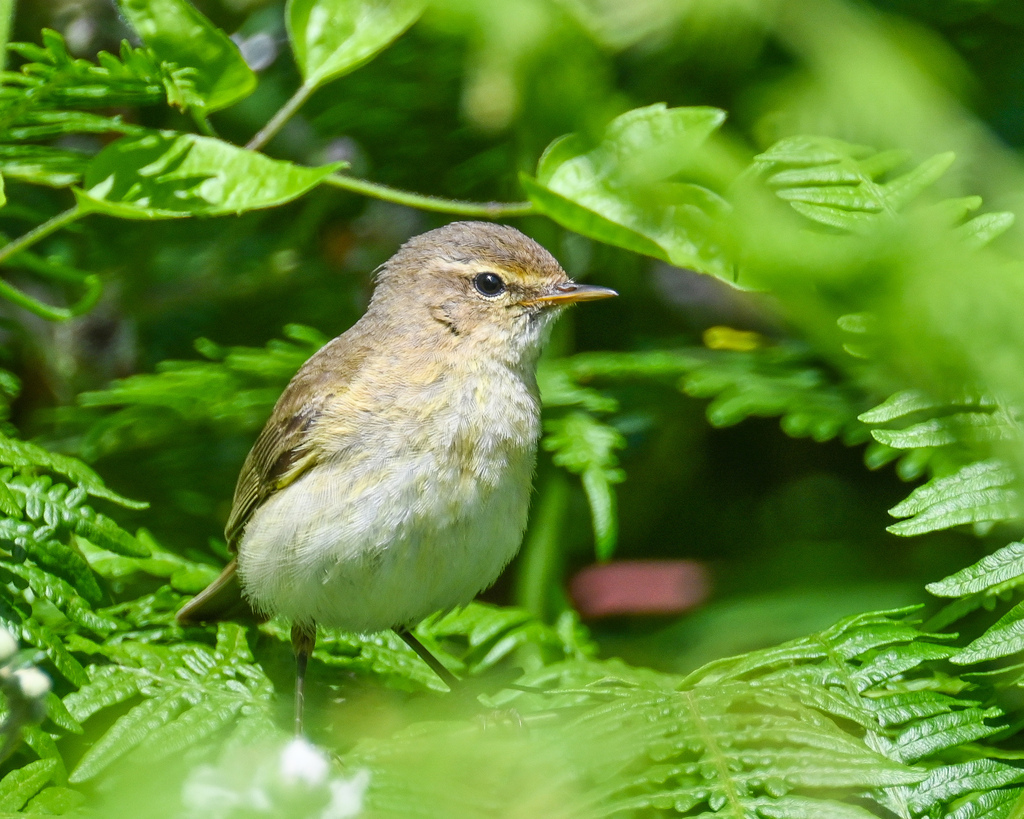
The common chiffchaff is a small leaf warbler with a distinctly understated appearance. It is greenish-brown above and off-white below, making it a subtle bird to spot among foliage. The species is named onomatopoeically for its simple, repetitive "chiff-chaff" song, which remains one of the most reliable ways to identify it in the field. Several subspecies exist with subtle variations: the nominate form is the most widespread, while the northern abietinus subspecies appears greyer-olive above with a pale yellow supercilium and whiter underparts. The Siberian tristis subspecies is notably duller, grey or brownish above and whitish below, with minimal yellow in the plumage and a longer buff-white supercilium.
The common chiffchaff is most easily confused with the willow warbler and wood warbler, which are similar in appearance. However, it lacks the crown stripes, yellow rump, and obvious wing bars that distinguish some of its closest relatives. Subspecific identification can be challenging, particularly outside main breeding and wintering ranges, as individual variation often makes distinguishing between nominate collybita and abietinus difficult without hearing their vocalizations.
Range & Habitat
The common chiffchaff is a widespread breeder throughout northern and temperate Europe and the Palearctic, with the nominate subspecies breeding across Europe east to Poland and Bulgaria. The species is highly migratory, wintering in southern and western Europe, southern Asia, and North Africa. Notably, the nominate form has been expanding its range northwards into Scandinavia since 1970, while the northern abietinus subspecies winters from southeastern Europe and northeastern Africa east to Iraq and western Iran. The Siberian tristis subspecies, which breeds in Siberia east of the Pechora River, winters in the lower Himalayas but is also regularly recorded in western Europe during winter.
The species favours open woodlands for breeding, showing preference for areas with scattered trees and dense ground vegetation where it can hunt and nest. This habitat flexibility has contributed to its widespread success and secure conservation status across its vast range.
Behaviour & Diet
The common chiffchaff is an insectivorous specialist, gleaning small insects from foliage and bark within woodland habitats. It is an active, restless forager, constantly searching for prey among branches and leaves. The species is notably territorial: while males play little role in nest construction and chick-rearing, they vigorously defend their territories against rivals and will attack potential predators to protect their breeding grounds.
Breeding ecology reveals distinct sex roles. The female builds a distinctive domed nest on or near the ground and assumes most responsibility for brooding and feeding chicks, whilst the male's primary contribution is territorial defence. The species faces predation from various quarters: mammals including cats and mustelids, and birds particularly hawks of the genus Accipiter, pose regular threats to both adults and young.
Best Time & Places to See It
The common chiffchaff's best time for observation depends on location and subspecies. In Europe, spring and summer are ideal for seeing breeding birds in their open woodland habitats, when territorial males are most vocal and conspicuous. Winter observers in southern and western Europe, southern Asia, and North Africa may encounter wintering populations. The nominate subspecies is most easily found around the Mediterranean and in North Africa during winter months.
For travellers seeking the species, open woodlands across its breeding range offer the best opportunities. Spring migration periods can be particularly productive, as birds return to breeding grounds and vocalize frequently. Northern observers may encounter the Siberian tristis subspecies in winter, though this requires familiarity with its distinctive high-pitched "suitsistsuisit" song and shorter "cheet" call, which differ markedly from the nominate form's vocalizations.
Photography Tips
Photographing the common chiffchaff presents challenges due to its small size, restless behaviour, and preference for dense woodland cover. The bird's greenish-brown and off-white plumage offers little contrast, making it blend seamlessly into foliage. Success requires patience and positioning near known singing males during spring, when birds are more predictable in their perching. Early morning light is advantageous for capturing the subtle tones of the plumage and any pale supercilium markings visible on some subspecies.
The bird's constant foraging activity means fast shutter speeds are essential to avoid motion blur. Focus on areas where males are actively singing, as these territorial birds will often return to favoured perches. Subspecific identification in photographs can be difficult due to individual variation, so detailed notes on behaviour, habitat, and any vocalizations heard will enhance documentation. Long-distance winter recordings of the Siberian tristis in western Europe are particularly valuable, as identification criteria remain poorly understood and good data remains limited.
HIDES
HOTSPOTS
Country
Type
Sort by
5,0 (1)
National Park
Kanha Tiger Reserve
Kanha Kisli F.V.·India
+321 birds+23 mammals
National Park
Aberdare National Park
Mweiga ward·Kenya
+394 birds+30 mammals
National Park
Abijata-Shalla Lakes National Park
Ethiopia
+438 birds+7 mammals
National Park
Abruzzo, Lazio and Molise National Park
Pescasseroli·Italy
+139 birds+18 mammals
National Park
Aggtelek National Park
Szin·Hungary
+119 birds+13 mammals
Natural Park
Alpilles Regional Nature Park
Saint-Rémy-de-Provence·France
+219 birds+37 mammals
National Park
Alta Murgia National Park
Bari·Italy
+168 birds+6 mammals
National Park
Altai Tavan Bogd National Park
Tsengel·Mongolia
+146 birds+3 mammals
National Park
Appennino Lucano Val d’Agri Lagonegrese National Park
Spinoso·Italy
+121 birds+3 mammals
Nothing matches these filters.
COMMUNITY
Share your photo of this species
Sort by
No community photos yet. Log in to add the first one.
0
Observed by
0
Hotspots reported
0
Countries
No community observations of this species yet.