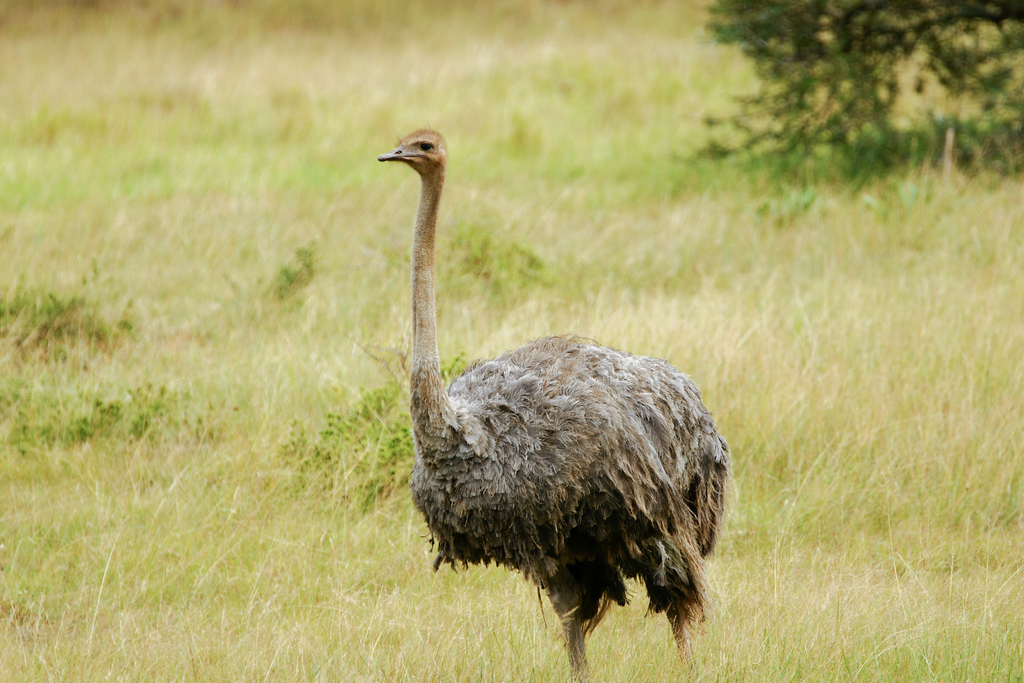
Common Ostrich
Photo © martin ingemansson
Photo © martin ingemansson — CC BY 4.0 — Source: iNaturalist photo #475328241Identification
The common ostrich is the world's tallest and heaviest living bird, making it unmistakable in the field. Males stand 2.1 to 2.75 metres tall and weigh 100 to 130 kilograms, while females are noticeably smaller at 1.75 to 1.9 metres and 90 to 120 kilograms. Adult males are predominantly black with distinctive white primaries and white tail feathers, whereas females and young males display greyish-brown and white plumage. Both sexes have nearly bare heads and necks with a thin layer of down, and their eyes—the largest of any land vertebrate at 50 millimetres in diameter—provide excellent vision for spotting distant predators. The bird's powerful, unfeathered legs are a defining feature, with the tarsus (lowest upright part) measuring 39 to 53 centimetres and displaying scales that are red in males and black in females. Uniquely among birds, ostriches have only two toes on each foot, an adaptation that aids their remarkable running ability.
Range & Habitat
The common ostrich is native to certain areas of Africa, with historical populations also found in Arabia. The species inhabits open grasslands and arid regions where their long neck allows them to survey the landscape for threats across vast distances. They are well-adapted to environments where temperatures can vary by as much as 40 degrees Celsius between night and day, employing behavioural thermoregulation to maintain comfort in these extremes.
Behaviour & Diet
Ostriches are highly social birds, living in nomadic groups of 5 to 50 individuals. They are primarily herbivorous, feeding mainly on plant matter, though they supplement their diet with invertebrates and small reptiles. Mating patterns vary by region, with territorial males competing for harems of two to seven females. When threatened, an ostrich will typically attempt to hide by lying flat against the ground or flee at remarkable speed. If cornered, however, it will defend itself with powerful kicks delivered by its strong legs. Despite their size, ostriches are capable of running at speeds over 70 kilometres per hour, with short bursts reaching about 70 kilometres per hour, making them the fastest land speed of any bipedal animal. Their impressive strides can cover 3 to 5 metres in a single step.
Best Time & Places to See It
Ostriches are found across certain regions of Africa, though specific localities and seasonal patterns should be confirmed with local wildlife guides and travel operators familiar with current ostrich distributions. Their nomadic nature means sightings can vary, but open grasslands and arid habitats offer the best opportunities for observation.
Photography Tips
The ostrich's distinctive black and white plumage in males and large size make for striking photographic subjects. The bird's impressive height means photographers should position themselves to capture the full length of the neck and legs. The large, expressive eyes are a key focal point worth emphasizing. Early morning and late afternoon light will bring out the contrast in male plumage and illuminate the bare skin of the head and neck. Capturing an ostrich at full stride demonstrates their remarkable speed and adaptation, while their powerful legs are a distinctive photographic feature worth highlighting.
Nothing matches these filters.
Aberdare National Park
Abijata-Shalla Lakes National Park
Addo Elephant National Park
Agulhas National Park
Amboseli National Park
Arusha National Park
Awash National Park
Bandia Wildlife Reserve
Bontebok National Park
Nothing matches these filters.
No community photos yet. Log in to add the first one.
No community observations of this species yet.