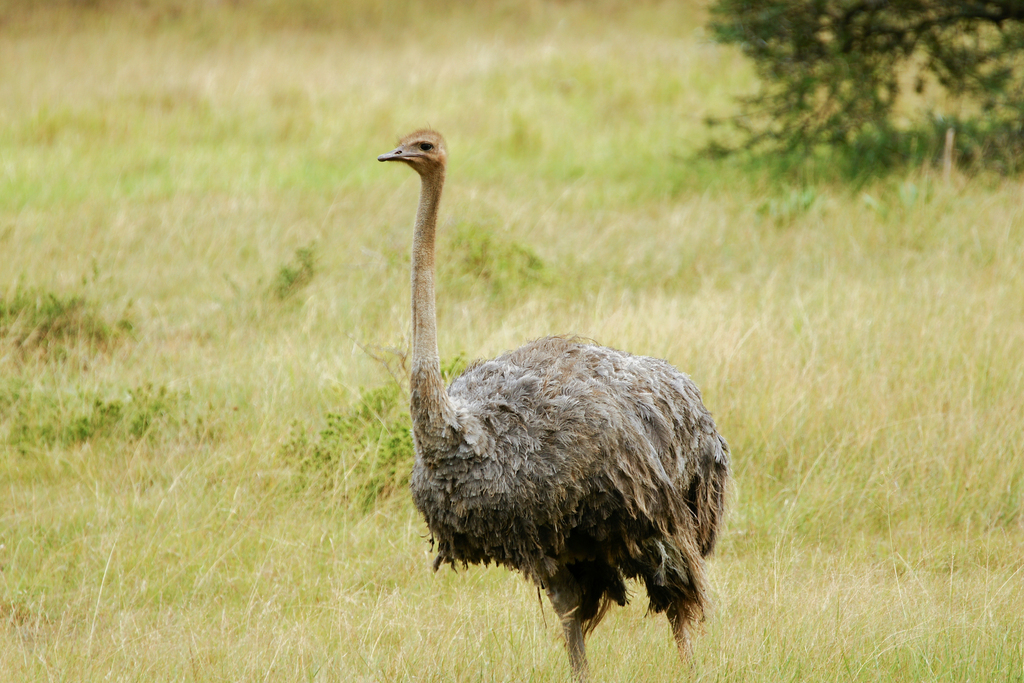
Avestruz común
Photo © martin ingemansson
Photo © martin ingemansson — CC BY 4.0 — Source: iNaturalist photo #475328241Identificación
El avestruz común es el ave viviente más alta y pesada del mundo, lo que la hace inconfundible en el campo. Los machos miden entre 2,1 y 2,75 metros de altura y pesan entre 100 y 130 kilogramos, mientras que las hembras son notablemente más pequeñas, con 1,75 a 1,9 metros de altura y 90 a 120 kilogramos. Los machos adultos son predominantemente negros con plumas primarias y plumas de cola blancas distintivas, mientras que las hembras y los machos jóvenes muestran plumaje grisáceo-marrón y blanco. Ambos sexos tienen la cabeza y el cuello prácticamente desnudos con una fina capa de plumón, y sus ojos —los más grandes de cualquier vertebrado terrestre con 50 milímetros de diámetro— proporcionan una visión excelente para detectar depredadores distantes. Las poderosas patas sin plumas del ave son una característica definitoria, con el tarso (parte vertical más baja) que mide entre 39 y 53 centímetros y muestra escamas rojas en los machos y negras en las hembras. De manera única entre las aves, los avestruces tienen solo dos dedos en cada pie, una adaptación que favorece su extraordinaria capacidad para correr.
Distribución y Hábitat
El avestruz común es nativo de ciertas áreas de África, con poblaciones históricas también encontradas en Arabia. La especie habita en pastizales abiertos y regiones áridas donde su cuello largo le permite examinar el paisaje en busca de amenazas a grandes distancias. Están bien adaptados a ambientes donde las temperaturas pueden variar hasta 40 grados Celsius entre la noche y el día, empleando termorregulación comportamental para mantener la comodidad en estos extremos.
Comportamiento y Dieta
Los avestruces son aves altamente sociales que viven en grupos nómadas de 5 a 50 individuos. Son principalmente herbívoros, alimentándose principalmente de materia vegetal, aunque complementan su dieta con invertebrados y pequeños reptiles. Los patrones de apareamiento varían según la región, con machos territoriales compitiendo por harenes de dos a siete hembras. Cuando se sienten amenazados, un avestruz generalmente intentará esconderse acostándose sobre el terreno o huirá a una velocidad extraordinaria. Sin embargo, si se ve acorralado, se defenderá con potentes patadas propinadas por sus fuertes patas. A pesar de su tamaño, los avestruces son capaces de correr a velocidades superiores a 70 kilómetros por hora, con ráfagas cortas alcanzando aproximadamente 70 kilómetros por hora, lo que los convierte en los animales bípedos más rápidos del mundo. Sus zancadas impresionantes pueden cubrir de 3 a 5 metros en un solo paso.
Mejor Época y Lugares para Verlo
Los avestruces se encuentran en ciertas regiones de África, aunque las localidades específicas y los patrones estacionales deben confirmarse con guías de vida silvestre locales y operadores turísticos familiarizados con las distribuciones actuales de avestruces. Su naturaleza nómada significa que los avistamientos pueden variar, pero los pastizales abiertos y los hábitats áridos ofrecen las mejores oportunidades para la observación.
Consejos para Fotografía
El plumaje negro y blanco distintivo del avestruz en los machos y su tamaño considerable lo hacen un sujeto fotográfico impresionante. La altura extraordinaria del ave significa que los fotógrafos deben posicionarse para capturar la longitud completa del cuello y las patas. Los grandes ojos expresivos son un punto focal clave que merece ser enfatizado. La luz de primera hora de la mañana y última hora de la tarde realzarán el contraste en el plumaje de los machos e iluminarán la piel desnuda de la cabeza y el cuello. Capturar un avestruz en toda su zancada demuestra su velocidad y adaptación notables, mientras que sus poderosas patas son una característica fotográfica distintiva digna de destacar.
Serengeti National Park
Tanzania
+131 aves+30 mamíferos
Dawn breaks over an endless golden savanna where acacia-studded plains stretch to distant volcanic highlands, their slopes cloaked in montane […]
VER PARQUE NACIONALChobe National Park
Botsuana
+122 aves+30 mamíferos
Where the Zambezi River cuts through northern Botswana, one of Africa’s greatest concentrations of large mammals gathers across flood plains, […]
VER PARQUE NACIONALNxai Pan National Park
Botsuana
+83 aves+19 mamíferos
Where acacia woodland gives way to sweeping grasslands and stark salt pans, a landscape of raw African beauty unfolds across […]
VER PARQUE NACIONALKhaudum National Park
Botsuana
+57 aves+18 mamíferos
Where the Kalahari’s red dunes roll into dense mopane woodland and riverine thickets, a raw and unforgiving landscape rewards those […]
VER PARQUE NACIONALKidepo Valley National Park
Uganda
+133 aves+29 mamíferos
Where granite peaks rise above sweeping savanna and acacia woodlands meet riverine forests, one of Africa’s most remote wilderness sanctuaries […]
VER PARQUE NACIONALTsavo West National Park
Mwatate, Kenya
+132 aves+30 mamíferos
Where volcanic rock formations pierce the savanna and sulfurous springs bubble beneath rust-coloured earth, Kenya’s southwestern wilderness reveals itself in […]
VER PARQUE NACIONALAmboseli National Park
Etonet/Lenkism ward, Kenya
+124 aves+30 mamíferos
Dawn breaks over a vast volcanic plain where Mount Kilimanjaro dominates the horizon, its snow-capped peak floating above the Tanzanian […]
VER PARQUE NACIONALKilimanjaro National Park
Kenya
+132 aves+30 mamíferos
Where Africa’s tallest mountain rises in solitary majesty, moorland grasslands give way to dense montane forests draped in moss and […]
VER PARQUE NACIONALMount-Kenya National Park
Abothuguchi west ward, Kenya
+132 aves+30 mamíferos
Where volcanic peaks pierce the equatorial sky and glaciers crown Africa’s second-highest mountain, an extraordinary ecosystem unfolds across five distinct […]
VER PARQUE NACIONALTarangire National Park
Tanzania
+124 aves+30 mamíferos
Where acacia woodlands meet vast plains and the Tarangire River cuts a lifeline through Tanzania’s heartland, one of Africa’s most […]
VER PARQUE NACIONALNgorongoro Conservation Area
Tanzania
+123 aves+30 mamíferos
Where the East African plateau drops away into a vast amphitheatre of volcanic splendour, a 600-square-kilometre caldera cradles one of […]
VER ÁREA DE GESTIóN DE VIDA SILVESTREPilanesberg National Park
Moses Kotane Local Municipality, Sudáfrica
+130 aves+30 mamíferos
Where ancient volcanic calderas rise above the surrounding lowveld, a 734-square-kilometre sanctuary unfolds across the North West Province of South […]
VER PARQUE NACIONALMokala National Park
Siyancuma Local Municipality, Sudáfrica
+123 aves+30 mamíferos
Where semi-arid savanna meets ancient granite outcrops, a 715-square-kilometre wilderness unfolds across the Northern Cape’s undulating terrain. Mokala’s landscape is […]
VER PARQUE NACIONALKruger National Park
Ba-Phalaborwa Local Municipality, Sudáfrica
+132 aves+30 mamíferos
Where the Limpopo River forms a natural frontier, vast savannas sweep across nearly 20,000 square kilometers of pristine African wilderness. […]
VER PARQUE NACIONALAgulhas National Park
Cape Agulhas Local Municipality, Sudáfrica
+106 aves+30 mamíferos
Where the Indian and Atlantic Oceans collide along Africa’s southernmost tip, a rugged coastline of limestone cliffs and windswept grasslands […]
VER PARQUE NACIONALTankwa-Karoo National Park
Hantam Local Municipality, Sudáfrica
+101 aves
Where ancient mountains crumble into rust-red plains, the Tankwa Karoo unfolds as one of South Africa’s most austere and compelling […]
VER PARQUE NACIONALMountain Zebra National Park
Inxuba Yethemba Local Municipality, Sudáfrica
+123 aves+30 mamíferos
Jagged sandstone peaks rise abruptly from the high interior plateau of the Eastern Cape, their weathered faces sculpted by millennia […]
VER PARQUE NACIONALAugrabies Falls National Park
Kai !Garib Local Municipality, Sudáfrica
+48 aves+14 mamíferos
Where granite gorges plunge 56 metres into churning white water, the Orange River has carved one of Africa’s most dramatic […]
VER PARQUE NACIONALAddo Elephant National Park
Sundays River Valley Local Municipality, Sudáfrica
+129 aves+30 mamíferos
Where granite outcrops pierce acacia woodland and dense thicket smothers the Eastern Cape landscape, one of Africa’s most biodiverse reserves […]
VER PARQUE NACIONALIthala Game Reserve
uPhongolo Local Municipality, Sudáfrica
+133 aves+29 mamíferos
Where granite ridges thrust upward through acacia woodland, the landscape shifts between intimate valleys and sweeping grasslands across nearly 500 […]
VER PARQUE NACIONALMarakele National Park
Modimolle Local Municipality, Sudáfrica
+122 aves+30 mamíferos
Where granite gorges slice through the bushveld and ancient mountains rise in weathered majesty, southern Africa’s most underrated wilderness unfolds […]
VER PARQUE NACIONALCamdeboo National Park
Camdeboo Local Municipality, Sudáfrica
+124 aves+30 mamíferos
Where granite gorges slice through semi-arid plateaus, ancient dolerite formations rise like sentinels above the Sundays River valley. Sprawling across […]
VER PARQUE NACIONALKhaudum National Park
Namibia
+46 aves+16 mamíferos
Where mopane woodland gives way to sudden waterhole clearings and ancient elephant paths cross calcrete plains, one of southern Africa’s […]
VER PARQUE NACIONALSperrgebiet National Park
Barcelona, Namibia
+119 aves+30 mamíferos
Where the Namib Desert’s red dunes collide with the Atlantic’s cold embrace, over 56,000 square kilometers of raw wilderness unfolds […]
VER PARQUE NACIONALDorob National Park
Henties Bay, Namibia
+118 aves+30 mamíferos
Where the Skeleton Coast’s haunting dunes surrender to gravel plains and rocky outcrops, an extraordinary expanse of Namibian wilderness unfolds […]
VER PARQUE NACIONALSkeleton Coast Park
Barcelona, Namibia
+28 aves+9 mamíferos
Where the Atlantic’s cold Benguela Current meets the Namib Desert’s endless dunes, one of Africa’s most haunting and biodiverse coastlines […]
VER PUNTO DE OBSERVACIóNNamib-Naukluft National Park
Namibia
+119 aves+30 mamíferos
Where rust-coloured dunes rise like frozen waves against an impossibly blue sky, Africa’s oldest desert unfolds across nearly 95,000 square […]
VER PARQUE NACIONALBwabwata National Park
Namibia
150+ aves+23 mamíferos
Where the Kavango and Zambezi rivers converge across northeastern Namibia, a vast wilderness of 14,249 square kilometres unfolds in layers […]
VER PARQUE NACIONALEtosha National Park
Namibia
+62 aves+30 mamíferos
Brilliant white salt pans stretch endlessly beneath Namibian skies, interrupted by scattered acacia woodlands and mopane scrubland that characterize this […]
VER PARQUE NACIONALNamibRand Nature Reserve
Hammerstein, Namibia
+66 aves+30 mamíferos
Where rust-coloured dunes surrender to sculpted granite outcrops and vast plains stretch toward an endless horizon, one of southern Africa’s […]
VER RESERVA NATURALWaterberg Plateau National Park
Okambukonde, Namibia
+124 aves+31 mamíferos
Where ancient sandstone cliffs rise 200 metres above the surrounding bushveld, a fortress of geology creates one of southern Africa’s […]
VER PARQUE NACIONALTable Mountains National Park
Karłów, Polonia
150+ aves+30 mamíferos
Where sandstone plateaus rise like ancient fortresses above forested valleys, Poland’s 108-square-kilometre wilderness unfolds across the Table Mountains. Vertical rock […]
VER PARQUE NACIONALMakgadikgadi Pans National Park
Gucta, Botsuana
+107 aves+22 mamíferos
Where salt-crusted flatlands stretch endlessly toward a shimmering horizon, one of Africa’s most extraordinary ecosystems awakens with the rains. The […]
VER PARQUE NACIONALAún no hay fotos de la comunidad. Inicia sesión para añadir la primera.
Aún no hay observaciones de la comunidad de esta especie.