Common Redstart
Phoenicurus phoenicurus
Photo © Jerzy Strzelecki
Photo © Jerzy Strzelecki — CC BY-SA 4.0 — Source: Wikimedia CommonsABOUT
Subspecies of Common Redstart
Eurasian RedstartEhrenberg's Redstart
Identification
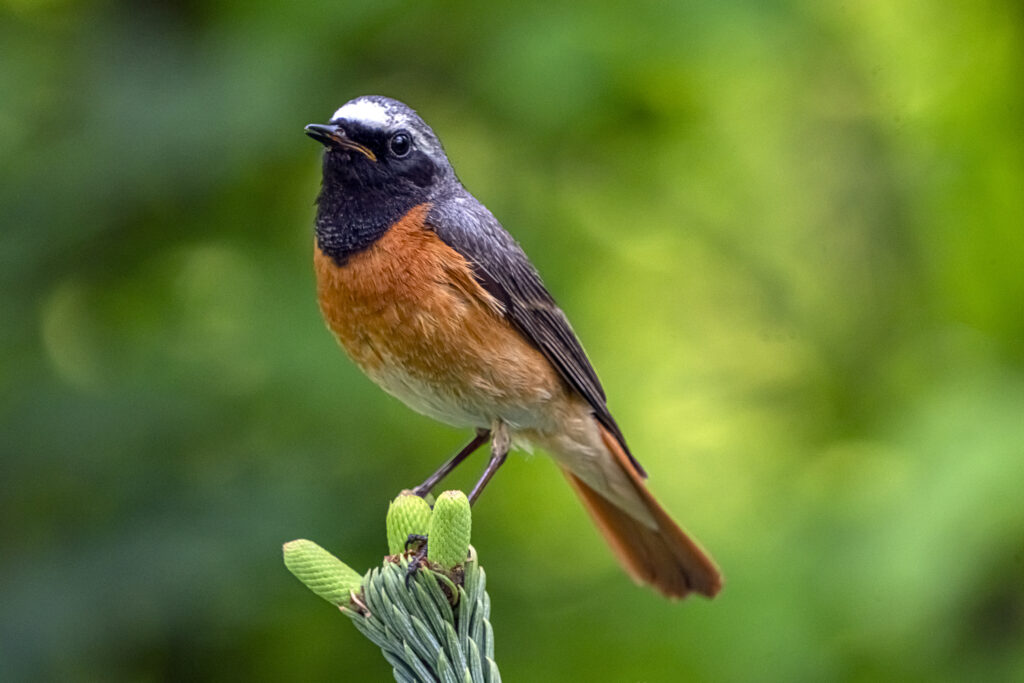
The Common Redstart is a small passerine bird, 13–14.5 cm long and weighing 11–23 g, slightly slimmer than the European Robin to which it shows some behavioural affinity. Its most distinctive feature is the bright orange-red tail, which gives the species its name ("start" being an old word for "tail"), and this tail is frequently quivered. The male in summer is particularly striking, with a slate-grey head and upperparts contrasting sharply with an orange-chestnut rump, tail, and flanks; the forehead is white while the sides of the face and throat are black. The bill and legs are black. In autumn, pale feather fringes create a washed-out appearance. Females are grey-brown above with buff-white or light orange underparts; most show a whitish throat, though some older females display a dark bib. Among common European birds, only the Black Redstart shares a similarly coloured tail.
Range & Habitat
The Common Redstart is found across two subspecies: the nominate form ranges throughout Europe and into Siberia, while subspecies samamisicus (sometimes called Ehrenberg's Redstart) inhabits the region from the Crimean Peninsula and Greece through Turkey, the Caucasus, the Middle East, and into Central Asia. The species prefers open, mature birch, oak, or conifer woodland with high horizontal visibility and minimal shrub understorey, particularly where trees are old enough to contain nesting cavities. Other habitats include orchards, parks, and old gardens in urban areas. In Britain, it occurs primarily in upland areas less affected by agricultural intensification and has declined significantly in recent decades. It is very rare in Ireland, with breeding restricted to just one to five pairs annually, nearly all in County Wicklow.
Behaviour & Diet
A summer visitor throughout most of Europe and western Asia (east to Lake Baikal) and northwest Africa, the Common Redstart winters in central Africa and Arabia, south of the Sahara but north of the Equator, from Senegal to Yemen. Males arrive in early to mid-April, typically a few days ahead of females. Five or six light blue eggs are laid during May, with a second brood occurring in midsummer in the southern breeding range. Birds depart for Africa between mid-August and early October. The species often feeds like a flycatcher, making aerial sallies after passing insects, with winged insects comprising most of its diet. Contact calls vary regionally: in Central Europe a rising, slightly dissyllabic "huid," replaced by a monosyllabic "heed" in southern Italy and within the samamisicus range.
Best Time & Places to See It
The Common Redstart is best observed during the breeding season from April through August in upland broadleaf woodlands and mature open woodland throughout Britain and mainland Europe. In Britain, upland areas with less intensive agriculture offer the best viewing opportunities. The species favours mature trees with cavities and areas with high moss and lichen cover. Early mornings in April and May, when males first arrive and are most vocal and active, provide excellent chances for observation. Birdwatchers visiting continental Europe, particularly across Scandinavia and the Mediterranean regions, may encounter this attractive species in suitable woodland habitats during the breeding season.
Photography Tips
The male Common Redstart's striking plumage—with slate-grey upperparts, white forehead, black face, and bright orange-chestnut tail and flanks—makes it a rewarding photographic subject during breeding season. The frequently quivered tail is a characteristic behaviour worth capturing. Early morning light in April and May, when males are most active, provides optimal conditions for photography. Position yourself near open woodland areas with good visibility and mature trees containing nesting cavities. The bird's smaller size and tendency to make aerial sallies after insects mean faster shutter speeds will be necessary to freeze action. The contrast between the male's grey and orange plumage is best rendered in clear, bright conditions.
HIDES
HOTSPOTS
Country
Type
Sort by
5,0 (1)
National Park
Murchison Falls National Park
Uganda
+608 birds+33 mammals
National Park
Abruzzo, Lazio and Molise National Park
Pescasseroli·Italy
+139 birds+18 mammals
National Park
Aggtelek National Park
Szin·Hungary
+119 birds+13 mammals
Natural Park
Alpilles Regional Nature Park
Saint-Rémy-de-Provence·France
+219 birds+37 mammals
National Park
Alta Murgia National Park
Bari·Italy
+168 birds+6 mammals
National Park
Altai Tavan Bogd National Park
Tsengel·Mongolia
+146 birds+3 mammals
National Park
Appennino Lucano Val d’Agri Lagonegrese National Park
Spinoso·Italy
+121 birds+3 mammals
National Park
Appennino Tosco-Emiliano National Park
Ventasso·Italy
+86 birds+8 mammals
National Park
Asinara National Park
Porto Torres·Italy
+103 birds+5 mammals
Nothing matches these filters.
COMMUNITY
Share your photo of this species
Sort by
No community photos yet. Log in to add the first one.
0
Observed by
0
Hotspots reported
0
Countries
No community observations of this species yet.