Common Starling
Sturnus vulgaris
Photo © egorbirder
Photo © egorbirder — CC BY 4.0 — Source: iNaturalist photo #118675313ABOUT
Subspecies of Common Starling
European Common StarlingAzores StarlingFaroe StarlingShetland Islands StarlingSiberian Common StarlingBlack Sea StarlingHimalayan StarlingPakistani StarlingKazakh StarlingSturnus vulgaris caucasicusSturnus vulgaris purpurascensSturnus vulgaris nobilior
Identification
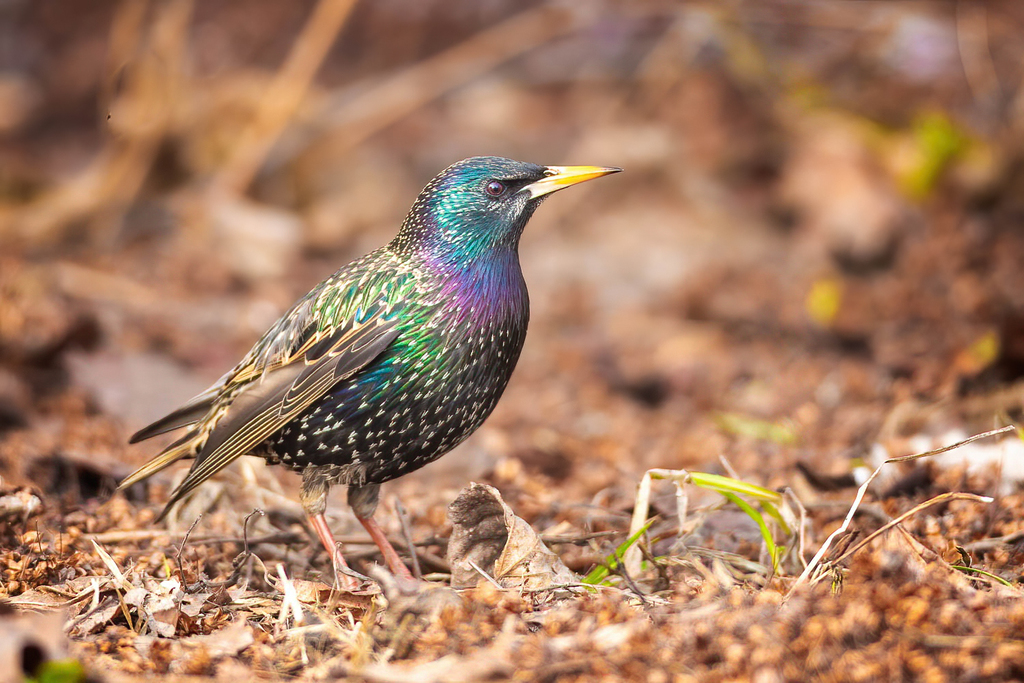
The common starling is a medium-sized passerine about 20 cm long with a distinctive glossy black plumage displaying a metallic sheen. The most striking seasonal feature is the bird's bill: black in winter but bright yellow in summer. Its pink legs provide a useful identifying mark. In some seasons, white speckles dot the dark plumage, creating a spotted appearance. Young birds are noticeably browner than adults, making age determination relatively straightforward for observers.
Range & Habitat
The common starling is native to temperate Europe and the Palearctic region, extending across its breeding range to western Mongolia, with about 12 subspecies recognized across this vast area. In its native range, the species inhabits open habitats. Western and southern European populations are resident year-round, while birds from the northeast migrate south and west within their breeding range during winter, with some traveling further to Iberia and North Africa.
Beyond its native range, this adaptable species has been introduced to Australia, New Zealand, Canada, the United States, Mexico, Argentina, South Africa, and Fiji, where it has become established as an invasive species. It builds untidy nests in natural or artificial cavities, laying four or five glossy pale blue eggs that incubate for two weeks, with young remaining in the nest for a further three weeks.
Behaviour & Diet
Common starlings are renowned for their exceptional mimicry abilities—a gift noted since ancient times in texts ranging from the Mabinogion to the works of Pliny the Elder and William Shakespeare. The species is highly social and often forms large flocks, which can be agriculturally beneficial by controlling invertebrate pests. However, these same flocks may cause damage by feeding on fruit and sprouting crops, and their urban roosts create noise and mess that makes them occasional urban nuisances.
Omnivorous and opportunistic, common starlings feed on a wide range of invertebrates supplemented by seeds and fruit. They typically attempt one or two breeding attempts each year. The species faces predation from various mammals and birds of prey, and hosts numerous external and internal parasites.
Best Time & Places to See It
Common starlings are easiest to observe in open habitats across Europe, particularly in agricultural areas and urban settings where they congregate in flocks. In northern and central Europe, winter months may offer the most spectacular viewing opportunities, as birds aggregate in larger numbers during migration periods. The species' resident populations in western and southern Europe provide year-round viewing opportunities.
Photography Tips
Photograph common starlings during breeding season to capture the bright yellow bill and metallic sheen of glossy black plumage. Winter plumage offers the bonus of white speckles that create interesting textural patterns against the dark feathers. Large flocking behavior provides opportunities for dramatic group compositions, though individual portraits will best showcase the bird's distinctive seasonal bill coloration and metallic iridescence. Young birds' browner plumage offers a distinct visual contrast to adults.
HIDES
HOTSPOTS
Country
Type
Sort by
Natural Park
Delta de l’Ebre Natural Park
Eucaliptus·Spain
+341 birds+18 mammals
National Park
Abel Tasman National Park
New Zealand
+96 birds+9 mammals
National Park
Abruzzo, Lazio and Molise National Park
Pescasseroli·Italy
+139 birds+18 mammals
National Park
Acadia National Park
Bar Harbor·United States
+291 birds+27 mammals
National Park
Addo Elephant National Park
Sundays River Valley Local Municipality·South Africa
+388 birds+55 mammals
National Park
Aggtelek National Park
Szin·Hungary
+119 birds+13 mammals
National Park
Agulhas National Park
Cape Agulhas Local Municipality·South Africa
+224 birds+13 mammals
Wildlife Sanctuary
Alaska Maritime National Wildlife Refuge
Alaska·United States
+391 birds+58 mammals
Natural Park
Algonquin Provincial Park
Canada
+257 birds+32 mammals
Nothing matches these filters.
COMMUNITY
Share your photo of this species
Sort by
1
Observed by
1
Hotspot reported
1
Country
Countries reported:
Spain