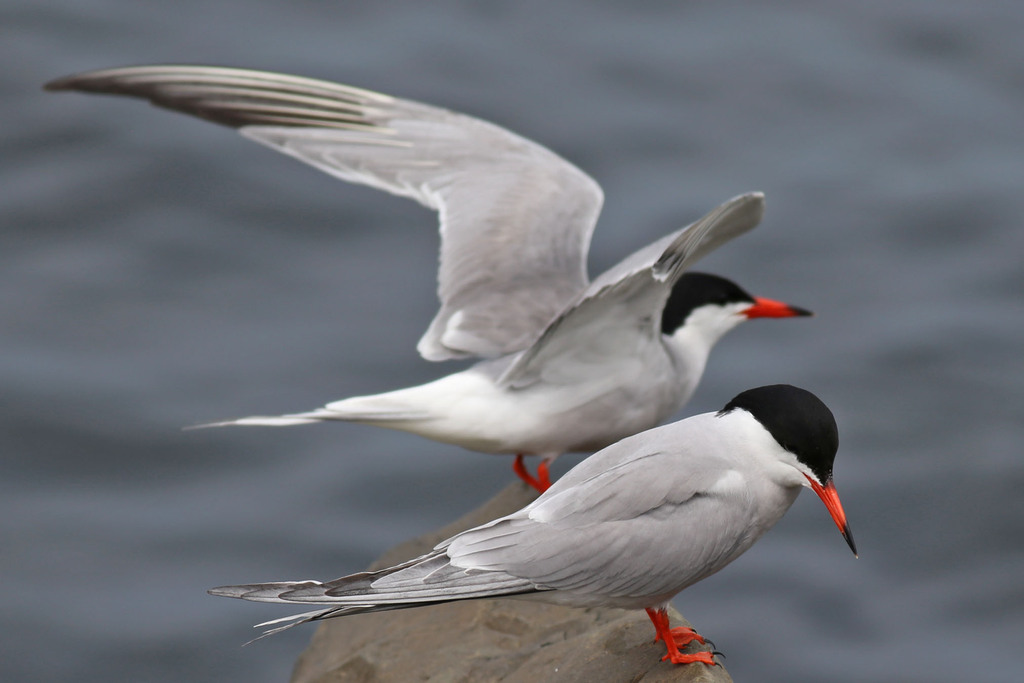
Common Tern
Photo © Bill Keim
Photo © Bill Keim — CC BY 4.0 — Source: iNaturalist photo #533458379Identification
The common tern is a graceful seabird measuring 31–35 cm in length with a distinctive 77–98 cm wingspan. Breeding adults are unmistakable: pale grey upperparts contrast sharply with very pale grey underparts, a bold black cap crowns the head, and bright orange-red legs support a narrow pointed bill (which may be mostly red with a black tip, or entirely black depending on subspecies). The deeply forked tail and long pointed wings give the bird its buoyant, swift flight characteristic of terns. In non-breeding plumage, the forehead becomes white and the bill turns black or black with a red base, while a dark carpal bar appears on the wings. Juveniles show brown tones on the crown and nape with ginger-coloured foreheads that wear to white by autumn. The species can be separated from similar relatives like the Arctic tern by careful attention to plumage details, leg and bill colour, and distinctive vocalisations.
Range & Habitat
The common tern enjoys a circumpolar distribution across four recognised subspecies, breeding throughout temperate and subarctic regions of Europe, Asia, and North America. This strongly migratory species winters in coastal tropical and subtropical regions, making it a globe-trotter among seabirds. Remarkably, the common tern breeds in a wider range of habitats than any of its relatives, nesting on any flat, poorly vegetated surface close to water including beaches, islands, and even artificial floating rafts. Its adaptability to various substrates—from bare sand and gravel to man-made structures—makes it an unusually flexible breeder within the tern family.
Behaviour & Diet
Common terns are colonial nesters, typically laying up to three eggs in simple scrapes lined or edged with whatever debris is available. The eggs' dull colours and blotchy patterns provide excellent camouflage on open beaches. Both parents share incubation duties, with eggs hatching in around 21–22 days (longer if predators disturb the colony), and downy chicks fledging within 22–28 days. Like most terns, this species is a specialist plunge-diver, dropping dramatically from the air to catch fish in both marine and freshwater environments. However, molluscs, crustaceans, and other invertebrates may form a significant part of the diet in some regions. Nests and chicks face predation from mammals such as rats, badgers, and American mink, as well as large birds including gulls, owls, and herons.
Best Time & Places to See It
Common terns are best observed during their breeding season in temperate and subarctic regions across Europe, Asia, and North America, where they gather at coastal colonies on beaches and islands. Look for them in their wintering grounds in tropical and subtropical coastal regions. Their large global population and vast breeding range mean they are classified as of least concern; however, numbers in North America have declined sharply in recent decades, and some populations are threatened by habitat loss, pollution, and disturbance to breeding colonies. Visit protected breeding sites during the nesting season for the most reliable sightings.
Photography Tips
The common tern's swift, buoyant flight and dramatic plunge-dives offer exciting photographic opportunities for fast shutter speeds and tracking skills. During breeding season, photograph birds at their colonies on beaches and islands, where you can capture adults bringing fish to chicks and engaging in courtship displays. The bird's pale plumage requires careful exposure metering to avoid blown highlights; bracket your exposures when shooting in bright sunlight over water. The striking black cap and orange-red legs and bill provide excellent colour contrast in breeding plumage. Position yourself low to take advantage of the bird's habit of hovering over water before diving, and use burst mode to capture the moment of plunge-dive entry. Non-breeding birds show more subtle plumage patterns that reward closer inspection through the viewfinder.
Acadia National Park
Addo Elephant National Park
Agulhas National Park
Alaska Maritime National Wildlife Refuge
Algonquin Provincial Park
Alligator River National Wildlife Refuge
Alpilles Regional Nature Park
Altai Tavan Bogd National Park
Altun Mountain National Nature Reserve
Nothing matches these filters.
No community photos yet. Log in to add the first one.
No community observations of this species yet.