Common Wood Pigeon
Columba palumbus
Photo © Tina Ellegaard Poulsen
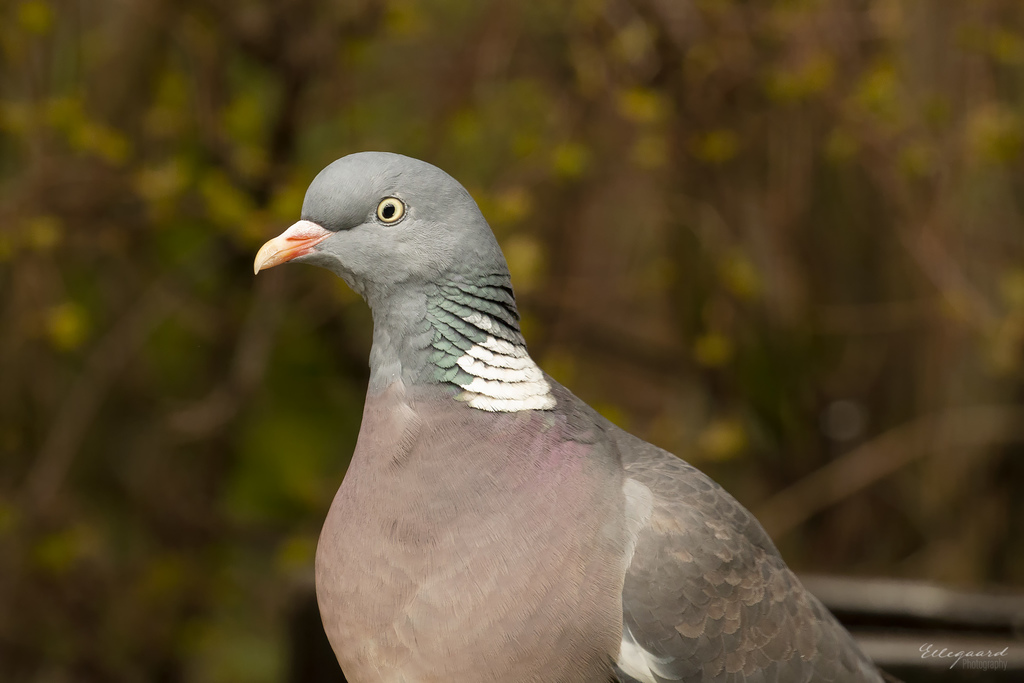
Photo © Tina Ellegaard Poulsen — CC BY 4.0 — Source: iNaturalist photo #121018864ABOUT
Subspecies of Common Wood Pigeon
European Wood PigeonAzores Wood PigeonAsian Wood PigeonIranian Wood PigeonMadeiran Wood Pigeon
Identification
The common wood pigeon is the largest of the Western European Columba pigeons, measuring 38–44.5 cm in length with a wingspan of 68–80 cm. Its most distinctive features are the white patches on either side of its neck and the white on its wings, which immediately set it apart from related species. The bird is otherwise predominantly grey with a distinctive pinkish breast, and adults bear green and white patches on the neck along with a pink patch on the chest. The eye colour is pale yellow, contrasting sharply with the orange-red eyes of rock doves and the dark eyes of stock doves.
Juveniles can be distinguished from adults by their lack of white neck patches, greyer bill, and overall lighter grey appearance. Young birds develop small white neck patches around six months of age, which gradually increase in size until they are fully formed by 6–8 months old.
Range & Habitat
Native to the western Palearctic, the common wood pigeon is distributed across Europe and western Asia, with five recognized subspecies occupying different regions from Northwest Africa and Europe through to western China, northwestern India and Nepal. In the colder northern and eastern parts of its range, the species is migratory, while in southern and western Europe it is a well-distributed and often abundant resident.
In Great Britain, wood pigeons are commonly seen in parks and gardens and are increasingly visible in towns and cities. These adaptable birds breed in trees in woodlands, parks and gardens, showing a preference for trees near roads and rivers. A single record from Quebec, Canada in 2019 represents the only known sighting of the species in the Americas.
Behaviour & Diet
Wood pigeons are highly gregarious birds, often forming very large flocks outside the breeding season. Their flight is fast and regular, characterized by occasional sharp flicks of the wings and a loud clatter on takeoff. The species is fiercely territorial, with males using threat displays and pursuit to deter competitors, though direct confrontation involving jumping and striking with both wings also occurs. Their distinctive call means they are usually heard before they are seen.
The diet consists mainly of plant material, particularly cereals and fleshy leaves, making the species a considerable agricultural pest over much of its range. Despite being extensively hunted throughout much of Europe, where they are legal quarry, this pressure does not appear to significantly impact population numbers. Wood pigeons are wary in rural areas but often become quite tame in urban settings, sometimes even more so than feral pigeons, and can become exceptionally approachable in areas where they are not persecuted.
Best Time & Places to See It
Wood pigeons are best observed in parks, gardens, and increasingly in urban areas where they have become habituated to human presence. The main breeding season runs from April to October, during which territorial males are particularly active and vocal. Outside the breeding season, the birds form large flocks that offer excellent viewing opportunities. In Great Britain and across much of western and southern Europe, wood pigeons are year-round residents, making them accessible to observers throughout the year.
Photography Tips
The white neck patches and distinctive colouration make wood pigeons relatively straightforward subjects for identification in photographs, particularly in flight when the white wing patches are visible. Urban and garden birds are often exceptionally tame, allowing photographers to approach closely for detailed portraits. During the breeding season, males engaged in nuptial displays offer dramatic photographic opportunities, particularly their characteristic display flight with wings cracking as they glide down on stiff wings.
The bird's loud takeoff and fast, regular flight style provide action photography opportunities, while perched birds offer chances to capture the pale yellow eye and the subtle iridescent green and white patches on the neck. Early morning hours in parks and gardens typically offer the best light and activity levels for photography.
HIDES
HOTSPOTS
Country
Type
Sort by
Natural Park
Delta de l’Ebre Natural Park
Eucaliptus·Spain
+341 birds+18 mammals
National Park
Abruzzo, Lazio and Molise National Park
Pescasseroli·Italy
+139 birds+18 mammals
National Park
Aggtelek National Park
Szin·Hungary
+119 birds+13 mammals
Natural Park
Alpilles Regional Nature Park
Saint-Rémy-de-Provence·France
+219 birds+37 mammals
National Park
Alta Murgia National Park
Bari·Italy
+168 birds+6 mammals
National Park
Appennino Lucano Val d’Agri Lagonegrese National Park
Spinoso·Italy
+121 birds+3 mammals
National Park
Asinara National Park
Porto Torres·Italy
+103 birds+5 mammals
National Park
Åsnens National Park
Kronoberg County·Sweden
+141 birds+8 mammals
National Park
Aspromonte National Park
Careri·Italy
+89 birds+5 mammals
Nothing matches these filters.
COMMUNITY
Share your photo of this species
Sort by
No community photos yet. Log in to add the first one.
1
Observed by
1
Hotspot reported
1
Country
Countries reported:
Spain