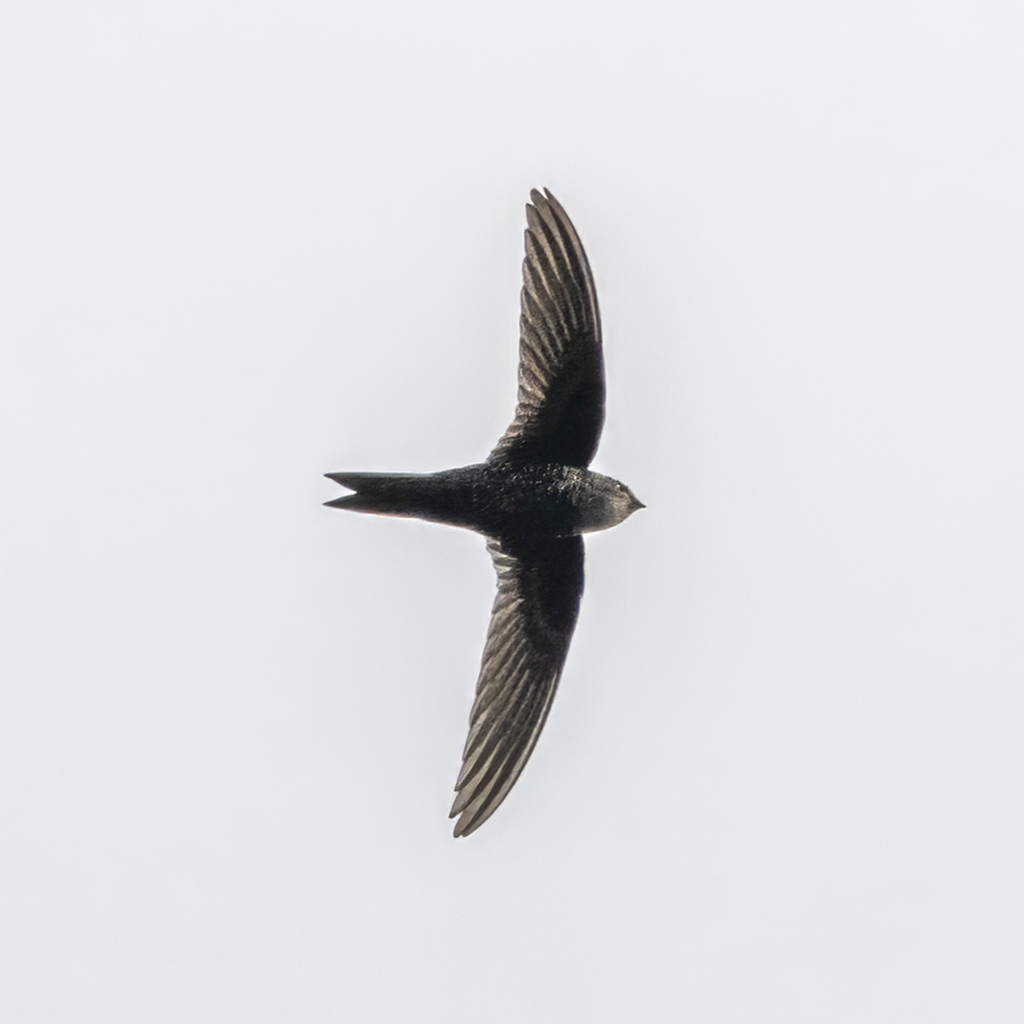
Cook’s Swift
Photo © Dan Vickers
Photo © Dan Vickers — CC BY 4.0 — Source: iNaturalist #346057533Identification
Cook's swift is a small, dark bird superficially similar to a house martin, though completely unrelated—swifts belong to the order Apodiformes rather than the passerines. The resemblance between the groups is a striking example of convergent evolution, reflecting their similar aerial lifestyles. Cook's swift is black in plumage except for a distinctive white rump. It is similar in size to the common swift but can be distinguished from a partially leucistic common swift by its deeper tail fork, longer wings, larger head, and notably larger white throat patch. The species displays a subtle green iridescence that may be visible in good light.
Range & Habitat
Cook's swift breeds in limestone caves found across Thailand, Myanmar, and Indochina. As a short-distance migrant, the species moves seasonally within this broader Southeast Asian region, making it a partially nomadic inhabitant of its range. The birds are strongly associated with cave systems in karst limestone formations, which provide essential breeding and roosting sites. A 2011 taxonomic study prompted many specialists to recognize Cook's swift as a distinct species, splitting it from what was previously considered the fork-tailed swift complex.
Behaviour & Diet
Cook's swifts spend the vast majority of their lives airborne, catching insects in their beaks while in flight. They are supremely adapted for this aerial existence: their legs are extremely short and are used solely for clinging to vertical surfaces such as cave walls and cliff faces. They never voluntarily settle on the ground, and their very name reflects this adaptation—the scientific name comes from the Greek απους (apous), meaning "without feet," emphasizing their reduced reliance on these limbs.
These birds are highly faithful to their breeding sites, returning to the same locations year after year. They build their nests on cliffs, typically within or near cave entrances, and lay clutches of 2–3 eggs. Nests are rebuilt when necessary, suggesting a strong territorial attachment to traditional breeding territories.
Best Time & Places to See It
To observe Cook's swifts, visitors should focus on limestone cave regions throughout Thailand, Myanmar, and Indochina during the breeding season. Since the species is a short-distance migrant, timing your visit to coincide with the breeding period will maximize your chances of locating birds at known cave sites. Early morning and late afternoon hours are typically best for swift watching, as birds are most active during these cooler parts of the day.
Photography Tips
Photographing Cook's swifts presents a rewarding challenge. The white rump is a striking field mark and makes for an excellent focal point in images. When photographing near cave entrances, position yourself to backlight birds as they emerge or return, which can highlight the white rump and throat patch against darker backgrounds. Fast shutter speeds are essential—at minimum 1/2000th of a second—to freeze the rapid wing beats of these aerial hunters. A telephoto lens of 400mm or greater will help you capture detail from a distance without disturbing the birds at their cliff and cave roosts.
Khao Yai National Park
Prachantakham District, Thailand
+377 birds+46 mammals
Evergreen dipterocarp forest blankets the rolling terrain of this national park in eastern Thailand, where limestone hills rise abruptly from the forest floor and seasonal streams…
VIEW NATIONAL PARKKhao Laem National Park
Sangkhla Buri District, Thailand
+197 birds
Where the Vajiralongkorn Reservoir sprawls across the forested valleys of Kanchanaburi's northern borderlands, Khao Laem National Park protects a landscape where limestone ridges rise dramatically from…
VIEW NATIONAL PARKTaman Negara National Park
Kampong Samas, Malaysia
+393 birds+48 mammals
Where ancient rainforest meets limestone peaks, one of Southeast Asia's oldest protected wilderness preserves sprawls across 4,343 square kilometers of primordial landscape. Dipterocarp giants tower overhead,…
VIEW NATIONAL PARKNo community photos yet. Log in to add the first one.
No community observations of this species yet.