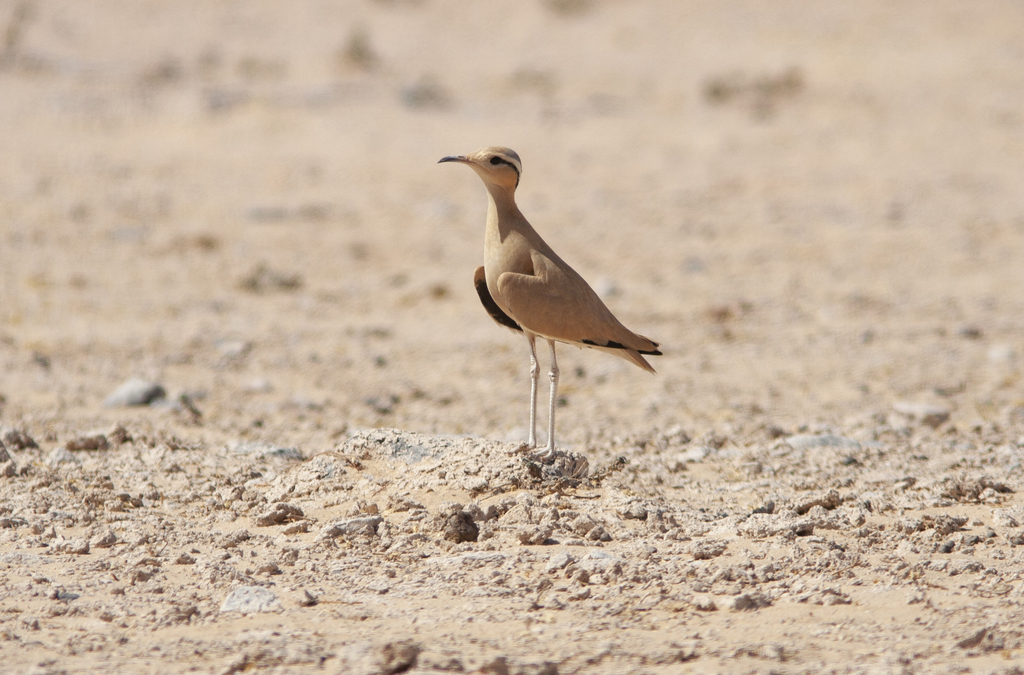
Cream-colored Courser
Photo © Tero Linjama
Photo © Tero Linjama — CC0 1.0 — Source: iNaturalist photo #105974292Identification
The Cream-colored Courser is a slender wader measuring 19–27 cm in length with a wingspan of 51–57 cm. Its most distinctive features are its sandy-colored body plumage, which fades to whitish on the lower belly, and striking head markings: a grey crown grading to blue-grey on the nape, a bold black eyestripe, and a conspicuous white supercilium. The bird has characteristically long legs (7–8 cm), long pointed wings, and a slightly downcurved bill. In flight, the outer upperwing and underwing are notably black, creating a striking contrast with the pale body. Juveniles appear mottled dark above with duller head patterns than adults. In flight, the species resembles a pratincole, with relaxed wingbeats and pointed wings.
Range & Habitat
Cream-colored Coursers inhabit dry, open semi-desert regions across a wide geographic range spanning the Canary Islands, Cape Verde, North Africa, and Southwest Asia. The species is partially migratory: northern and northwestern populations winter along the southern edge of the Sahara, in Arabia, and in northwestern India, while others breed in southern desert regions of northwestern India and Pakistan. The species has occasionally bred in southern Spain. Though rare north of the breeding range, vagrants have reached as far as Finland, Norway, and Great Britain; flocks of up to 30 have been recorded on Malta.
Behaviour & Diet
True to their scientific name—derived from the Latin "cursor" meaning runner—these coursers are ground hunters that typically pursue their insect prey by running across open terrain rather than taking flight. They lay their two eggs in simple ground scrapes, displaying flexible breeding timing that extends from February through September, with additional breeding in autumn and winter when local rainfall conditions are favorable.
Best Time & Places to See It
Cream-colored Coursers are best sought in North Africa and the Middle East, particularly in semi-desert habitats. Malta offers more regular sightings, with occasional flocks present. The breeding season extends from February to September, though birds may breed at other times depending on local rainfall. Northern vagrants are rare but occur unpredictably; birders in northern Europe should watch for them during migration periods, particularly around spring and autumn.
Photography Tips
The bird's pale sandy plumage requires careful exposure metering to avoid overexposure in bright desert light. The striking head pattern—black eyestripe and white supercilium against grey crown—makes for compelling close-up portraits. Photograph coursers in their preferred habitat of open ground to capture their characteristic running behavior. In-flight shots reveal the dramatic black underwings contrasting with pale upperparts. Early morning or late afternoon light will enhance the bird's subtle coloring and head markings.
Timanfaya National Park
Tinajo, Spain
+37 birds
Across Lanzarote's northwestern plains, where the Atlantic wind sculpts black lava fields into a landscape of geological drama, lies one of Europe's most visually arresting volcanic…
VIEW NATIONAL PARKCabo de Gata-Níjar Natural Park
San José, Spain
+274 birds+11 mammals
Where volcanic ridges plunge toward the Mediterranean, Cabo de Gata-Níjar Nature Park unfolds across one of Europe's most arid coastlines, a landscape sculpted by tectonic violence…
VIEW NATURAL PARKDelta de l’Ebre Natural Park
Eucaliptus, Spain
+341 birds+18 mammals
Where the Ebro River spreads into a vast labyrinth of shallow lagoons, reed beds, and brackish marshes before surrendering to the Mediterranean, one of southern Europe's…
VIEW NATURAL PARKKeoladeo National Park
Shreenagar Rural, India
+326 birds+14 mammals
Where shallow wetlands shimmer beneath vast Rajasthani skies, one of Asia's finest bird sanctuaries pulses with extraordinary life. This former maharaja's hunting reserve, now spanning 29…
VIEW NATIONAL PARKNo community photos yet. Log in to add the first one.
No community observations of this species yet.