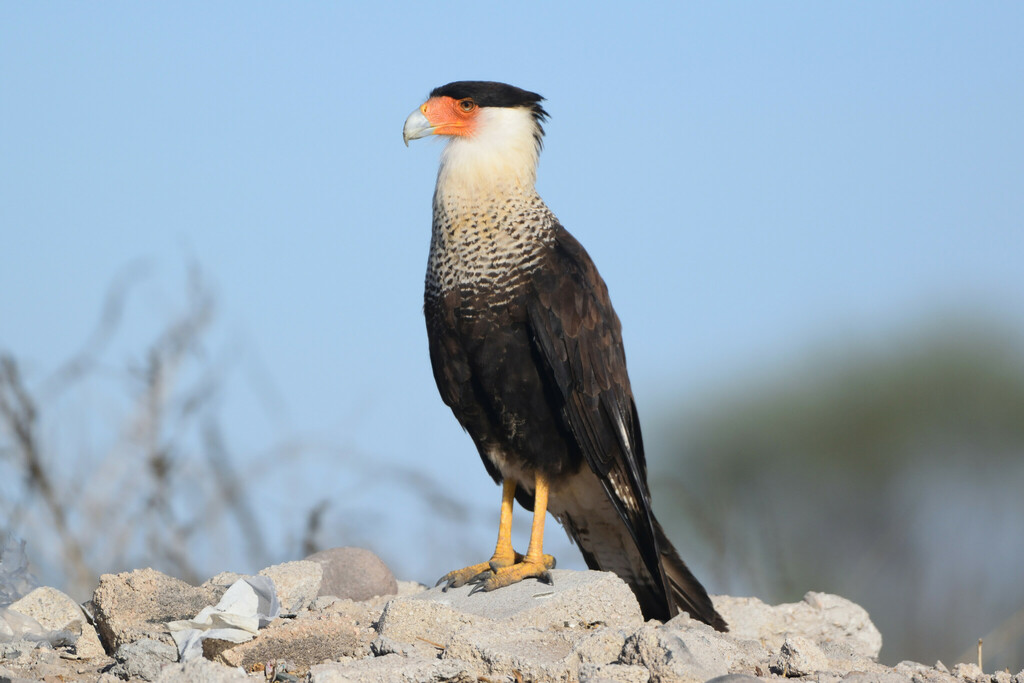
Crested Caracara
Photo © Juan Cruzado Cortés
Photo © Juan Cruzado Cortés — CC BY 4.0 — Source: iNaturalist photo #344678876Identification
The crested caracara is a distinctive bird of prey belonging to the falcon family. Despite occasionally being called the "Mexican eagle," it is not a true eagle. This species is unmistakable in the field, with a prominent crest that gives it its common name. Two subspecies are recognised: C. p. cheriway occurs in the northern portion of the range from the southern United States through Central America and into South America, while C. p. plancus is found in southeastern Peru, Bolivia, eastern Brazil, and southward to Tierra del Fuego and the Falkland Islands.
Range & Habitat
The crested caracara has an extensive distribution spanning from Tierra del Fuego in southernmost South America northward through Central America, Mexico (where it is present in every state), and into the southern and southeastern United States. The species is remarkably adaptable, thriving in semi-arid and desert climates, maritime and coastal areas, subtropical and tropical forests, temperate regions, plains, swamps, and even urban areas. It characteristically avoids the Andean highlands and dense humid forests like the Amazon rainforest, though it can be found in relatively open sections along major rivers in such regions.
In Florida, a relict population has persisted since the last glacial period, surviving in prairies and marshes. North American range has been expanding, with documented sightings as far north as Minnesota, California, and the Canadian provinces of Alberta, Ontario, and Prince Edward Island. The species has become increasingly common in central and north Texas in recent years.
Behaviour & Diet
The crested caracara is described as quite adaptable and hardy for a neotropical species. The bird's name comes from onomatopoeia, with "caracara" ultimately tracing its origins to the Old Tupi word karakará, imitating the bird's distinctive call. The caracara is often found near human settlements, demonstrating its tolerance of human presence and ability to thrive in modified landscapes alongside natural habitats.
Best Time & Places to See It
For North American birders and wildlife photographers, south Texas and the southern United States offer the most reliable opportunities to encounter crested caracaras. The species is generally common south of the US border throughout Mexico and Central America. In Florida, the bird is most frequently encountered in DeSoto, Glades, Hendry, Highlands, Okeechobee, and Osceola Counties, though it is listed as threatened in the state. Throughout its range, caracaras favour open and semi-open habitats where visibility is good and human activity is present.
Photography Tips
The crested caracara's distinctive crest and large size make it a rewarding photographic subject. The species' habit of frequenting relatively open habitats and showing tolerance of human presence increases opportunities for quality photography. Look for caracaras perched on low structures or foraging on the ground in open areas. In Florida, cabbage palmetto and southern live oak trees are preferred nesting sites, offering opportunities to photograph birds near vegetation. The bird's boldness and willingness to forage near human settlements mean that patient observation in suitable habitat, particularly in south Texas or Mexico, should yield productive photo sessions.
Arizona in Winter
Guided Birding Tour
Nothing matches these filters.
Alerce Costero National Park
Amacayacu National Park
Amazônia National Park
Anavilhanas National Park
Antisana National Park
Araucárias National Park
Arenal Volcano National Park
Bahuaja Sonene National Park
Barbilla National Park
Nothing matches these filters.
No community photos yet. Log in to add the first one.
No community observations of this species yet.