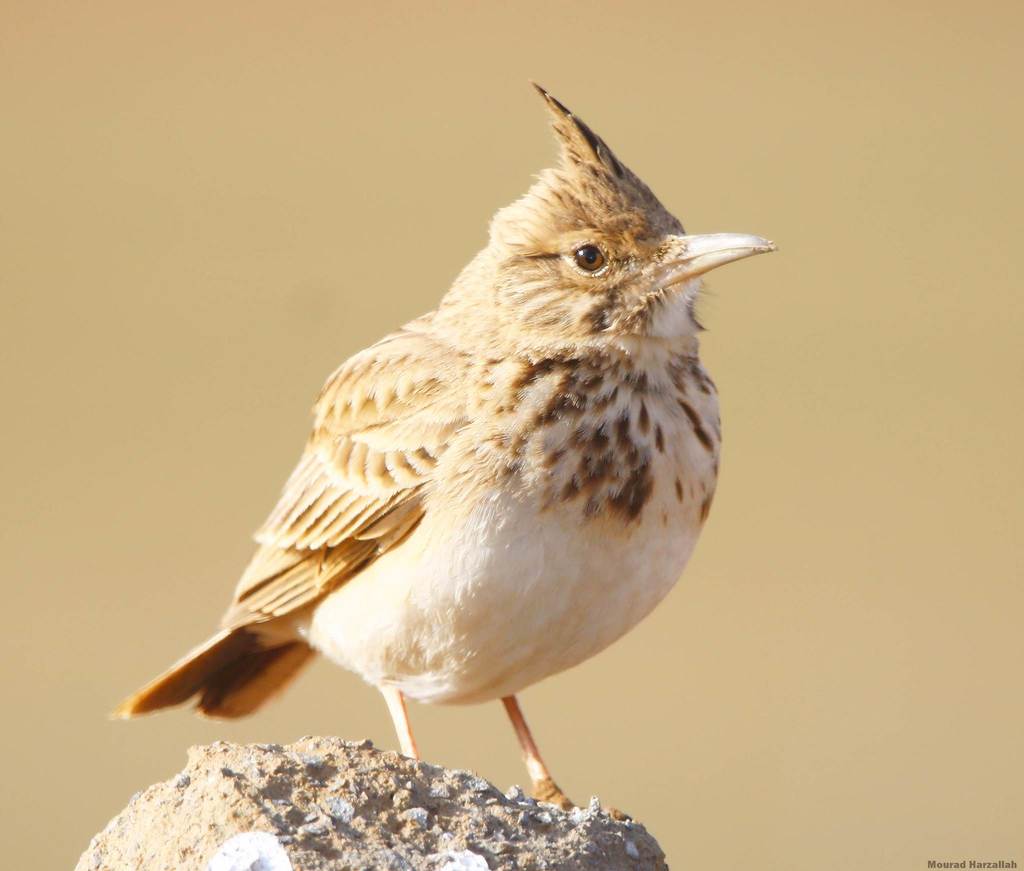
Crested Lark
Photo © Mourad Harzallah
Photo © Mourad Harzallah — CC BY 4.0 — Source: iNaturalist photo #200288151Identification
The crested lark is a fairly small, brown lark roughly the same size as a Eurasian skylark, though shorter overall and bulkier around the head and body. It measures approximately 17 cm in height with a wingspan of 29 to 38 cm, weighing between 37 and 55 grams. The bird's most distinctive feature is its conspicuous crest, which is pronounced at all times but becomes especially prominent during territorial displays, courtship, and singing. Its plumage is downy but sparse, appearing whitish, with a short tail displaying light brown outer feathers. In flight, the crested lark shows distinctive reddish underwings. Males and females are virtually identical in appearance, though young birds display more spots on their backs than adults.
The crested lark shares many characteristics with the Thekla lark, but can be distinguished by its beak structure, the Thekla's heavier black-brown streaks, and the Thekla's grey (rather than reddish) underwing coloration in European specimens.
Range & Habitat
The crested lark is widespread across Eurasia and northern Africa, with thirty-five recognized subspecies distributed from the Iberian Peninsula eastward through Europe, the Mediterranean basin, North Africa, the Middle East, and across central Asia to northeastern China, Korea, and the Indian subcontinent. Populations in the Maghreb region show distinct genetic differences, with birds in drier areas of Morocco and Tunisia possessing longer bills compared to their shorter-billed counterparts in more coastal regions.
This is a non-migratory species, remaining year-round throughout its extensive range, though it occasionally appears as a vagrant in Great Britain.
Behaviour & Diet
The source material provided does not contain specific information about the crested lark's behaviour, diet, or feeding habits. For detailed information on these aspects, readers are encouraged to consult additional ornithological resources.
Best Time & Places to See It
As a non-migratory resident across its range, the crested lark can be encountered throughout the year across temperate Eurasia and northern Africa. The bird's extensive distribution spans from western Europe through the Mediterranean region, North Africa, the Middle East, and eastward across central Asia to East Asia, offering numerous opportunities for observation across diverse geographic locations.
Photography Tips
The crested lark's most distinctive feature—its conspicuous crest—is most pronounced during territorial displays, courtship behaviour, and singing, presenting excellent opportunities for photographers to capture this characteristic feature. The bird's reddish underwings are visible in flight, offering dynamic photography opportunities. The subtle coloration and downy plumage of this small brown lark require careful attention to lighting and exposure to capture detail effectively.
Private Full-Day Birdwatching Tour from Lisbon to the Tagus Estuary
Nothing matches these filters.
Delta de l’Ebre Natural Park
Abruzzo, Lazio and Molise National Park
Aggtelek National Park
Alpilles Regional Nature Park
Alta Murgia National Park
Appennino Lucano Val d’Agri Lagonegrese National Park
Bardenas Reales
Bardiya National Park
Basse Casamance National Park
Nothing matches these filters.
No community photos yet. Log in to add the first one.