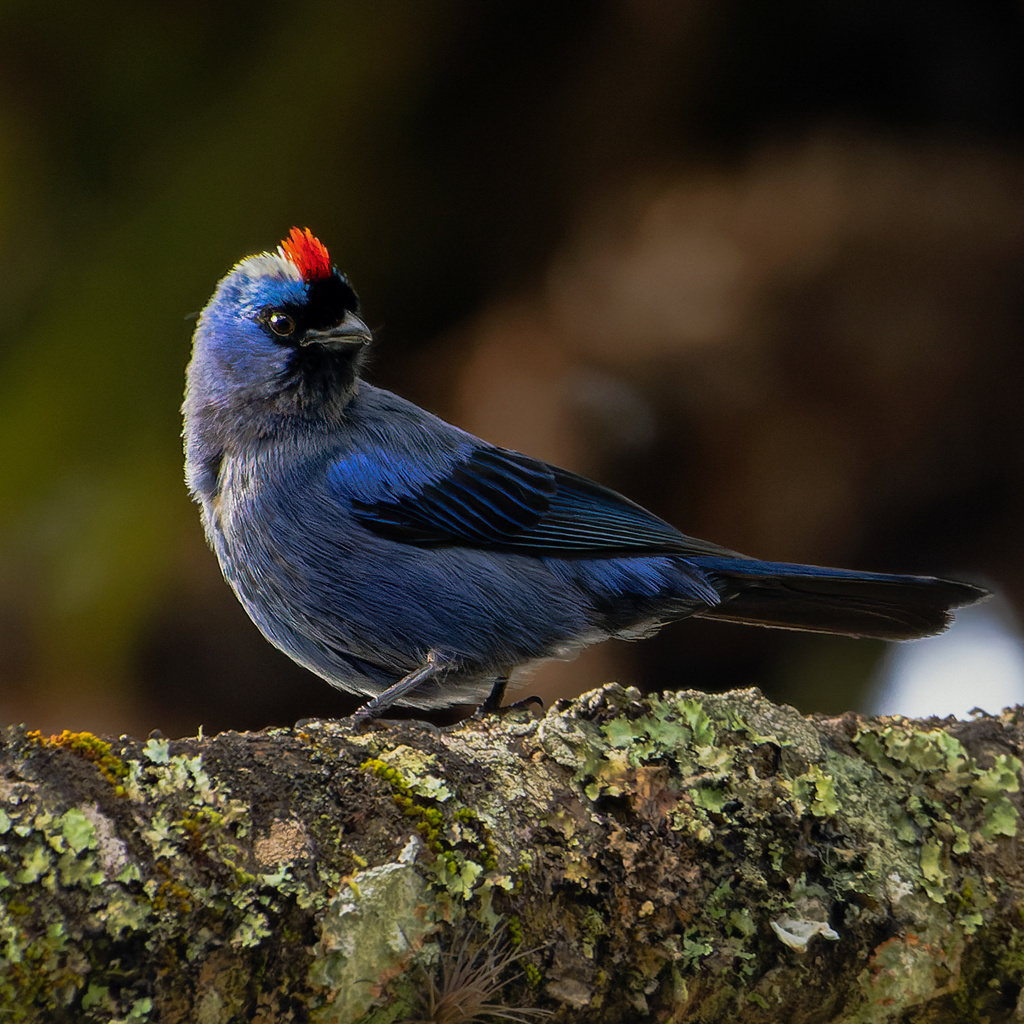
Diademed Tanager
Photo © Paulo Mascaretti
Photo © Paulo Mascaretti — CC0 1.0 — Source: iNaturalist photo #258512420Identification
The diademed tanager is a striking small songbird, averaging 19 cm (7.5 in) long and weighing 35–41.5 g. Its most distinctive feature is its white crown, which bears a small red patch at the front—the "diadem" that gives the species its name. In good light, the bird displays a mostly dark glossy bluish-violet plumage, though it often appears dull blackish in poor conditions. The face features a striking black "mask" extending from the front of the crown down to the chin, while the wings and tail are characterized by blue-bordered black feathers, creating a elegant contrast with the body plumage.
Range & habitat
This Neotropical tanager is endemic to southeastern South America, with a range extending from Minas Gerais in Brazil through the southeast of the country, south through eastern Paraguay into all of Uruguay and far northeastern Argentina. It is the sole member of its genus, Stephanophorus, making it a unique representative within the tanager family.
The diademed tanager inhabits a variety of forested environments, including riparian forest, Araucaria conifer forests, and scrubland adjacent to marshes. It readily adapts to man-made habitats such as gardens, making it accessible to observers in populated areas. The species is predominantly a lowland bird throughout most of its range, though in Rio de Janeiro it is restricted to highland elevations. Populations in Argentina and southern Uruguay may conduct localized migrations.
Behaviour & diet
The diademed tanager is largely frugivorous, though it supplements its diet with flowers, insects, and honeydew produced by plant lice—a diverse feeding strategy well-suited to its varied habitat. Foraging typically occurs in pairs or small flocks that associate with larger mixed-species feeding groups, a behavior common among tanagers that allows the birds to benefit from the vigilance and foraging expertise of multiple species.
Best time & places to see it
The diademed tanager is most reliably found in suitable habitats throughout its range in southeastern Brazil, Paraguay, Uruguay, and northeastern Argentina. Its adaptability to gardens and scrubland makes it accessible to travelers visiting populated areas, while those seeking pristine natural habitat should explore riparian forests and Araucaria conifer forests. In Rio de Janeiro, focus on highland areas. Visitors should be aware that Argentinian and southern Uruguayan populations may conduct localized migrations, potentially affecting seasonal abundance.
Photography tips
The contrast between the bird's dark plumage and white crown makes the diademed tanager photogenic, but lighting is crucial—seek well-illuminated subjects to capture the glossy bluish-violet coloration; in poor light, the plumage appears dull and lacks definition. The bird's tendency to forage in small flocks offers multiple photographic opportunities. Photograph birds within mixed-species flocks to capture natural behavior, and frame shots to highlight the distinctive white crown with its red patch, the black facial mask, and the blue-bordered wing feathers.
Tijuca National Park
Brazil
+317 birds+13 mammals
Where the Atlantic forest rises steeply from Rio de Janeiro's urban edge, Tijuca National Park encompasses a landscape of dramatic granite peaks, cascading waterfalls, and closed-canopy…
VIEW NATIONAL PARKItatiaia National Park
Brazil
+519 birds+12 mammals
Where granite peaks pierce the Atlantic rainforest canopy in southeastern Brazil, Itatiaia National Park rises as one of the country's oldest and most ecologically vital protected…
VIEW NATIONAL PARKPeixe National Park Lagoon
Brazil
+293 birds+4 mammals
Where the coastal plains of Rio Grande do Sul meet the Atlantic, Peixe National Park Lagoon sprawls across nearly 2,200 square kilometres of shallow waters, reed…
VIEW NATIONAL PARKSaint-Hilaire/Lange National Park
Brazil
+225 birds
Subtropical Atlantic forests rise and fall across the plateaus of inland Paraná, where Saint-Hilaire/Lange National Park protects nearly 578 square kilometres of Brazil's most biodiverse woodland…
VIEW NATIONAL PARKSerra da Bocaina National Park
Brazil
+441 birds+5 mammals
Where the escarpment of the Serra da Bocaina rises sharply from the Atlantic coastal plain, tropical rainforest cloaks steep mountainsides that climb toward peaks exceeding 2,000…
VIEW NATIONAL PARKIguaçu National Park
Brazil
+387 birds+17 mammals
Where the Paraná Plateau plunges toward the Atlantic watershed, six thousand square kilometers of subtropical rainforest cling to steep gorges and river valleys in this corner…
VIEW NATIONAL PARKSão Joaquim National Park
Brazil
+222 birds+9 mammals
Where the southern Brazilian highlands rise above the Atlantic Forest, São Joaquim National Park protects nearly 1,000 square kilometers of montane terrain that shifts between temperate…
VIEW NATIONAL PARKSerra dos Órgãos National Park
Brazil
+446 birds+13 mammals
Granite peaks thrust skyward through the Atlantic Forest canopy in the mountains immediately north of Rio de Janeiro, their bare rock faces rising above a landscape…
VIEW NATIONAL PARKAraucárias National Park
Brazil
+231 birds+3 mammals
Where the southern Brazilian highlands rise into cool temperate forest, Araucárias National Park protects one of the Atlantic Forest's most distinctive ecosystems across 506 square kilometres…
VIEW NATIONAL PARKSerra Geral National Park
Brazil
+211 birds+2 mammals
Where basalt cliffs and sandstone escarpments rise above the subtropical forests of southern Brazil, Serra Geral National Park preserves one of the Atlantic region's most dramatic…
VIEW NATIONAL PARKEl Palmar National Park
Distrito Sexto, Argentina
+244 birds+14 mammals
Across the Paraná River floodplain in northeastern Argentina, palms rise from wetland and grassland in a landscape shaped by water and time. El Palmar National Park…
VIEW NATIONAL PARKIguazú National Park
Puerto Iguazú, Argentina
+346 birds+15 mammals
Where the Paraná Plateau plunges toward the Atlantic watershed, nearly 800 square kilometers of subtropical rainforest drape across Misiones Province in a landscape carved by millennia…
VIEW NATIONAL PARKNo community photos yet. Log in to add the first one.
No community observations of this species yet.